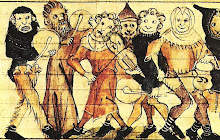
Having trouble figuring out what to wear for Halloween? What could be scarier than this?
Wednesday, October 30, 2013


Friday, October 25, 2013
Categorical Ramble
When I worked as the classical music director for a college radio station during the later 1980s and 1990s I marveled at the way the students who maintained the library put recordings into categories. There was jazz, cool jazz, bebop, new age, folk, hard bop, blues, hip-hop, soul, rock, world, and a whole slew of modifiers that divided each "genre" into specific sub-genres. I believe doing it gave the students who assigned the recordings their labels a sense of accomplishment and importance.
Then there was "classical," which was divided into two categories: general, and "short-takes." As far as most of the students were concerned (except for the ones who I worked with) "classical" was just one thing. Boring is one word that comes to mind. I never really let it bother me, since most the students I worked with found out that their preconceptions were wrong. After spending a few months working on the "classical" music programs, some of them even became knowledgeable, and some found music that they really liked in the vast sea of the "classical" section.
My music appreciation students begin every semester with similar preconceptions about this music we insist on referring to as "classical." Most of them come into the class knowing country music and whatever popular music happens to be saturating the commercial airwaves at the time. A few of them are eclectic and have developed specialized tastes, but they still initially see the vast world of all that is "not classical" as having far greater variety than the music they will be learning about in class.
I take great pleasure in breaking them of this preconception, and always get a mid-term "lift" when I read the papers they write about their experiences listening to the radio (we have two NPR stations in our area) and going to concerts. Nearly every student is surprised at the variety of music that he or she hears, and nearly every student is pleased that s/he can identify music from the different periods we have studied (and at mid-term we haven't even gone beyond the Viennese Classical Period--the only application of the word "classical" I feel comfortable with). Semester after semester the students who stay in the class (i.e. the students who do the assignments and come to class) let me know how surprised they are to find that they actually enjoy listening to "classical" music.
There are probably more excellent "classical" recordings being made now than ever before. More people have the tools and practical knowledge to make a recording sound professional than ever before, and, with a little bit of money, people can easily create their own recording labels and arrange for their own marketing and distribution. "Classical" recordings are still a small sliver of the genre-rich recording market, and though there are a vast number of "stars," there are only a handful of living "classical" musicians who are recognized by the general public. Those musicians are people who have been well marketed, and many of the most prominent "classical" stars are simply not the best musicians. Some of them are downright lousy.
High-profile people in the musical blogosphere talk about "classical music's problems." They have been talking about them for years. Some people find fault with the way organizations that perform "classical music" promote their concerts and reach out to audiences. Others find fault with the kind of programming that orchestras offer. Lately people take issue with the way managers of "classical" organizations treat the musicians that they employ.
These are not "classical music's" problems. "Classical music" is not an institution. "Classical music" is not an organization. "Classical music" is not dying, because "it" is not a living organism.
Musicians simply go on with their work, whether it is something they can make a living from or not. Some play beautifully, and some play well. Some don't play so well. Composers write music because they write music. Some of it is great, some is good, and some is not. A small amount of the music that people compose gets recorded, and relatively little of it gets performed, but people still do play newly-written music for pleasure. People play older music for pleasure too. They take lessons, play with their friends, play concerts for audiences large and small, and they practice.
What we do is really not that different from what people have always done. The problems I encounter while practicing a piece of Mozart are the same problems that countless other musicians have encountered during the 19th century and the 20th, and in all parts of the world. The joys that I get from getting a passage to sound good through analysis and repetition are the same joys that countless other musicians have enjoyed. The intimate exchanges that happen during concerts are the same kinds of intimate exchanges that have always happened, regardless of the size of the hall, the size of the audience, or the size of the city.
"Classical music" doesn't have a problem; just a lousy name that reduces the size and scope of centuries of music from all over the world so that it can be safely tucked away from view and effectively marginalized.
Then there was "classical," which was divided into two categories: general, and "short-takes." As far as most of the students were concerned (except for the ones who I worked with) "classical" was just one thing. Boring is one word that comes to mind. I never really let it bother me, since most the students I worked with found out that their preconceptions were wrong. After spending a few months working on the "classical" music programs, some of them even became knowledgeable, and some found music that they really liked in the vast sea of the "classical" section.
My music appreciation students begin every semester with similar preconceptions about this music we insist on referring to as "classical." Most of them come into the class knowing country music and whatever popular music happens to be saturating the commercial airwaves at the time. A few of them are eclectic and have developed specialized tastes, but they still initially see the vast world of all that is "not classical" as having far greater variety than the music they will be learning about in class.
I take great pleasure in breaking them of this preconception, and always get a mid-term "lift" when I read the papers they write about their experiences listening to the radio (we have two NPR stations in our area) and going to concerts. Nearly every student is surprised at the variety of music that he or she hears, and nearly every student is pleased that s/he can identify music from the different periods we have studied (and at mid-term we haven't even gone beyond the Viennese Classical Period--the only application of the word "classical" I feel comfortable with). Semester after semester the students who stay in the class (i.e. the students who do the assignments and come to class) let me know how surprised they are to find that they actually enjoy listening to "classical" music.
There are probably more excellent "classical" recordings being made now than ever before. More people have the tools and practical knowledge to make a recording sound professional than ever before, and, with a little bit of money, people can easily create their own recording labels and arrange for their own marketing and distribution. "Classical" recordings are still a small sliver of the genre-rich recording market, and though there are a vast number of "stars," there are only a handful of living "classical" musicians who are recognized by the general public. Those musicians are people who have been well marketed, and many of the most prominent "classical" stars are simply not the best musicians. Some of them are downright lousy.
High-profile people in the musical blogosphere talk about "classical music's problems." They have been talking about them for years. Some people find fault with the way organizations that perform "classical music" promote their concerts and reach out to audiences. Others find fault with the kind of programming that orchestras offer. Lately people take issue with the way managers of "classical" organizations treat the musicians that they employ.
These are not "classical music's" problems. "Classical music" is not an institution. "Classical music" is not an organization. "Classical music" is not dying, because "it" is not a living organism.
Musicians simply go on with their work, whether it is something they can make a living from or not. Some play beautifully, and some play well. Some don't play so well. Composers write music because they write music. Some of it is great, some is good, and some is not. A small amount of the music that people compose gets recorded, and relatively little of it gets performed, but people still do play newly-written music for pleasure. People play older music for pleasure too. They take lessons, play with their friends, play concerts for audiences large and small, and they practice.
What we do is really not that different from what people have always done. The problems I encounter while practicing a piece of Mozart are the same problems that countless other musicians have encountered during the 19th century and the 20th, and in all parts of the world. The joys that I get from getting a passage to sound good through analysis and repetition are the same joys that countless other musicians have enjoyed. The intimate exchanges that happen during concerts are the same kinds of intimate exchanges that have always happened, regardless of the size of the hall, the size of the audience, or the size of the city.
"Classical music" doesn't have a problem; just a lousy name that reduces the size and scope of centuries of music from all over the world so that it can be safely tucked away from view and effectively marginalized.
The Difference Between Music and Electronic Sound
This interruption of the Haydn Piano Concerto is so very interesting . . .
Watch all the way through. What happens when the musicians resume is very special and quietly empowering. The title of this video "Haydn Killed by Cell Phone" is wrong. Absolutely wrong. It should read "Haydn Triumphs" because he does. The smile and gleam in the eye of the concertmaster says it all.
Watch all the way through. What happens when the musicians resume is very special and quietly empowering. The title of this video "Haydn Killed by Cell Phone" is wrong. Absolutely wrong. It should read "Haydn Triumphs" because he does. The smile and gleam in the eye of the concertmaster says it all.
Wednesday, October 23, 2013
Baseball Brass
I remember being in Boston during the 2004 World Series. During one of the games (that the Red Sox won) I was at a Boston Philharmonic concert at Jordan Hall with my brother (the program was Mahler 1 and Songs of a Wayfarer), and my father was playing a BSO concert across the street. I went backstage at intermission to see my old friends (I used to play piccolo in the Boston Philharmonic), and all the brass players were fixated on the game, which was playing silently on a television. Our concert was over first, so we went to Symphony Hall and hung out backstage until our father's concert was over. There was just as much excitement among the BSO brass as there was at Jordan Hall. The excitement on the street was extreme (Fenway Park is just down the street from Symphony Hall). At that point I understood something about Boston that I never understood before.
I really enjoyed watching this video, so I'm sharing it here. I love the engraving on the BSO tuba player's instrument, and I love the spirit of the whole thing.
I can no longer recognize a single face in the current BSO brass section, but now that I live in the midwest I actually recognize some of the St. Louis Symphony brass players (that bearded trombonist is hard not to miss). Go figure. Time marches on. I'm still rooting for the Red Sox.
I really enjoyed watching this video, so I'm sharing it here. I love the engraving on the BSO tuba player's instrument, and I love the spirit of the whole thing.
I can no longer recognize a single face in the current BSO brass section, but now that I live in the midwest I actually recognize some of the St. Louis Symphony brass players (that bearded trombonist is hard not to miss). Go figure. Time marches on. I'm still rooting for the Red Sox.
Quintet for Flute, Oboe, and String Trio
My friend Allison Brewster Franzetti, who coaches a group of chamber-music-playing adults at Rutgers in New Jersey, asked me if I had written anything for flute, oboe, and string trio. To my surprise, I hadn't. It's one of my favorite instrumental combinations, thanks to Johann Christian Bach.
My new two-movement piece is now in the Petrucci Library, and if you want to hear it right now (before the recording uploads itself into the library), you can listen here.
My new two-movement piece is now in the Petrucci Library, and if you want to hear it right now (before the recording uploads itself into the library), you can listen here.
Monday, October 21, 2013
Mystery Musicians

I found this on picture on Mike Brubaker's TempoSenzaTempo blog (it's well worth spending a lot of time there), and thought I'd open up the mystery here. Perhaps someone reading might be able to identify one or more of the musicians (or the art on the walls).
Here's his fascinating post about the photo.
Sunday, October 20, 2013
Something I Learned about Writing Music from Mr. Matisse
Yesterday Michael and I went to a Matisse exhibit at the Indianapolis Museum of Art. The paintings, prints, drawings, and sculptures exhibit came from the Baltimore Museum of Art's Cone Collection, which is the largest private collection of Matisse's work. It was but a sliver of his total output, but it was enough to get the gist of what made him "tick" as an artist.
Like Picasso, Matisse had an extraordinary amount of pure technique. He could do anything, and he did everything constantly, working from the purely representational through all kinds of abstraction in search of what he wanted to say for that particular piece. There are, of course, many ways of saying the same thing. One might not be more successful than the other, but that doesn't matter. Presenting an image from one perspective may not be better than presenting it from another. Today I prefer the first image of this scene, but tomorrow I may prefer the second (I did see the first in the "flesh" yesterday).


Maybe Matisse's attraction to sculpture had something to do with the inside-out nature of three-dimensional art: the sculpture is seen from many different angles, and the "composition" is supplied by the viewer.
Neither of these piano-oriented paintings were in yesterday's exhibit, but I learned a great deal about looking at them from having seen the Matisse works in the exhibit that used the same scenes or the same objects.
The Peters Haydn edition on the piano in the first image has special meaning for me, and so does the Pleyel Piano. I love the way these two paintings work together. One is lively and interactive, with a sense of everything belonging to everything else (including the otherwise-absorbed father of the child, and the person listening outside). In the second image the boy is left alone, and a metronome sits on the piano. The light is the same, and the art on the wall has changed somewhat. Matisse changed the painting-within-the-painting too, giving the the woman the illusion of a face that is turned towards the boy. The father has been replaced with a female sculpture (which seems to be more attentive than the father), and the boy has a different face. The violin has vanished. Both are complete paintings that "say" very different things.


Something I learned from Mr. Matisse about writing music (or what I am learning from Mr. Matisse about writing music) is that everything is about composition. What goes where. Something complete and lively can be just as satisfying as something with fewer elements in it. The way to get those elements to work best together comes from a mixture of technique, intuition, trial, error, and taking many risks.
Like Picasso, Matisse had an extraordinary amount of pure technique. He could do anything, and he did everything constantly, working from the purely representational through all kinds of abstraction in search of what he wanted to say for that particular piece. There are, of course, many ways of saying the same thing. One might not be more successful than the other, but that doesn't matter. Presenting an image from one perspective may not be better than presenting it from another. Today I prefer the first image of this scene, but tomorrow I may prefer the second (I did see the first in the "flesh" yesterday).


Maybe Matisse's attraction to sculpture had something to do with the inside-out nature of three-dimensional art: the sculpture is seen from many different angles, and the "composition" is supplied by the viewer.
Neither of these piano-oriented paintings were in yesterday's exhibit, but I learned a great deal about looking at them from having seen the Matisse works in the exhibit that used the same scenes or the same objects.
The Peters Haydn edition on the piano in the first image has special meaning for me, and so does the Pleyel Piano. I love the way these two paintings work together. One is lively and interactive, with a sense of everything belonging to everything else (including the otherwise-absorbed father of the child, and the person listening outside). In the second image the boy is left alone, and a metronome sits on the piano. The light is the same, and the art on the wall has changed somewhat. Matisse changed the painting-within-the-painting too, giving the the woman the illusion of a face that is turned towards the boy. The father has been replaced with a female sculpture (which seems to be more attentive than the father), and the boy has a different face. The violin has vanished. Both are complete paintings that "say" very different things.


Something I learned from Mr. Matisse about writing music (or what I am learning from Mr. Matisse about writing music) is that everything is about composition. What goes where. Something complete and lively can be just as satisfying as something with fewer elements in it. The way to get those elements to work best together comes from a mixture of technique, intuition, trial, error, and taking many risks.
Friday, October 18, 2013
Haydn Piano Sonatas
In my quest to learn more about the piano, more about music, and more about Haydn, I have almost completed my first run through the 43 Haydn Piano Sonatas in my four-volume Peters Edition set. I usually limit myself to a movement or two, but today I played through the whole C major Sonata, Hoboken 16/50, because I found it so fascinating, so beautiful, and so much fun to play. My intuition tells me that Schubert probably loved this sonata too.
Here it is played (at the proper tempo) by Brendel:
My daily Haydn has become my refuge. I think that after tomorrow I'll just go back to volume one and start again.
Here it is played (at the proper tempo) by Brendel:
My daily Haydn has become my refuge. I think that after tomorrow I'll just go back to volume one and start again.
Saturday, October 12, 2013
Friday, October 11, 2013
A Bit of Tuba Excitement in Pullman, Washington
On Thursday, October 17th, Chris Dickey will be giving a faculty recital at Washington State University in Pullman, and he will be playing the world premiere of a Sonata for Tuba and Piano that I wrote for him.


A Most Exciting of Musical Families

I have just discovered the wonderful piano playing of Nadia Reisenberg (1904-1983), and also just learned that she is the sister of Clara Rockmore, (1911-1998) the great Theremin virtuoso, and the mother of WQXR's "The Listening Room" host Robert Sherman.
New Strings, Old Habits
I put new strings on my viola last night (at long last), and this morning I had a little bit of time to break them in. Instead of doing the normal three-octave scales that use all four of the strings, I decided to break in one string at a time. My mind, ear, and hand went to the Taffanel-Gaubert tetrachord exercise that I used to play on the flute every day for at least 15 years. Perhaps even 20.

Like all students of Julius Baker (and all students of students of Julius Baker), I began every day with this. It was a kind of mindless meditation, where my fingers just "did" (I really had no idea what the names of the notes I was playing were, nor did I really stop to consider what the configuration of half and whole steps actually was), and my main concern was the feeling of my breathing and the uniform quality of the sound I was making.
I began on the D string, and went all the way up, shifting with a different finger for each repetition, and changing the number of repetitions I would keep in one bow occasionally. I have always said that the flute was kind of like a violin (or viola) with one string, and the challenge of playing the flute is to use the air and the tongue to manipulate the natural color of the pitches in order to get variety.
My breathing started to get very deep as soon as I began, and I noticed that I could use my deep breathing to allow tension to slip away from my left hand and arm as I played the notes that I could generate without thinking. There was time, due to the repetitions, to consider my bow changes, and there was time and "head space" to consider the quality and process of my shifting.
The strange thing for me is the physical relaxation response that results from playing the same series of pitches on a different instrument. How I wish I could communicate with another flutist (one who studied seriously and played at professional level) who switched to violin or viola and plays at a professional level on his or her new instrument.
I used to do these exercises on the alto flute too (which is pitched in G), so I imagine that all sorts of alto-flute-related sensations will come to mind when I do these exercises on that string, now that my D is broken in. It's funny that doing this exercise on the A string doesn't bring flute sensations to mind for me, but doing this exercise from Marcel Moyse does.

Well, it's time to go and break in my G string.

Like all students of Julius Baker (and all students of students of Julius Baker), I began every day with this. It was a kind of mindless meditation, where my fingers just "did" (I really had no idea what the names of the notes I was playing were, nor did I really stop to consider what the configuration of half and whole steps actually was), and my main concern was the feeling of my breathing and the uniform quality of the sound I was making.
I began on the D string, and went all the way up, shifting with a different finger for each repetition, and changing the number of repetitions I would keep in one bow occasionally. I have always said that the flute was kind of like a violin (or viola) with one string, and the challenge of playing the flute is to use the air and the tongue to manipulate the natural color of the pitches in order to get variety.
My breathing started to get very deep as soon as I began, and I noticed that I could use my deep breathing to allow tension to slip away from my left hand and arm as I played the notes that I could generate without thinking. There was time, due to the repetitions, to consider my bow changes, and there was time and "head space" to consider the quality and process of my shifting.
The strange thing for me is the physical relaxation response that results from playing the same series of pitches on a different instrument. How I wish I could communicate with another flutist (one who studied seriously and played at professional level) who switched to violin or viola and plays at a professional level on his or her new instrument.
I used to do these exercises on the alto flute too (which is pitched in G), so I imagine that all sorts of alto-flute-related sensations will come to mind when I do these exercises on that string, now that my D is broken in. It's funny that doing this exercise on the A string doesn't bring flute sensations to mind for me, but doing this exercise from Marcel Moyse does.

Well, it's time to go and break in my G string.
Thursday, October 10, 2013
Wednesday, October 09, 2013
Yet Another Study Reveals that Studying Music is Good for Young Minds
Ironically, these findings come at a time when 1.3 million of the nation’s public elementary school students receive no specific instruction in music—and the children who do not have access to music education are disproportionately those who attend high-poverty schools. While wealthier school districts can compensate for budget cuts that reduce or eliminate music programs with private funding, low-income school districts cannot, so the kids who might benefit most from music education are often the least likely to get it. “One certainly hopes,” Iversen says, “that the results of these kinds of studies will cause a re-evaluation of the role of arts education in schools.”Everybody reading this probably already knows the findings of the latest study about why music should be part of every child's education, particularly in districts where money is not flowing, but I thought I'd share this new article from the The Atlantic by Lori Miller Kase here anyway.
Sunday, October 06, 2013
Performing is Such a Strange Word
I do not consider myself to be a "performer," but I find the concentration that I experience when playing concerts exhilarating. It makes me feel so truly alive and truly involved (even relaxed) when I am playing chamber music or orchestral music for a group of people who are listening. When the concert at hand is over, I want to have the experience again; but the only way I can "get" it is through playing music with people for people. I suppose it is kind of an addiction.
Doesn't the word "performing" seem very much out of place?
Doesn't the word "performing" seem very much out of place?
Subscribe to:
Posts (Atom)