For a quarter of a century I have spent the months leading up to March practicing music for recital progams devoted exclusively to music written by women. At the beginning of the twenty-first century (and back into the twentieth century) the very idea that women could write music as well as men could write music was an exotic and sometimes subversive thought. Those of us who have played music written by women knew (and know) that gender has nothing to do with quality when it comes to composition. And those of us who have spent their musical lives trying to prove that point have learned, sometimes the hard way, that public perception and, by extension, public awareness is really important.
You can read my musings on the subject here. The posts go back to 2007, so make sure to click on "older posts" at the bottom of each page to see everything this link has to show. I have tried to do my part to increase public awareness.
The pianist with whom I played Women’s History and Awareness Month recitals for years is no longer performing, but I can still enjoy the fact that a great many musicians around the world are now giving concerts in March devoted exclusively to music written by women. Many find the months leading up to March as an opportunity to expand their repertoire by learning new works by living women, and some think of it as an opportunity to study and perform music by women who are no longer living.
The State University of New York at Fredonia hosts a database that offers detailed searches to help find such music.
March is particularly fun for me these days because musicians from all over the world send me email messages to let me know that they are playing something I wrote, often on a concert in March that is dedicated to music written by women. Some people ask for information to use for program notes, and some people send pre-performances recordings and ask for feeback. I have also enjoyed spending time on Zoom calls with students who are preparing performances of pieces I have written. Having a coaching session with living composer be just a phone call away is something I never could have imagined during my student days.
A remarkable thing about this gender-specific expansion of repertoire is that there seems to be a concurrent movement towards accepting the idea that well-written new music does not have to sound difficult, complicated, dense, noisy, or academic in order to be worth listening to or performing.
Showing posts with label Women's History Month. Show all posts
Showing posts with label Women's History Month. Show all posts
Friday, February 28, 2025


Thursday, February 01, 2024
Growing Up Female, 1971
This post is not about music. It's about a forty-nine-minute-long documentary film about being female in the 1970s. The film begins with small children in preschool and their social behavior being described by their teacher along strict gender lines. I never went to preschool, and the household I grew up in was far from typical, so my socialization began in Kindergarten and in the neighborhood. Everything this teacher says sounds like something out of a textbook (maybe to "impress" the film maker), and everything she says about children has since been proven wrong.
But the stuff about eleven-year-old girls (as described by their teacher) really rang true for me and for my experience. As the film progressed a larger truth about growing up female in the 1970s came clearly into focus.
I remember the 1970s as a dark time that was lit up by compelling pop music. I remember the 1970s as a decade when girls couldn't wear pants to school, and then we finally could, but it wasn't until later in the decade that clothing companies made pants that were comfortable to wear for women who were not skinny. I remember the idea of womanhood in the 1970s being a scary series of beauty parlors, pointy bras, magazines that showed us girls how we were supposed to look if we wanted boys to like us. And here it is, unscripted in glorious black and white. Watch only if you dare.
But the stuff about eleven-year-old girls (as described by their teacher) really rang true for me and for my experience. As the film progressed a larger truth about growing up female in the 1970s came clearly into focus.
I remember the 1970s as a dark time that was lit up by compelling pop music. I remember the 1970s as a decade when girls couldn't wear pants to school, and then we finally could, but it wasn't until later in the decade that clothing companies made pants that were comfortable to wear for women who were not skinny. I remember the idea of womanhood in the 1970s being a scary series of beauty parlors, pointy bras, magazines that showed us girls how we were supposed to look if we wanted boys to like us. And here it is, unscripted in glorious black and white. Watch only if you dare.
Tuesday, January 16, 2024
In response to the perennial question
In a "contemporary classical music" Facebook forum the question of the value of music written by women comes up often. This time I felt compelled to answer. Facebook doesn't allow paragraph breaks, so I kept the discussion "as is."
Forum person:
"It is often said that classical music has a diversity problem. Which I think is correct in many ways. But my question is: to what extent recording albums or programming symphonies and concertos by, say, Florence Price or Grazina Bacewicz is a worthwhile gesture destined to correct historic injustices and expand audiences (as we are made to believe)? First of all: is the music any good? I'd say yeah, it's not bad, but also not remarkable or original. This is of course a subjective opinion, but let's suppose it is correct, just for the sake of argument. On the one hand, to program music that is admitedly not excellent can be perfectly reasonnable. One has to take chances in order to surprise and delight the audiences, and one can surely make the argument that mediocre music by dead white men is being performed often enough. But if you are used to, say, the level of achievement of Mahler or Shostakovich, I fear this inclusivity trend is going to wear thin pretty quickly. Yet no one will accept this publicly. Now to be fair, you can use the same argument to not program contemporary pieces by white dudes either, indeed any contemporary music whatsoever, in the (rational) fear that it will not hold up to scrutiny when compared to the greats. Yes classical audiences are used to the most wonderful experiences in concert and most music just won´t cut it. There's a lot to critique about that kind of mindset. But also: Are we trying to invent great female composers out of thin air? Is it not enough that there are actually great female composers out there, such as Gubaidulina, Saariaho or Unsuk Chin? Do we have to pretend that excellency is everyone's right and go through the motions of these concerts and clap in the end just out of fear of being elitist and out of touch? Is that healthy?"
My response:
Do we have to have this conversation year after year? Perhaps looking towards the future (a future where living composers who are women are taken as seriously by musicians as male composers who are living) is a healthier way of considering the idea of gender equity. Florence Price, for example, was a terrific composer. As a professional she was treated horribly by the people (men) in power. But her teaching pieces (teaching pieces were acceptable by women) that could make money for publishers were items of value. The story of her life is a sad one: she worked very hard, and got little in the way of recognition. Why is it, for example, that we only have a handful of photos of her? The music of the past written by people no longer alive is finite. The music of the living present and the future is not. And there are more women writing music (that is available) now than in centuries past. Our critical gatekeeping establishment is in sad shape, so musicians need to decide for themselves what is “good” and what is “great.” Publishers often rank work by what will sell, and orchestras and opera companies rank work by what will sell tickets. Ultimately (at least I believe) “greatness” has to do with how a piece of music at hand feels to play, and how musicians can connect to its emotional and intellectual substance. If musicians can project their love for a piece of music (written by any gender, age, nationality, race, etc.) it could be felt as “greatness.” Some composers are able to write accessibility into their music so that it is (relatively) easy to translate its pitches, rhythms, and phrases into something that can become a personal “voice” for a musician or a group of musicians. That kind of thing remains my only way of honestly judging anything having to do with a piece of music. It’s time, in my opinion, for a different kind of discussion when evaluating musical quality.
Forum person:
"It is often said that classical music has a diversity problem. Which I think is correct in many ways. But my question is: to what extent recording albums or programming symphonies and concertos by, say, Florence Price or Grazina Bacewicz is a worthwhile gesture destined to correct historic injustices and expand audiences (as we are made to believe)? First of all: is the music any good? I'd say yeah, it's not bad, but also not remarkable or original. This is of course a subjective opinion, but let's suppose it is correct, just for the sake of argument. On the one hand, to program music that is admitedly not excellent can be perfectly reasonnable. One has to take chances in order to surprise and delight the audiences, and one can surely make the argument that mediocre music by dead white men is being performed often enough. But if you are used to, say, the level of achievement of Mahler or Shostakovich, I fear this inclusivity trend is going to wear thin pretty quickly. Yet no one will accept this publicly. Now to be fair, you can use the same argument to not program contemporary pieces by white dudes either, indeed any contemporary music whatsoever, in the (rational) fear that it will not hold up to scrutiny when compared to the greats. Yes classical audiences are used to the most wonderful experiences in concert and most music just won´t cut it. There's a lot to critique about that kind of mindset. But also: Are we trying to invent great female composers out of thin air? Is it not enough that there are actually great female composers out there, such as Gubaidulina, Saariaho or Unsuk Chin? Do we have to pretend that excellency is everyone's right and go through the motions of these concerts and clap in the end just out of fear of being elitist and out of touch? Is that healthy?"
My response:
Do we have to have this conversation year after year? Perhaps looking towards the future (a future where living composers who are women are taken as seriously by musicians as male composers who are living) is a healthier way of considering the idea of gender equity. Florence Price, for example, was a terrific composer. As a professional she was treated horribly by the people (men) in power. But her teaching pieces (teaching pieces were acceptable by women) that could make money for publishers were items of value. The story of her life is a sad one: she worked very hard, and got little in the way of recognition. Why is it, for example, that we only have a handful of photos of her? The music of the past written by people no longer alive is finite. The music of the living present and the future is not. And there are more women writing music (that is available) now than in centuries past. Our critical gatekeeping establishment is in sad shape, so musicians need to decide for themselves what is “good” and what is “great.” Publishers often rank work by what will sell, and orchestras and opera companies rank work by what will sell tickets. Ultimately (at least I believe) “greatness” has to do with how a piece of music at hand feels to play, and how musicians can connect to its emotional and intellectual substance. If musicians can project their love for a piece of music (written by any gender, age, nationality, race, etc.) it could be felt as “greatness.” Some composers are able to write accessibility into their music so that it is (relatively) easy to translate its pitches, rhythms, and phrases into something that can become a personal “voice” for a musician or a group of musicians. That kind of thing remains my only way of honestly judging anything having to do with a piece of music. It’s time, in my opinion, for a different kind of discussion when evaluating musical quality.
Monday, August 08, 2022
Ika Peyron Gavotte et Chansonette
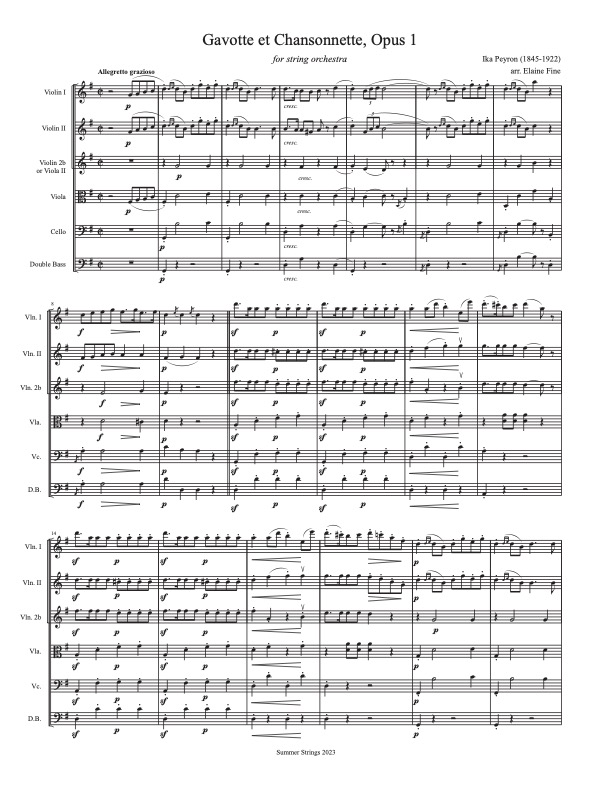
She wrote songs, music for violin, and mostly music for piano. Altogether we know of forty pieces.
This charming Gavotte et Chansonette, her Opus 1, works very nicely for strings. A PDF of this arrangement (as well as the piano original) is available on this page of the IMSLP. You can also find this arrangement here.
You can listen to a computer-generated recording here.
Thursday, March 03, 2022
Women's History Month 2022
I remember reading that after Lili Boulanger died on March 15, 1918, Nadia Boulanger used stationery with a black border during every subsequent March to honor the memory of her sister. I wish I remember where I read it (I have scoured all the possible sources on my bookshelves), but when the month of March became a month dedicated to women's history (the process started in 1978, and Congress made it official in 1987), I always believed, in my music-centered way, that it was because of the memory of Lili by Nadia. It could just be coincidence, though.
My interest in learning about and performing music written by women began in the later 1980s (it didn't occur to me that I might try my hand at writing music myself for at least ten years). Every March, from the small university radio station where I worked, I would broadcast as much music written by women as I could find. During the rest of the year I wrote articles about women who wrote music for the Maud Powell Signature (which has since been renamed), and eventually my pianist friend John David and I would play concerts of music written by women presented every March by the Women's Studies Program at the university. We hope to play our next concert for the Women's Studies Program in March of 2023.
I had to work really hard over the decades to convince people (musicians and listeners) that it was indeed possible for a women to write music as well as a man. I had to work especially hard at it while I worked as a reviewer for the American Record Guide (where most readers thought of me as "Mr. Fine" because reviews were signed by last name only, and more than 95% of the reviewers were men).
I know, of course, that some men are better composers than some women are, and I know that some women are better composers than some men are. I also know that most composers (with rare exceptions) write music of varying quality. But contrary to a lot of the listeners and a lot of the critics I have encountered, all men are not better composers than all women.
We now know this to be true. We didn't always.
My interest in learning about and performing music written by women began in the later 1980s (it didn't occur to me that I might try my hand at writing music myself for at least ten years). Every March, from the small university radio station where I worked, I would broadcast as much music written by women as I could find. During the rest of the year I wrote articles about women who wrote music for the Maud Powell Signature (which has since been renamed), and eventually my pianist friend John David and I would play concerts of music written by women presented every March by the Women's Studies Program at the university. We hope to play our next concert for the Women's Studies Program in March of 2023.
I had to work really hard over the decades to convince people (musicians and listeners) that it was indeed possible for a women to write music as well as a man. I had to work especially hard at it while I worked as a reviewer for the American Record Guide (where most readers thought of me as "Mr. Fine" because reviews were signed by last name only, and more than 95% of the reviewers were men).
I know, of course, that some men are better composers than some women are, and I know that some women are better composers than some men are. I also know that most composers (with rare exceptions) write music of varying quality. But contrary to a lot of the listeners and a lot of the critics I have encountered, all men are not better composers than all women.
We now know this to be true. We didn't always.
Monday, December 13, 2021
Deborah Drattell
I remember watching a live broadcast of Deborah Drattell's "Festival of Regrets" on the television in 1999, and being amazed. I had hoped to hear more of her music, but, living so much of my new-musical life through recordings at that time, it wasn't possible.
There is very little of her music on line, and professionally she has turned in the direction of what women might wear to the opera rather than what they might listen to there. Her work as a belt and brooch maker is stunning. If I were the type of person to wear jewelry (and if I had places to wear it and riches to buy it with), I would buy it. I applaud her choice to use her expression in ways, particularly ways that can be profitable enough to make a living. But that doesn't mean that her music is no less spectacular that her work as a belt and brooch designer. Just listen to this movement from Lilith.
You can find her musical biography on a page in Wikipedia, and you can see the spoils of her second life here. I doubt Deborah Drattell has any regrets.
You can find her musical biography on a page in Wikipedia, and you can see the spoils of her second life here. I doubt Deborah Drattell has any regrets.
Sunday, December 12, 2021
. . . and just like that
The holiday gigging season in pre-pandemic times (if I group pre-pandemic years together, as one does these days) involved pretty constant activity. Just like that my two seasonal orchestra concerts are over, and without any pressing projects on the horizon, I have been watching more television than usual.
The two new programs I am faithfully watching, Curb Your Enthusiasm and And Just Like That were made to air in what everyone thought would be a post-pandemic world. The references to Covid and "the lockdown" in both are early, and (I'm not giving anything away) then situations come up that allow for the "sweet smell of forget" (I think I just coined a phrase) to mix with the general suspension of disbelief that turns on when we turn the television on.
I'm only two episodes into Just Like That, which I am watching without Michael, and in order to give myself the illusion of having company, I have looked at posts here and there (mostly there, since this is the blogosphere).
What I have noticed is that people seem to want a "remake" of Sex and the City, with the characters exactly the way they were twenty years ago. It seems to me that (young) critics of the show (just like that everyone's a critic) are not terribly interested in the often serious things that women in their mid 50s tend to have to face.
Men in their fifties and sixties are often thought of as being in their prime. Those with creative ability have had time and often the institutional support (perhaps that world should have an uppercase I, because there are lowercase-i institutions like those in academia who only support a selected slice of their employees) to accomplish remarkable things, and even be recognized for doing so. Those of us who are living life as older middle-age women, who are also in the intellectual and artistic prime of life, are still judged (mostly) by how we appear and how we treat others, rather than the work we have done.
But I digress.
If you are looking for light 1990s comedy about attractive young women navigating through friendships, shoes, and relationships in a New York that I barely recognize and could never afford to live in, watch re-runs of Sex in the City. If you want to watch a truly brilliant show about a New York I recognize from the late 1970s, watch The Days and Nights of Molly Dodd on YouTube.
But if you happen to be watching And Just Like That, I would be very interested in your reactions to the way big issues are handled (you could replace that lowercase b with an uppercase one if you like). I have much more empathy for the main characters in their 50s than I had for them when they were in their 30s. And I like what promise to be interesting new characters.
The comments here are always open.
The two new programs I am faithfully watching, Curb Your Enthusiasm and And Just Like That were made to air in what everyone thought would be a post-pandemic world. The references to Covid and "the lockdown" in both are early, and (I'm not giving anything away) then situations come up that allow for the "sweet smell of forget" (I think I just coined a phrase) to mix with the general suspension of disbelief that turns on when we turn the television on.
I'm only two episodes into Just Like That, which I am watching without Michael, and in order to give myself the illusion of having company, I have looked at posts here and there (mostly there, since this is the blogosphere).
What I have noticed is that people seem to want a "remake" of Sex and the City, with the characters exactly the way they were twenty years ago. It seems to me that (young) critics of the show (just like that everyone's a critic) are not terribly interested in the often serious things that women in their mid 50s tend to have to face.
Men in their fifties and sixties are often thought of as being in their prime. Those with creative ability have had time and often the institutional support (perhaps that world should have an uppercase I, because there are lowercase-i institutions like those in academia who only support a selected slice of their employees) to accomplish remarkable things, and even be recognized for doing so. Those of us who are living life as older middle-age women, who are also in the intellectual and artistic prime of life, are still judged (mostly) by how we appear and how we treat others, rather than the work we have done.
But I digress.
If you are looking for light 1990s comedy about attractive young women navigating through friendships, shoes, and relationships in a New York that I barely recognize and could never afford to live in, watch re-runs of Sex in the City. If you want to watch a truly brilliant show about a New York I recognize from the late 1970s, watch The Days and Nights of Molly Dodd on YouTube.
But if you happen to be watching And Just Like That, I would be very interested in your reactions to the way big issues are handled (you could replace that lowercase b with an uppercase one if you like). I have much more empathy for the main characters in their 50s than I had for them when they were in their 30s. And I like what promise to be interesting new characters.
The comments here are always open.
Thursday, October 07, 2021
Representation from "Are Women People?"
Here's another contribution to what I hope will become a body of work by various composers (see this challenge to fellow composers). I was compelled to set this song for male voice and piano, and made versions of it for baritone and for tenor which is available on this page of the IMSLP.
Here's the first page of the song in the baritone key:
Here's a link to a computer-generated audio file, and here is the text as published in 1915. Go ahead and sing along!
Here's the first page of the song in the baritone key:

Here's a link to a computer-generated audio file, and here is the text as published in 1915.

Monday, October 04, 2021
Are Women People? A Book of Rhymes for Suffrage Times

You can find podcast episode here, and the 1915 book they talk about here.
I am in the process of setting a few of the poems for voice and harp (or piano), and have shared the first of my set in the IMSLP. I'm hoping for a real performance in the not-too-distant future, but for now you can listen to a computer-generated one here.
It is my hope that other composers will set some of the verses in this book (that link goes to the public domain Gutenberg text), and will also make their songs available in the IMSLP. Then we might have a whole collection.
Please share this post with composers you think might be interested. My setting is for harp because I happened to talk about the idea first with a harpist, but I'm hoping for a grand array of vocal and instrumental settings.

You can find my setting of "Evolution" on this page of the IMSLP
I'm happy to report that I'm not the first composer to be moved musically by this set. Lori Laitman set a few of these poems, and used the title of Alice Duer Miller's book as the title of her recently released CD.
I'm hoping to be able to add other composers to this list. You (and I) can find out more about Alice Duer Miller and her work here.
Thursday, May 20, 2021
American Discoveries
Since I started reading The Heart of a Woman, Rae Linda Brown's biography of Florence Price, I have come to realize that my knowledge of twentieth-century American orchestral music is not is comprehensive as I would like it to be (or thought it was). This could be due to the programming and re-programming of music by the same well-known (and accessible) American male composers alongside the same well-known (and accessible) male European composers, many of whom came to America to escape pogroms, Nazis, and totalitarian regimes.
In the case of Igor Stravinsky, Bela Bartok, Paul Hindemith, Erich Korngold, Franz Waxman, Kurt Weill, Ernst Toch, and Arnold Schoenberg (to name some of the better known men), the direction of influence almost always went "back" to Europe, which is completely understandable.
The American-born composers who dominated concert programs during the twentieth century like Charles Ives, Howard Hanson, Vincent Persichetti, Irving Fine, Samuel Barber, George Gershwin, Aaron Copland, and Leonard Bernstein gave us a set of lovely framed musical pictures that defined an American "voice" for many of us.
In the case of Igor Stravinsky, Bela Bartok, Paul Hindemith, Erich Korngold, Franz Waxman, Kurt Weill, Ernst Toch, and Arnold Schoenberg (to name some of the better known men), the direction of influence almost always went "back" to Europe, which is completely understandable.
The American-born composers who dominated concert programs during the twentieth century like Charles Ives, Howard Hanson, Vincent Persichetti, Irving Fine, Samuel Barber, George Gershwin, Aaron Copland, and Leonard Bernstein gave us a set of lovely framed musical pictures that defined an American "voice" for many of us.
Then came a set of American-born (male) composers like Roger Sessions, George Crumb, Eliot Carter, John Cage, Philip Glass, Steve Reich, and Milton Babbit that stretched the idea of new American music towards the experimental, the minimalist, and the intellectual. The music that these composers wrote sometimes scared audiences away, but orchestras still programmed them because they wanted to have some skin in the game regarding new directions in music.
I'm not passing judgement. I'm just reporting on the male-dominated (and white-dominated) musical landscape that we are all starting to look at through a rearview musical mirror.
There have been female composers who held a place of importance in American music. Or of relative importance. The best known American woman composer would be Amy Beach. I was surprised to see the small number of people on this Wikipedia list of female American Composers, and I was equally surprised to see the people who didn't make that particular list (like Marion Bauer). I hope to see this list expand soon. I might have to take matters into my own hands.
Not present on this list are the three composers that have music on this recording of newly-discovered orchestral music by women: Priscilla Alden Beach, Linda Robbins Coleman, and Alexandria Pierce. The project represents a great deal of care and work (during a pandemic year) by the Landsdowne Symphony Orchestra, its conductor Reuben Blundell, and the the librarians that take care of the Edwin A. Fleisher Collection of Orchestral Music at the Free Library of Philadelphia.
Priscilla Alden Beach (1902-1970) wrote "City Trees" in 1928, and Howard Hanson gave the first performance that year with Rochester Philharmonic. "City Trees" is a lush and romantic piece that brings to mind the paintings of the Hudson River School. The trees depicted musically here progress from rural trees to early twentieth-century urban trees. In scope, variety, and color it brings to mind Respighi's "Pines of Rome," but (and I wrote this in my listening notes before reading the liner notes) the trees here might be better associated with Rome, New York than Rome, Italy. Turns out that the composer, a descendant of John and Priscilla Alden of Mayflower fame, spent her childhood in Rome, New York!
Beach went to Smith College, and the studied at Eastman (I imagine with Howard Hanson), and had a fellowship at Juilliard. She wrote music for a series of silent movies that were shown at the Museum of Modern Art in New York, and then disappeared from musical life entirely to write books about pets and work as a laboratory technician.
I'm not passing judgement. I'm just reporting on the male-dominated (and white-dominated) musical landscape that we are all starting to look at through a rearview musical mirror.
There have been female composers who held a place of importance in American music. Or of relative importance. The best known American woman composer would be Amy Beach. I was surprised to see the small number of people on this Wikipedia list of female American Composers, and I was equally surprised to see the people who didn't make that particular list (like Marion Bauer). I hope to see this list expand soon. I might have to take matters into my own hands.
Not present on this list are the three composers that have music on this recording of newly-discovered orchestral music by women: Priscilla Alden Beach, Linda Robbins Coleman, and Alexandria Pierce. The project represents a great deal of care and work (during a pandemic year) by the Landsdowne Symphony Orchestra, its conductor Reuben Blundell, and the the librarians that take care of the Edwin A. Fleisher Collection of Orchestral Music at the Free Library of Philadelphia.

Priscilla Alden Beach (1902-1970) wrote "City Trees" in 1928, and Howard Hanson gave the first performance that year with Rochester Philharmonic. "City Trees" is a lush and romantic piece that brings to mind the paintings of the Hudson River School. The trees depicted musically here progress from rural trees to early twentieth-century urban trees. In scope, variety, and color it brings to mind Respighi's "Pines of Rome," but (and I wrote this in my listening notes before reading the liner notes) the trees here might be better associated with Rome, New York than Rome, Italy. Turns out that the composer, a descendant of John and Priscilla Alden of Mayflower fame, spent her childhood in Rome, New York!
Beach went to Smith College, and the studied at Eastman (I imagine with Howard Hanson), and had a fellowship at Juilliard. She wrote music for a series of silent movies that were shown at the Museum of Modern Art in New York, and then disappeared from musical life entirely to write books about pets and work as a laboratory technician.
I wonder if there is more of her music hiding in a closet or a drawer, somewhere.
Professional life as a composer has been far less difficult for Linda Robbins Coleman. She enjoys an impressive career, and the American heartland (she lives in Iowa) has been good to her. What she has given back is music that reflects her love of the nature around her.
I noticed that "For a Beautiful Land," which she wrote in 1996, is "informed" by the Americana of Copland and Stravinsky. This piece is episodic, and is filled with interesting textures. Overall the wind, brass, and percussion sections seem far more present and important than the strings, though there is some enjoyable playful interaction that involves the strings. The woodwind solos and duets (there are a lot) are engaging and beautiful. "For a Beautiful Land" is relentlessly tonal, and, after a brief nod to Ravel's "Bolero," comes to a bold and optimistic conclusion.
Alexandra Pierce was born in 1934 and just died this past February. She studied at the University of Michigan, earned Master's degrees from New England Conservatory and Harvard, and her doctorate from Brandeis. She taught at MIT and at Antioch College, and spent the bulk of her career on the faculty of the University of Redlands (she retired in 2001).
Professional life as a composer has been far less difficult for Linda Robbins Coleman. She enjoys an impressive career, and the American heartland (she lives in Iowa) has been good to her. What she has given back is music that reflects her love of the nature around her.
I noticed that "For a Beautiful Land," which she wrote in 1996, is "informed" by the Americana of Copland and Stravinsky. This piece is episodic, and is filled with interesting textures. Overall the wind, brass, and percussion sections seem far more present and important than the strings, though there is some enjoyable playful interaction that involves the strings. The woodwind solos and duets (there are a lot) are engaging and beautiful. "For a Beautiful Land" is relentlessly tonal, and, after a brief nod to Ravel's "Bolero," comes to a bold and optimistic conclusion.
Alexandra Pierce was born in 1934 and just died this past February. She studied at the University of Michigan, earned Master's degrees from New England Conservatory and Harvard, and her doctorate from Brandeis. She taught at MIT and at Antioch College, and spent the bulk of her career on the faculty of the University of Redlands (she retired in 2001).
Her 1976 "Behemoth" is a five-movement tone poem that explores ideas presented in the Book of Job. Pierce's use of orchestral color is typical of the 1970s, but I do not find it derivitive of any particular composer. Her technique at orchestration is excellent--as good as any better-known twentieth-century composer (see the list above). She often lets her material travel in a hocket-like fashion around her very large-sounding orchestra. Like Coleman's "City Trees," Pierce's "Behemoth" is very wind, brass, and percussion forward, with the strings mostly creating atmosphere (they engage in a healthy amount of pizzicato and tremolo) and giving support.
I particularly like the transparent and layered third movement that has a dialogue between the oboe and the horn that seems to travel over a foggy plain: ephemeral, questioning, and suspended. A bright flute glides above, and fades away. The percussion-rich fourth movement has a solo flute and a gauze-like color in the strings that reminds me of "The Dance of the Seven Veils" from Salome.
You can buy the album here. It is both inexpensive and rich.
You can buy the album here. It is both inexpensive and rich.
Friday, May 07, 2021
Freedom and free stuff
As a child I was in an odd position of freedom to cobble together my own sense of what is right, moral, and true in the world. I did it mostly through books. One of my favorites was Arnold Dolin's Great American Heroines. It was a beautifully written and beautifully illustrated book that was published in 1960. Through reading it I learned about Pocahontas, Anne Hutchinson, "Mad Ann" Bailey, Betsy Ross, Molly Pitcher, Barbara Frietchie, Dolly Madison, Sacajawea, Mary Lyon, Dorothea Dix, Harriet Beecher Stowe, Idawalley Lewis, Maria Mitchell, Harriet Tubman, Susan B. Anthony, Elizabeth Blackwell, Clara Barton, Emma Lazarus, Juliette Low, Jane Addams, Lillian Wald, Amelia Earhart, and Helen Keller.
The title above will take you to the Internet Archive entry, which will let you "borrow" it for an hour to read on the screen.
Another really important part of my elementary school childhood was the kindness I found in the parents of my various friends. I can still visualize the interiors of the houses my friends lived in better than I can visualize the interior of my own house. I also had a music teacher who used to let me hang out with her after school. Home was a place I slept, read, and practiced. I had a relatively safe childhood (with the exception of a few incidents), and learned to make my way around the various neighborhoods of childhood without any parental input (really). I envied the fact that the parents of my friends had rules and limitations. I had none. Maybe I was just a very good child (I doubt it).
I really wanted to do something important when I grew up, like the women I read about in Dolin's book, but I had no understanding of how to go about how to go about it because I was a child. I couldn't ask for help from my parents. In the material things department they were adequate. There was always plenty of food, and I could ask for clothes. They took care of me when I was sick. My brothers and I got presents for holidays which were often thoughtful and appropriate, but I have only sketchy memories concerning my emotional needs. And though my friends and their parents helped me to navigate the social world, I could not ask them for the kind of emotional support that I needed in order to grow into a confident adult (or even a confident child). Grown-up people often commented on how happy I seemed to be, but they had no idea that my happiness was due to the fact that they paid attention to me, asked me questions, and listened to my answers.
So what does this have to do with free stuff? Very early on I learned that I could give myself the illusion of being loved if I gave love. If I wanted to have a friend, being a friend was the way to do it. If I waited for friends to come to me, it just wouldn't happen.
This pattern continued for a long time, and as a teenager the friendships I pursued were not always the best. Sometimes, in the case of older friends who thought being friends with me would help them gain access to my father, those choices had lasting consequences.
Let me get back to the point of this post. My intention was to explain something about why I make so much of the music I write available for free in the IMSLP. The basic reason is that for me writing music is a kind of energized play with purpose. I set up a set of relationships, the instruments or voices being characters, I set a few boundaries (working with a text is one example of a boundary), and I introduce a set of problems that will need to be resolved. I wrestle with the beast, and I use my executive authority to remove or modify anything offensive that messes up the soup. I do my best to make sure what I write feels good to sing or play, and I do my best to make it easy to read. Then I release it into the world of musicians I do not yet know as a gesture of friendship, and when it is accepted as such I am deeply happy.
Perhaps if I grew up with more of a sense of entitlement, or if I had been given heartfelt encouragement from my parents when I was a child, I would feel more energized by having music published and would enjoy the whole song and dance of musical commerce, where composers are taken seriously only if their work carries a price tag. After nearly twenty years of having music published, I am finally getting royalty checks. It is nice when publishers see commercial value in the work I do, but what really matters to me is how the people playing the music enjoy relating to each other through playing it, and, in the case of solo music, how people enjoy navigating through phrases, and using their creativity to create a kind of a dialogue between themselves and me, through the notes and phrases on the page.
I wish that in the future more people (non-musicians in particular) will be able to appreciate the value of music that is written in the spirit of friendship rather than music that is written as an expression of ego. Sometimes I wish I could be a person who thrives on praise, but I'm just now wired that way. I never developed that particular habit. But I love hearing from people who play my music (and arrangements) and accept it as a gift of friendship.
Maybe, at sixty-two, it is now time to put the deficiences from my childhood behind me, and celebrate, rather than bemoan the way I have learned to compensate.

The title above will take you to the Internet Archive entry, which will let you "borrow" it for an hour to read on the screen.
Another really important part of my elementary school childhood was the kindness I found in the parents of my various friends. I can still visualize the interiors of the houses my friends lived in better than I can visualize the interior of my own house. I also had a music teacher who used to let me hang out with her after school. Home was a place I slept, read, and practiced. I had a relatively safe childhood (with the exception of a few incidents), and learned to make my way around the various neighborhoods of childhood without any parental input (really). I envied the fact that the parents of my friends had rules and limitations. I had none. Maybe I was just a very good child (I doubt it).
I really wanted to do something important when I grew up, like the women I read about in Dolin's book, but I had no understanding of how to go about how to go about it because I was a child. I couldn't ask for help from my parents. In the material things department they were adequate. There was always plenty of food, and I could ask for clothes. They took care of me when I was sick. My brothers and I got presents for holidays which were often thoughtful and appropriate, but I have only sketchy memories concerning my emotional needs. And though my friends and their parents helped me to navigate the social world, I could not ask them for the kind of emotional support that I needed in order to grow into a confident adult (or even a confident child). Grown-up people often commented on how happy I seemed to be, but they had no idea that my happiness was due to the fact that they paid attention to me, asked me questions, and listened to my answers.
So what does this have to do with free stuff? Very early on I learned that I could give myself the illusion of being loved if I gave love. If I wanted to have a friend, being a friend was the way to do it. If I waited for friends to come to me, it just wouldn't happen.
This pattern continued for a long time, and as a teenager the friendships I pursued were not always the best. Sometimes, in the case of older friends who thought being friends with me would help them gain access to my father, those choices had lasting consequences.
Let me get back to the point of this post. My intention was to explain something about why I make so much of the music I write available for free in the IMSLP. The basic reason is that for me writing music is a kind of energized play with purpose. I set up a set of relationships, the instruments or voices being characters, I set a few boundaries (working with a text is one example of a boundary), and I introduce a set of problems that will need to be resolved. I wrestle with the beast, and I use my executive authority to remove or modify anything offensive that messes up the soup. I do my best to make sure what I write feels good to sing or play, and I do my best to make it easy to read. Then I release it into the world of musicians I do not yet know as a gesture of friendship, and when it is accepted as such I am deeply happy.
Perhaps if I grew up with more of a sense of entitlement, or if I had been given heartfelt encouragement from my parents when I was a child, I would feel more energized by having music published and would enjoy the whole song and dance of musical commerce, where composers are taken seriously only if their work carries a price tag. After nearly twenty years of having music published, I am finally getting royalty checks. It is nice when publishers see commercial value in the work I do, but what really matters to me is how the people playing the music enjoy relating to each other through playing it, and, in the case of solo music, how people enjoy navigating through phrases, and using their creativity to create a kind of a dialogue between themselves and me, through the notes and phrases on the page.
I wish that in the future more people (non-musicians in particular) will be able to appreciate the value of music that is written in the spirit of friendship rather than music that is written as an expression of ego. Sometimes I wish I could be a person who thrives on praise, but I'm just now wired that way. I never developed that particular habit. But I love hearing from people who play my music (and arrangements) and accept it as a gift of friendship.
Maybe, at sixty-two, it is now time to put the deficiences from my childhood behind me, and celebrate, rather than bemoan the way I have learned to compensate.
Monday, January 25, 2021
Dorothy Fox Andante from 5 Pieces, Op. 11
What a treat it was to find this in my email today:
Here is the information that Phillip Sear put in the notes that accompany this video (copied here so that it might be found by other Fox hunters):
And then there's this obituary from the Times that Mr. Sear sent:
INQUEST ON WOMAN COMPOSER
THE CORONER'S COMMENTS ON NOISE
The inquest was held at Windsor yesterday on the body of Miss K. Dorothy Fox, of Hyde Park Square, London, W., who was found hanging by a silk scarf at an hotel at Windsor on Saturday. She had been at the hotel about a fortnight, coming, is is stated, from a country town. Miss Fox was a talented composer, and a number of half-finished manuscripts were found in here luggage.
Dr. Edward Arthur Gibson, of Cleveland Square, London, said Miss Fox was 40 years old, and of independent means. Her father was abroad. She was highly strung, temperamental, and artistic.
The DEPUTY CORONER, Mr. J..A. Leonard, said that a quantity of drugs had been found in Miss Fox's room, and asked Dr. Gibson to say what they were.
Dr. Gibson examined several bottles and boxes and said they appeared to be harmless.
Miss Christabel Lowndes Yates, of Windsor House, Amersham, a novelist, said in evidence that Miss Fox had been living with her for about seven years. They met in France, where it was considered Miss Fox had only three months to live unless she could be looked after better. Miss Fox got better, but suffered from nerves. She had taken a medicinal on a doctor's prescription, but she had never threatened to take her life. She had, in fact, gone to the doctor's when she saw this drug on a list of dangerous drugs, and asked him if it would give her an urge in the direction of suicide. Thee witness did not know what the reply was, but the drug was not withdrawn.
Continuing, the witness said that Miss Fox was very small, and at one period only weighed 5st. 6oz. or 7oz. She was a very fine musician. Her work had been broadcast in several countries, and a concert of her work was given in London about a month ago, and another work was to be published in this country, France, and Germany. She was considered to be an extraordinarily promising composer. She had no love affairs so far as the witness knew, and no financial trouble.
"INCREDIBLE NOISE"
Miss Fox had left her house a fortnight before because oof the unbearable noise from the road repairs, the witness went on. There were about eight pneumatic drills, two engines, and other noisy things, and the vibration was so bad that they had to open the windows for fear they would be broken, dismantle the wireless, and pack up the piano and the china. They could not speak on the telephone. The noise was incredible. The witness received a letter from Miss Fox posted the night before her death, and it was perfectly cheerful and normal.
The CORONER--Do you think this pneumatic drill got on her nerves?
Miss Yates--While she was there, but I don't think so after she had gone
The CORONER said that a good deal of prominence had been given to Miss Fox's death, possibly from a feeling of indignation against "these nerve-shattering machines," which were one of the many tribulations of this age of noise. But he thought in this case the noise of the pneumatic drill was a very small link in the chain of events leading to Miss Fox's unhappy ending. It was evident that Miss Fox was of an artistic and perhaps somewhat neurotic temperament. He recorded a verdict of "Suicide while of unsound mind."
Here is the information that Phillip Sear put in the notes that accompany this video (copied here so that it might be found by other Fox hunters):
Phillip Sear plays a piece from around 1925 by the short-lived English composer K. Dorothy Fox (1894-1934).
There seems to be very little information available on K(alitha) Dorothy Fox. As you can see from her brief Wikipedia page she wrote a few pieces of piano and chamber music in her short life. She was born in Kensington, London, and must have been a prodigy, as her first piece was published at the age of just 12. She took her unusual first name from her mother, born Kaletha Marianne Childs. Some of her scores were published in Paris, and she was certainly living there around 1927 (her family seem to have moved overseas in the early 1900s), and she spent her last years living with a friend in Amersham, Bucks.
She died in a hotel in Windsor, Berkshire (she sadly hung herself with a silk scarf), having gone there to escape the noise from pneumatic drills at her home, and had some incomplete manuscripts with her at the time. The beneficiary of her will (and dedicatee of her viola sonata - see here for some programme notes from a 2017 performance (Ooh! that's a link to this blog!) was her brother Gerald Hugh Borlase Fox (1900-95). I put these details here in the hope that people with more information on her might find this description and be able to add to what is known of her life.
The '5 Pieces' were dedicated to another little-known British woman composer, and fellow member of the Society of Women Composers, the harpsichordist Dorothy Erhart (1894-1971).
My thumbnail shows a colourized detail from a photo in Amersham Museum of the 1934 Boxing Day hunt in the Broadway, an event Dorothy might well have witnessed as she was living in Amersham at the time.
And then there's this obituary from the Times that Mr. Sear sent:

INQUEST ON WOMAN COMPOSER
THE CORONER'S COMMENTS ON NOISE
The inquest was held at Windsor yesterday on the body of Miss K. Dorothy Fox, of Hyde Park Square, London, W., who was found hanging by a silk scarf at an hotel at Windsor on Saturday. She had been at the hotel about a fortnight, coming, is is stated, from a country town. Miss Fox was a talented composer, and a number of half-finished manuscripts were found in here luggage.
Dr. Edward Arthur Gibson, of Cleveland Square, London, said Miss Fox was 40 years old, and of independent means. Her father was abroad. She was highly strung, temperamental, and artistic.
The DEPUTY CORONER, Mr. J..A. Leonard, said that a quantity of drugs had been found in Miss Fox's room, and asked Dr. Gibson to say what they were.
Dr. Gibson examined several bottles and boxes and said they appeared to be harmless.
Miss Christabel Lowndes Yates, of Windsor House, Amersham, a novelist, said in evidence that Miss Fox had been living with her for about seven years. They met in France, where it was considered Miss Fox had only three months to live unless she could be looked after better. Miss Fox got better, but suffered from nerves. She had taken a medicinal on a doctor's prescription, but she had never threatened to take her life. She had, in fact, gone to the doctor's when she saw this drug on a list of dangerous drugs, and asked him if it would give her an urge in the direction of suicide. Thee witness did not know what the reply was, but the drug was not withdrawn.
Continuing, the witness said that Miss Fox was very small, and at one period only weighed 5st. 6oz. or 7oz. She was a very fine musician. Her work had been broadcast in several countries, and a concert of her work was given in London about a month ago, and another work was to be published in this country, France, and Germany. She was considered to be an extraordinarily promising composer. She had no love affairs so far as the witness knew, and no financial trouble.
"INCREDIBLE NOISE"
Miss Fox had left her house a fortnight before because oof the unbearable noise from the road repairs, the witness went on. There were about eight pneumatic drills, two engines, and other noisy things, and the vibration was so bad that they had to open the windows for fear they would be broken, dismantle the wireless, and pack up the piano and the china. They could not speak on the telephone. The noise was incredible. The witness received a letter from Miss Fox posted the night before her death, and it was perfectly cheerful and normal.
The CORONER--Do you think this pneumatic drill got on her nerves?
Miss Yates--While she was there, but I don't think so after she had gone
The CORONER said that a good deal of prominence had been given to Miss Fox's death, possibly from a feeling of indignation against "these nerve-shattering machines," which were one of the many tribulations of this age of noise. But he thought in this case the noise of the pneumatic drill was a very small link in the chain of events leading to Miss Fox's unhappy ending. It was evident that Miss Fox was of an artistic and perhaps somewhat neurotic temperament. He recorded a verdict of "Suicide while of unsound mind."
Wednesday, August 05, 2020
Future's Future
I find this passage, which follows a paragraph about about the relationship
between the media and corporations, from Toni Morrison's
The Source of Self-regard serious food for thought:

What strings these social perversions together, for me, is profound error--not only the errors in questionable but unquestioned data, in distored "official" releases, in censorship and the manipulation of the press, but also and especially faoults deepy embedded in the imagination. A prime example is the inability or unwillingless to imagine future's future. The inability or unwillingness to contemplate a future that is neither afterlife nor the tenure of grandchildren. Time itself seems not to have a future that equals the length or breadth or sweep or even the fascination of its past. Infinity is now, apparently, the domain of the past. And the future becomes discoverable space, outer space, which is in fact the discovery of past time. Billions of years of it. Random outbreaks of armageddonism and persistent apocalyptic yearnings suggest that the future is already over.In March (which feels like the distant past) Americans either had one view of the future or we (whoever we actually is) had many views of the future, depending on where we lived, what we did for a living, what our religious beliefs were, or how we voted. Our downstate Illinois area had only a few cases for quite a while, but our governor wisely chose to move all the schools in the state to on-line learning.
A false sense of security in these less-densely-populated parts led to an serious increase in cases. And now kids in families who either don't have the option for on-line learning, or don't want to take the option, will be spending their days in school buildings either wearing their masks or not, and either maintaining social distance or not. Administrators and teachers will end up directing much of their energy to enforcing safety, and students will end up directing much of their energy in ways that have little to do with doing their schoolwork.
For grown-ups with advanced degrees, a trip to the supermarket is intellectually exhausting. I can't imagine what it will be like when a space the size of a grocery store is filled with kids who need to stay six feet apart.
I'm trying to imagine a future.

[from a drawing by Marc Foden]
In the musical internets, which ends up being the place where I spend most of my "social" time, the international and collective we are starting to look at the distant and not-so-distant musical past differently. Handel, for example, owned shares in a corporation that profited from the slave trade. This piece by David Hunter in Musicology Now has information that would be most interesting to anyone reading this post. So much of the European Baroque music that we love was steeped in a culture (read: financed by people) of buying and selling human beings for the profit of their shareholders and their customers in the Americas.
While thinking about the unsavory state of musical patronage during Handel's time (and before), I can't help but reflect on the fact that I have routinely played concerts for organizations that are supported by entities that engage in business practices that I consider unsavory. I have also often played for weddings for families that may have earned the money they have paid me with in ways I would consider unsavory, and I have taught children who come from families that support politicians I seriously dislike.
Musicians and performing organizations are using this dark time without live music to look at the business of what we call "classical" music with new eyes and listen with new ears. Some are hitching hopes to a handful of composers of color who have written music of serious quality, and are trying to imagine a musical world, a musical future, where people going to concerts in concert halls and other performance venues will be able to hear music by "rediscovered" and previously neglected (rejected) composers will have their works played by orchestras and chamber music ensembles (including the major ones) everywhere.
Will audiences in the future respond to unfamiliar music the way they have done in the past--not showing up if they have never heard of the composer, or if they doubt the quality of the music that they will hear if the composer they never heard of was female rather than male? Will a "return to normal" involve the pipe dreams of a more equitable musical world collapsing under the weight of the traditional concert repertoire that everyone missed hearing in concert halls during the pandemic?
Or will it not matter to most people.
In a post recession economy (assuming that we have one in America) I wonder how long it will take for (not wealthy) people to start spending their money in order to go to concerts given by organizations that are not "A-list" organizations. I imagine that much of the free online musical content that musicians have shared during the time of Covid-19 will still be available when concert-going becomes possible again.
I also wonder how much of the audience for "classical" music will opt to stay in, listen to CDs, and watch YouTube videos and DVDs. And I wonder if the idea of a "classical" repertoire will contract after the attempt at expansion that musicians have attempeted during this time.
Friday, July 24, 2020
Early American Music from the Ephrata Cloister!
This is one of the most exciting musicological discoveries ever. And I love the fact that it was prompted by the mention of Georg Conrad Beissel, the founder of the Ephrata Cloister, in Thomas Mann's Doktor Faustus. The Hymnal that holds this forgotten American music (written by three women: Sister Föben, Sister Ketura and Sister Hanna) has been hidden in plain sight.
You can read Avery Keatley's NPR article about the music, the community, and the upcoming recording here, and you can read more about the Ephrata Cloister here.
You can read Avery Keatley's NPR article about the music, the community, and the upcoming recording here, and you can read more about the Ephrata Cloister here.
Sunday, June 28, 2020
Black Female Brass Players Panel

What an amazing disscussion has emerged from this odd time: the intersection of musicians being out of work (out of school), and a time when we are all gaining a heightened awareness of the presence of racism in "places" that we don't usually hear about, partially because people who have to deal with racism have, in the past, tended to be quiet about it. Particularly in music, where people usually just "shut up and play" when they feel uncomfortable with the way they are being treated.
You can watch their panel discussion here.
These young women, who (mostly) do not know one another and live in different places, share so many similar experiences in their musical worlds. The are being open and honest with one another in their discussions about race, mentors, and the challenges they face navigating in their musical worlds. It is an honor to watch and listen to their discussion.
Monday, June 08, 2020
Welcome to the Future
Yesterday I participate in a Zoom discussion that was hosted by the Kaleidoscope Chamber Orchestra concerning the state of racial imbalance in many of the major American musical institutions (performing and educational). I was extremely impressed with the young people (meaning people who are still students) who spoke, and am eager to aquaint myself with the work of the Kaleidoscope Chamber Orchestra, which, I believe, is a window to the music of the future.
Schoenberg believed, for a period of time, that the future of music would lie in atonality. He was partially right, because the music of his future (the one that happened after he died--on the date that he predicted he would die) does involve atonality and does involve serialism. The people who wrote for television in the 1970s incorporated serialism and atonality into their scores. Most people watching shows like Bonanza probably didn't even realize that dramatic tension on the screen was often underscored with atonality. And don't forget about Jerry Goldsmith's brilliant score for Planet of the Apes.
Schoenbergian twelve-tone music, and music that followed the atonal course scared concert-goers away from concerts that included "twentieth-century music." Atonality was big when I was young. I actually take nostalgic comfort in hearing the atonality that underscored my teenage years and young adulthood, but I have learned that as human beings we all have emotional ties to the music we heard during those years.
When I was young there were records, cassettes, the radio, concerts, school ensembles, and extra-curricular ensembles. The music we read from was limited to music that was published. I had the opportunity at Tanglewood to hear "in-manuscript" pieces being performed, and also had the opportunity to attend and participate in composers' forums at Juilliard.
With very few exceptions, the music I heard and played during my youth was written by men of European descent. I had no idea that the pop music that I heard on the radio and in public places was performed or written by people who were not of European descent. Nobody told me. And I thought that jazz was a music that only Black people played well. White people who played jazz were, in my limited and immature mind, limited.
There were female singers (obviously), and female song writers who sang their own songs, but as a young person I never thought that there were female composers who wrote anything except pop music. I heard about Lili Boulanger and Nadia Boulanger when I was a teenager hanging out with composers at Tanglewood, and people talked about Clara Schumann (but nobody played her music) and Amy Beach (made fun of in my household), but I thought that they were exceptions to the rule that only men wrote music. There were no female composers at Juilliard. Victoria Bond was a conducting student there. I had no idea she was a composer. Elizabeth Brown was one of my fellow flute students. I had no idea she was a composer.
And there were very few people of color who were students, and none who were teachers. None.
The future at that point looked to me like the past, except with difficult (to play and hear) twentieth-century music added to the mix, and occasionally celebrated.
My life changed through working at a radio station, reading, listening, and learning new music. I was fortunate. I had a record library at the radio station, and I had a university library (with a card catalog) across the campus, and an interlibrary loan system.
People coming of musical age now can curate their own "comfort music" through YouTube. If they are smart, they will use this amazing resource to develop their own opinions and ideas of what is "good" and what is not. They don't have to rely on "gatekeepers" or even algorithms. Wikipedia is, I have found, a better music encyclopedia than Grove.
And through this Covid-19 isolation young people who have a taste for music (and a good internet connection) can hear performances of new music remotely. And they will see and hear that people writing and playing "classical music" really well are people of all genders, of all races, and of all nationalities.
There are some serious points of growth that have been brought on by the Covid-19 isolation:
Musicians have time and space to think about what their organizations will look like once we are able to play together in real spaces, with in-person audiences. I imagine that the future of those organizations will need to be far more inclusive concerning race and gender because that is where (eventually) the greater cultures of the world are headed. And there will be more and more ensembles like Kaleidoscipe run (I hope) by people like the students I met on this forum. There is no "going back" to the way things were. And I think that is a good thing.
Schoenberg believed, for a period of time, that the future of music would lie in atonality. He was partially right, because the music of his future (the one that happened after he died--on the date that he predicted he would die) does involve atonality and does involve serialism. The people who wrote for television in the 1970s incorporated serialism and atonality into their scores. Most people watching shows like Bonanza probably didn't even realize that dramatic tension on the screen was often underscored with atonality. And don't forget about Jerry Goldsmith's brilliant score for Planet of the Apes.
Schoenbergian twelve-tone music, and music that followed the atonal course scared concert-goers away from concerts that included "twentieth-century music." Atonality was big when I was young. I actually take nostalgic comfort in hearing the atonality that underscored my teenage years and young adulthood, but I have learned that as human beings we all have emotional ties to the music we heard during those years.
When I was young there were records, cassettes, the radio, concerts, school ensembles, and extra-curricular ensembles. The music we read from was limited to music that was published. I had the opportunity at Tanglewood to hear "in-manuscript" pieces being performed, and also had the opportunity to attend and participate in composers' forums at Juilliard.
With very few exceptions, the music I heard and played during my youth was written by men of European descent. I had no idea that the pop music that I heard on the radio and in public places was performed or written by people who were not of European descent. Nobody told me. And I thought that jazz was a music that only Black people played well. White people who played jazz were, in my limited and immature mind, limited.
There were female singers (obviously), and female song writers who sang their own songs, but as a young person I never thought that there were female composers who wrote anything except pop music. I heard about Lili Boulanger and Nadia Boulanger when I was a teenager hanging out with composers at Tanglewood, and people talked about Clara Schumann (but nobody played her music) and Amy Beach (made fun of in my household), but I thought that they were exceptions to the rule that only men wrote music. There were no female composers at Juilliard. Victoria Bond was a conducting student there. I had no idea she was a composer. Elizabeth Brown was one of my fellow flute students. I had no idea she was a composer.
And there were very few people of color who were students, and none who were teachers. None.
The future at that point looked to me like the past, except with difficult (to play and hear) twentieth-century music added to the mix, and occasionally celebrated.
My life changed through working at a radio station, reading, listening, and learning new music. I was fortunate. I had a record library at the radio station, and I had a university library (with a card catalog) across the campus, and an interlibrary loan system.
People coming of musical age now can curate their own "comfort music" through YouTube. If they are smart, they will use this amazing resource to develop their own opinions and ideas of what is "good" and what is not. They don't have to rely on "gatekeepers" or even algorithms. Wikipedia is, I have found, a better music encyclopedia than Grove.
And through this Covid-19 isolation young people who have a taste for music (and a good internet connection) can hear performances of new music remotely. And they will see and hear that people writing and playing "classical music" really well are people of all genders, of all races, and of all nationalities.
There are some serious points of growth that have been brought on by the Covid-19 isolation:
We are learning that there are excellent musicians everywhere. Great playing is not something that you only find in big cities. You find it everywhere.
And there are a lot of people using this time of isolation to practice.
Musicians are innovative: in the first weeks of the isolation musicians with smartphones and computers figured out how to record themselves and assemble plausible performances of short pieces with other musicians isolated in different places. I have heard some of the most moving performances put together in this way.
A lot of people use a free Acapella smartphone app that publishes directly to Facebook and Instagram. Selections are limited to three or four minutes, so shorter "classical" musical selections are being recorded and performed in this way a lot. Musicians who would not normally try their hand at arranging are making excellent arrangements. And we all know that making arrangements is a gateway drug to composition.
Some musicians are finding that they enjoy the technical process of weaving together remote voices. Some are "producing" excellent videos. These are skills of the future, because I believe that this way of music making will retain a place in the post-Covid-19 musical future.
I don't think that musicians will be abandoning the friendships they have made through these videos.
Musicians have time and space to think about what their organizations will look like once we are able to play together in real spaces, with in-person audiences. I imagine that the future of those organizations will need to be far more inclusive concerning race and gender because that is where (eventually) the greater cultures of the world are headed. And there will be more and more ensembles like Kaleidoscipe run (I hope) by people like the students I met on this forum. There is no "going back" to the way things were. And I think that is a good thing.
Tuesday, February 18, 2020
Ethel Barns music for violin in the first position
To aid in the search for music written by women to offer to young (or adult starter) violinists, here's an example of some lovely and expressive music by Ethel Barns. It's part of a collection of eight pieces written to be played in the first position:

You can find the music on this page of the IMSLP. It is the first part of a two-volume set. I'm hoping that someone will add the second volume in the near future.
The pieces in the first volume also work nicely for violists who are comfortable playing in fifth position. I like the fact that the piano parts are "string-teacher" easy.
Barns also wrote difficult violin music that you can find on this page of the IMSLP. I check back from time to time to see the new (old) Barns gems that people have added to her page.
You can learn more about Ethel Barns here.

You can find the music on this page of the IMSLP. It is the first part of a two-volume set. I'm hoping that someone will add the second volume in the near future.
The pieces in the first volume also work nicely for violists who are comfortable playing in fifth position. I like the fact that the piano parts are "string-teacher" easy.
Barns also wrote difficult violin music that you can find on this page of the IMSLP. I check back from time to time to see the new (old) Barns gems that people have added to her page.
You can learn more about Ethel Barns here.
Saturday, November 30, 2019
Monstrous Regiment of Women
I came across an excellent blog while looking for information about the composer Maddalena Laura Sirmen, who was a student of Giuseppe Tartini. Sharon L. Jansen, the keeper of the blog, sent me back to the IMSLP to find a letter from Tartini to Sirmen, where he implores her to practice playing open strings for an hour every day. In the letter he also clarifies the terms "half shift" and "full shift," and "double shift," that I recall W.A. Mozart writing about in a letter. I have always wondered exactly what those terms meant. Now I know. And so will you.
The half shift is a shift from first position to second position.
The full shift if a shift from first position to third position.
The double shift is a shift from first position to fifth position.
Tartini refers to fourth position in this letter, but he doesn't discuss shifting to it. It is just something you pass through on the way to fifth position.
I have put a link to the Monstrous Regiment of Women in the sidebar, for your reference and mine.
The half shift is a shift from first position to second position.
The full shift if a shift from first position to third position.
The double shift is a shift from first position to fifth position.
Tartini refers to fourth position in this letter, but he doesn't discuss shifting to it. It is just something you pass through on the way to fifth position.
I have put a link to the Monstrous Regiment of Women in the sidebar, for your reference and mine.
Thursday, November 14, 2019
A brief look into Ethel Smyth's Leipzig

John David and I will be performing this viola transcription of Ethel Smyth's Opus 5 Cello Sonata in March. I made the transcription this past summer, and John David and I played it for the first time yesterday. It is just too good a piece to keep to myself until March, so I just put it in the IMSLP. You can find it here. You can also find free digital copies of Ethel Smyth's various memoirs on these pages in the Internet Archive.
I was deeply impressed by Smyth's descriptions of life in Leipzig when I read her memoirs some twenty-five years ago, but I did not know many of the "players" at that time (aside from Brahms, of course, and Reinecke). Now that I have encountered many of those people through their music, re-visiting Smyth's writing (and playing her music) gives me a clearer and deeper picture of Leipzig during the last decades of the 19th-century.
Smyth grew up in England arrived at the Leipzig Conservatory in 1877 to study composition with Carl Reinecke. She found the Conservatory disappointing.
At the time I signed on as a pupil of the Conservatorium, that institution was merely trading on its Mendelssohnian reputation, though of course we in England did not know that. . . . The lessons with Reinecke were rather a farce; he was one of those composers who turn out music by the yard without effort or inspiration, the only emotion connected with them being the ever-boiling fury of his third wife--a tall, thin woman with a mop of frizzy black hair--at the world's preferring Brahms's music to that of her adored husband.
Like most of her contemporaries, Smyth admired Brahms. She had a letter of introduction to Brahms from the singer and conductor George Henschel from December 28, 1877:
The bearer of this [letter] is a jolly English girl, Miss Smyth, as talented as she is amusing. She wrote some quite charming little songs, even before she had had any lessons, and she is burning with longing to say just one word to you, or better still to hear you say it. Grant her that word, even if it were only, "Get out of here!"
Besides all this she jumps over chairs, back and all, rides, hunts, fishes, swims, etc., etc. The Härtels, through whom she hoped to see you, are in Leipzig momentarily, and therefore I have taken the liberty of sending these lines of introduction, whose purpose would be fulfilled, I am told, by one word from you.
With devoted greetings, always your
Henschel
Along with getting to know Brahms, Smyth became very close with Heinrich von Herzogenberg (who became her teacher when she left the Conservatory) and his wife Elizabeth, with whom Smyth fell head-over-heels in love. Brahms also adored "Frau Lisl." Smyth's feelings about Brahms were mixed.
[Brahms] was extraordinarily kind and fatherly to me; yet I cannot say I really liked or felt happy with him, though if ever he was to be seen at his best it was in that house. A salient trait of his was the greediness I consider one of the hallmarks of the true artist . . . I think what chiefly angered me was his views on women.
Brahms, as artist and bachelor, was free to adopt what may be called the poetical variant of the Kinder, Kirche, Küche axiom, namely that women are playthings. He made one or two exceptions, as such men will, and chief among these was Lisl, to whom his attitude was perfect . . . reverential, admiring and affectionate, without a tinge of amorousness. It specially melted him that she was such a spendid Hausfrau, and during his visits she was never happier than when concocting some exquisite dish to set before the king; like a glorified Frau Röntgen she would come in, flushed with stooping over the range, her golden hair wavier than ever from the heat, and cry, "Begin that movement again; that much you owe me!" and Brahms's worship would flame up in unison with the blaze in the kitchen. In short he was adorable with Lisl.
Brahms also tried to charm Lili Wach (1845-1910), the youngest daughter of Felix Mendelssohn, but Wach was not impressed with Brahms's manner. Smyth's recollections of Wach are the only recollections I have been able to find.
Smyth's Cello Sonata was published in 1887 as Opus 5. She had been steeped in the personal/musical culture of Leipzig for a decade, and you can hear the clear influence of Johannes Brahms and both Clara and Robert Schumann in this early work. It is also not dissimilar in organization and quality to the music of Amanda Maier, who was part of the Brahms/
Herzogenberg circle of friends. Maier was married to the pianist and composer Julius Röntgen, who was the cousin of Julius Klengel, who spent a lot of time, along with his violist-violinist brother Paul, playing chamber music at "papa" Engelbert Röntgen's home. Smyth studied violin with Engelbert Röntgen, who had had also been Amanda Maier's violin teacher. Cousin Julius Klengel was the dedicatee of Smyth's Opus 5 Sonata.
I kind of have an inkling that Smyth, who was not a cellist, might have worked some of this Opus 5 Sonata out on the viola. It just seems so nicely at home on the instrument.
Sunday, November 10, 2019
The Daffodil Perspective
Elizabeth de Brito of The Daffodil Perspective hosts a UK-based streaming radio program that plays recordings of classical music from the past 400 years. She gives equal time to music by male and female composers. As far as I know, she is the first person to do this over any extended period of time.
Here's a graphic of what she has done this year (you can click for a larger view).

One of her goals is to "rewrite the past." I don't think that the past can be re-written, because the "past" was never "written" in the first place. I still appreciate the gesture.
I have added Elizabeth's blog to the sidebar, and will be following her progress over the next year.
Here's a graphic of what she has done this year (you can click for a larger view).

One of her goals is to "rewrite the past." I don't think that the past can be re-written, because the "past" was never "written" in the first place. I still appreciate the gesture.
I have added Elizabeth's blog to the sidebar, and will be following her progress over the next year.
Subscribe to:
Posts (Atom)