The text of this piece is adapted from chapter eleven of Mary Shelley's Frankenstein, the only passage in the novel that I find appropriate for a musical setting.
It takes place in the moment that the monster becomes aware of his senses. He experiences pleasure when seeing the moon, and can contrast that pleasure with his feelings of hunger and thirst. He notices that over time day turns into night and back into day. He also notices the sounds of birds. He tries to imitate them, but can't.
[March 11, 2023]
The music and a computer-generated recording are available on this page of the IMSLP. You can also listen here. The piece is in three movements, and lasts around thirteen minutes.
Showing posts with label composition. Show all posts
Monday, July 24, 2023
Friday, January 13, 2023
Two Passages from Moby Dick
My friend Daniel Gianola-Norris loves Melville, and he particularly loves Moby Dick. I wrote this piece for two trumpets for him early in 2022, and today he uploaded a beautiful video to YouTube, and as a bonus he reads the passages from the novel that "inform" the music. If you have not yet read Moby Dick, now is a great time to read it. Now is always a great time to read Moby Dick. Thank you for making this video, Dan!
Saturday, December 31, 2022
We know we dream, we dream we know
My New Year's greeting for 2023 is a song set to a 1917 poem by Ella Wheeler Wilcox. Here's the text:
But not this one (as far as I know).
You can find the music for medium voice here (there's also a version for high voice). You can listen to the medium voice version here, you can find the music for both on this page of the IMSLP.
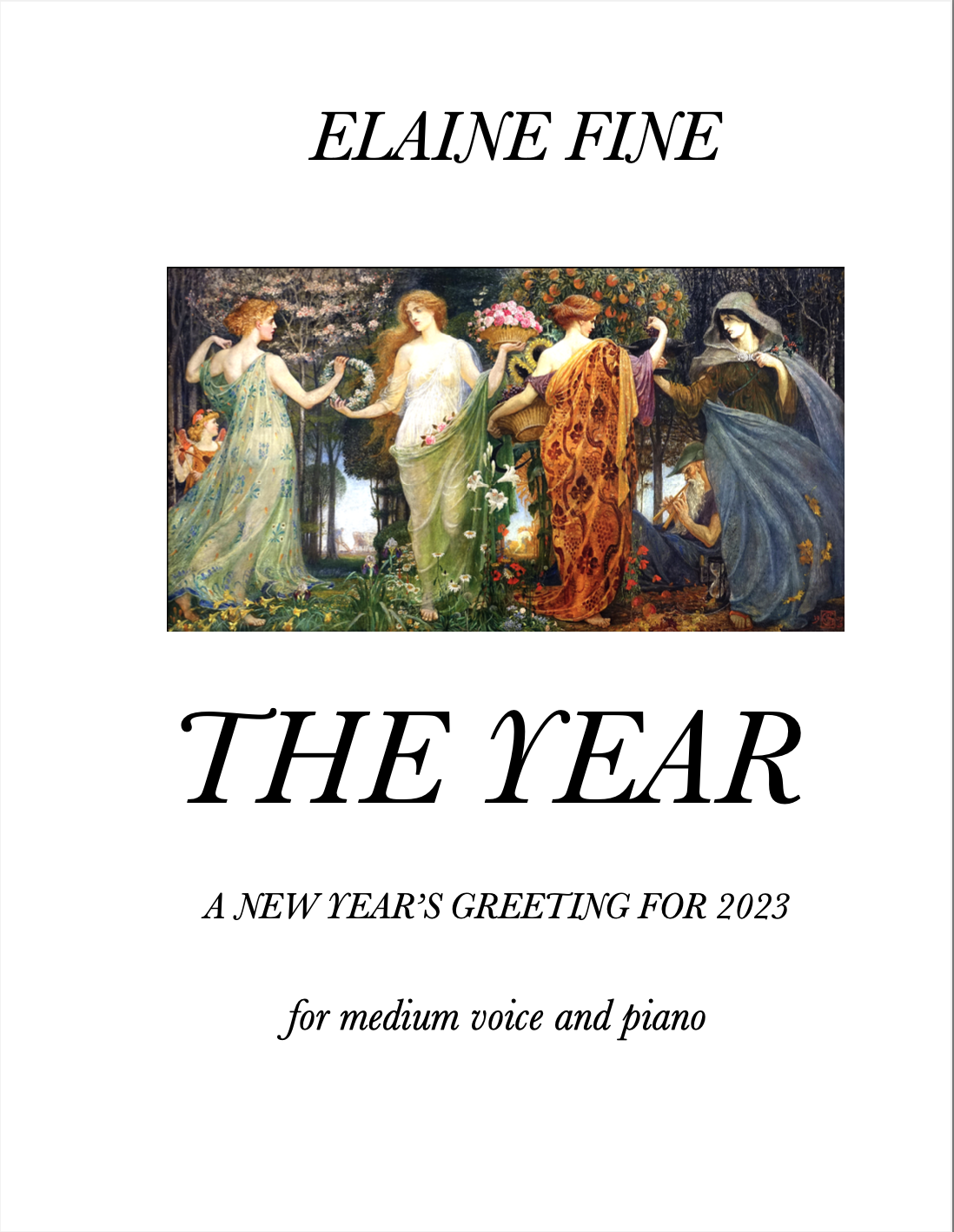
The cover image (which I chose simply because I love it) is "A Masque for the Four Seasons" painted by the British painter Walter Crane between 1905 and 1909, at the height of Ella Wheeler Wilcox's fame. Walter Crane was born in 1845 and died in 1915. Ella Wheeler Wilcox was born in 1850 and died in 1919. I had no idea that Walter Crane was a poet as well as a painter, and that he and Ella Wheeler Wilcox were published side-by-side in many magazines (Crane made illustrations for poems by James Russell Lowell in The Cosmopolitan). They were also both socialists. It tickles me to see these people I could never have known (but maybe I dreamed I knew . . .), and only recently learned about, tied together in both a blog post and a piece of brand-new music as we approach the new year of 2023.
Happy New Year.
What can be said in New Year rhymes,Ella Wheeler Wilcox was an extremely popular American writer during the early years of the twentieth century, and I only just learned (while writing this post, actually, because I was too caught up in working on the music to do any research at all on her life and work) that a good number of her poems have been set to music.
That's not been said a thousand times?
The new years come, the old years go,
We know we dream, we dream we know.
We rise up laughing with the light,
We lie down weeping with the night.
We hug the world until it stings,
We curse it then and sigh for wings.
We live, we love, we woo, we wed,
We wreathe our brides, we sheet our dead.
We laugh, we weep, we hope, we fear,
And that's the burden of the year.
But not this one (as far as I know).
You can find the music for medium voice here (there's also a version for high voice). You can listen to the medium voice version here, you can find the music for both on this page of the IMSLP.
The cover image (which I chose simply because I love it) is "A Masque for the Four Seasons" painted by the British painter Walter Crane between 1905 and 1909, at the height of Ella Wheeler Wilcox's fame. Walter Crane was born in 1845 and died in 1915. Ella Wheeler Wilcox was born in 1850 and died in 1919. I had no idea that Walter Crane was a poet as well as a painter, and that he and Ella Wheeler Wilcox were published side-by-side in many magazines (Crane made illustrations for poems by James Russell Lowell in The Cosmopolitan). They were also both socialists. It tickles me to see these people I could never have known (but maybe I dreamed I knew . . .), and only recently learned about, tied together in both a blog post and a piece of brand-new music as we approach the new year of 2023.
Happy New Year.
Sunday, October 31, 2021
Shifting Autumn Colors
"Dancing on the Fingerboard" has four brief autumn-themed violin or viola pieces for learning and practicing shifting from the first position to the third position. The first is in the major mode, is played with separate bows, and is mezzo-forte throughout. I call it "Shifting Colors of Autumn: Green. The second piece has the same pitches and rhythms as the first, but it has dynamics and bowings. It is called "Shifting Colors of Autumn: Yellow.
The third piece, "Shifting Colors of Autumn: Orange," is in the minor mode, uses separate bows, and maintains the same dynamic level throughout. The fourth piece, "Shifting Colors of Autumn: Red," marked at a slower tempo than the first three, has the same pitches as "Orange," but it has dynamic markings and bowings.
While Michael and I went walking in the woods today (Fox Ridge and Lake Charleston), I took some video of the yellow leaves to pair with "Shifting Colors of Autumn: Yellow." Yesterday I took some video of red trees for "Shifting Colors of Autumn: Red."
Now I have two videos to share.
The third piece, "Shifting Colors of Autumn: Orange," is in the minor mode, uses separate bows, and maintains the same dynamic level throughout. The fourth piece, "Shifting Colors of Autumn: Red," marked at a slower tempo than the first three, has the same pitches as "Orange," but it has dynamic markings and bowings.
While Michael and I went walking in the woods today (Fox Ridge and Lake Charleston), I took some video of the yellow leaves to pair with "Shifting Colors of Autumn: Yellow." Yesterday I took some video of red trees for "Shifting Colors of Autumn: Red."
Now I have two videos to share.
Labels:
composition,
Teaching,
Viola,
Violin,
YouTube links
Saturday, October 16, 2021
Dancing on the Fingerboard
I think that shifting from position to position on the violin and the viola should be a pleasure, and think that practicing in order to teach the arm and hand to shift should be an expressive activity rather than a mechanical one.
After years of teaching students to shift by using tried and true methods and materials from the nineteenth and twentieth centuries (which tend to bore them), I decided to try my hand writing at a set of twenty-first-century lighthearted pieces with whimsical titles that employ guiding fingers in their melodic material.
Initially I imagined a small set of short pieces to introduce the shift from first to third position, but my project grew into two sets of twenty pieces (one for violin and one for viola) that cover the first six positions and dip a toe into the seventh position.
I thought of having it published, but I am too impatient to wait. Plus, I really wanted to use this cover image, which I cobbled together from two very old books (one about folk dancing, and one about violin making), to celebrate the dance-like joy of moving the fingers of the left hand from place to place on the fingerboard.
I often tell my students that the four fingers of the left hand are like four dancing feet. Publishers like to use the work of their own artists, which I understand completely, but priorities are priorities.
So into the IMSLP it has gone for other violinists and violists to use for practicing and teaching. I did my best to make the titles and tempo markings witty, so I hope that help keep practicing fun.
You can find both the violin and the viola music on this page of the IMSLP.
Thursday, October 07, 2021
Representation from "Are Women People?"
Here's another contribution to what I hope will become a body of work by various composers (see this challenge to fellow composers). I was compelled to set this song for male voice and piano, and made versions of it for baritone and for tenor which is available on this page of the IMSLP.
Here's the first page of the song in the baritone key:
Here's a link to a computer-generated audio file, and here is the text as published in 1915. Go ahead and sing along!
Here's the first page of the song in the baritone key:
Here's a link to a computer-generated audio file, and here is the text as published in 1915. Go ahead and sing along!
Tuesday, August 31, 2021
Evening in Paris
This is the first piece of "Two Places in Illinois." It is a nostalgic look at the Paris of the past.
I got some of these images from a 1908 City Directory that I found by way of Archive.org. I also found a short history of the city, which was once a booming railroad town during the days when you could get almost anywhere by train.
Sunday, August 29, 2021
Coles County August 2020 and 2021
The natural world of Coles County, Illinois comes to a bright crescendo in August: everything is blooming, hopping, and buzzing. I wrote an optiminstic piano piece last August to celebrate the physical beauty of the place where I live. Writing it helped to offset the omnipresence of the pandemic. Oh those innocent days of the early virus!
Revisiting the piece in August of 2021, now that vaccines have FDA approval and are freely and readily available to everyone over the age of twelve, could have been rewarding and kind of triumphant.
But the virus is now much more infectious, and too many of the residents of Coles County choose to remain unvaccinated. Many of the adult residents of the county still will not wear masks in public indoor spaces. They still don't believe (for whatever reason) that Covid-19, particularly in its strengthened Delta state, is something to be concerned about.
But the flowers are blooming, and the trees are rich with bird life, bird songs, insect life, and insect songs.
My friend Marjorie takes beautiful photographs during her daily walks, and shares them with her friends. Yesterday I made a video using my "Coles County August" piece and photographs from some of Marjorie's August 2021 walks.
Revisiting the piece in August of 2021, now that vaccines have FDA approval and are freely and readily available to everyone over the age of twelve, could have been rewarding and kind of triumphant.
But the virus is now much more infectious, and too many of the residents of Coles County choose to remain unvaccinated. Many of the adult residents of the county still will not wear masks in public indoor spaces. They still don't believe (for whatever reason) that Covid-19, particularly in its strengthened Delta state, is something to be concerned about.
But the flowers are blooming, and the trees are rich with bird life, bird songs, insect life, and insect songs.
My friend Marjorie takes beautiful photographs during her daily walks, and shares them with her friends. Yesterday I made a video using my "Coles County August" piece and photographs from some of Marjorie's August 2021 walks.
Friday, August 27, 2021
Atlas Moth
This is the first piece in a forthcoming book of scale pieces in first position that will be published by Mel Bay later this year or in 2022. Like "Weights and Measures," this set goes through all the major and minor keys, moving stepwise with repeated pitches that happen only at the unison or the octave. Working this way gave me a some sense of structure during the first wave of the pandemic, and now making videos is giving me some structure during this Delta wave, where it is more like a sunami here in the lower parts of Illinois.
I call this collection "Scale Tales," because each scale corresponds to an animal that has scales like moths and butterflies, birds, fish, lizards, turtles, and flying squirrels (!!!).
The second volume (again with scales in all the major and minor keys, but using the full range of the violin) will probably carry the title "Advanced Scale Studies," but it is structured the same way.
I call this collection "Scale Tales," because each scale corresponds to an animal that has scales like moths and butterflies, birds, fish, lizards, turtles, and flying squirrels (!!!).
The second volume (again with scales in all the major and minor keys, but using the full range of the violin) will probably carry the title "Advanced Scale Studies," but it is structured the same way.
Friday, August 13, 2021
Habanera for Five Violas d'Amore played by Thomas Georgi
I'm so pleased to share this recording of the first piece of my Three Dances for Five Violas d'Amore played by Thomas Georgi.
Friday, July 16, 2021
Marked-up "Mole Unit" from "Weights and Measures" for Violin
One of my violin students suggested that I should make some tutorial videos for "Weights and Measures." I thought I could accomplish more (in less time) by marking up the first scale piece of the set. The beauty of keeping these pieces in the IMSLP on PDF is that teachers can print up multiple copies and apply bowings, fingerings, and dynamics of their choice. I find practicing this group of scale pieces a great way to warm up (on any instrument), and for students they provide a great way of actually hearing tonality (and its modal sisters) while they are playing. There is one one-page piece in each key-- first minor, then major.[click for a larger view]
You can find the whole set, in the original for solo recorder, and set up as duets for any instrument to play with violin or viola, on this page of the IMSLP. The soprano recorder/violin set is particularly fun to play down the octave on the viola.
Thursday, June 24, 2021
Dawn Chorus
I really love the chorus of birds (and frogs) that sing in the trees in our yard. It brightens my spirit every day. And despite the worries of the world (close by and far away) that can wear on me during the rest of the day, I seem to wake up each morning feeling hopeful.
I assure you that the quotation of any actual bird song you might hear in this chorus of piccolo, two flutes, clarinet, bassoon, violin, and viola is purely unconscious, and certainly accidental.
[June 24, 2021]
The score and parts are available on this page of the IMSLP, You can listen here (it's about five minutes long).
I assure you that the quotation of any actual bird song you might hear in this chorus of piccolo, two flutes, clarinet, bassoon, violin, and viola is purely unconscious, and certainly accidental.
[June 24, 2021]
The score and parts are available on this page of the IMSLP, You can listen here (it's about five minutes long).
Sunday, April 18, 2021
Oh my ears and whiskers!
I have spent the last several weeks writing music inspired by Lewis Carroll. This one is a duo for viola and euphonium intended for the underserved communities of euphonium players who have friends who play viola, and violists who have friends who play euphonium (silly "mirror" refrence intended).
It can also be played as a duo for viola and cello, as a companion piece, perhaps to the Beethoven Duet mit zwei obligaten Augengläsern, WoO 32 on a program. Trying to imagine dynamic balances in real acoustic spaces between viola and euphonium is difficult, so I treated the euphonium line as a cello part in order to come up with usable dynamics that can be taken down a notch by euphonium players. It was only AFTER doing this that I realized the "mirror" reference to Augengläseren (eyeglasses) in the title. [April 15, 2021]
You can find the music on this page of the IMSLP, and you can listen to a computer-generated recording here.
And coming to a YouTube channel in the near future is a performance of three songs I wrote for trumpet (cornet) and mezzo-soprano that I call "Adventures with Alice."
It can also be played as a duo for viola and cello, as a companion piece, perhaps to the Beethoven Duet mit zwei obligaten Augengläsern, WoO 32 on a program. Trying to imagine dynamic balances in real acoustic spaces between viola and euphonium is difficult, so I treated the euphonium line as a cello part in order to come up with usable dynamics that can be taken down a notch by euphonium players. It was only AFTER doing this that I realized the "mirror" reference to Augengläseren (eyeglasses) in the title. [April 15, 2021]
You can find the music on this page of the IMSLP, and you can listen to a computer-generated recording here.
And coming to a YouTube channel in the near future is a performance of three songs I wrote for trumpet (cornet) and mezzo-soprano that I call "Adventures with Alice."
Thursday, March 04, 2021
Solving technical problems with musical answers: thoughts about teaching
I got my "author's copies" of A Tunes this week, so I can assure you that physical copies are now available. It was a treat yesterday to teach lessons using a physical copy.
I thought that it might be a good idea to write a post expaining why I wrote it and what I hope teachers and students will get from using it. I have included a bit of my history for people who are not regular readers of this blog.
I have taught people to play, on one instrument or another, for more than forty years. And I have also, from time to time, been in the position of being a beginner or a near beginner. When I showed up for my first day of my first real job, teaching at a music school in a small town in Austria (a week before the semester was to begin), I was shocked to see that the majority of my students were recorder students. I think that there might have been two flutists, and thirty (or more) beginning recorder players. I hadn't touched a recorder since I was six or seven--the age of many of my students.
Fortunately there was a recorder in the top drawer of my desk, along with the beginner book my students would be using. I spent the whole week, when I wasn't studying German (which I barely spoke) learning to play the recorder, and I fell in love with the instrument. As soon as I had enough money to do so (I arrived in Schladming with only pocket change), I bought a soprano recorder and an alto recorder.
I was shocked that my students learned to play the recorder and learned to read music. I attribute my succes to the fact that I taught myself to read music while playing the recorder when I was five or six (a Honer recorder bought with S&H Greenstamps that I put toothmarks in, because I didn't know not to--I can still remember the taste of the wood).
The kids I taught in Austria also liked the kid-oriented folk music that was in the excellent recorder book they used. It was probably used by all the kids in Austria who learned to play recorder in their music schools. In Austria recorder was the "entry level" instrument, after which you could move to any other instrument. Everyone learned to read music while playing the recorder. Just like I had.
[The mechanics of recorder playing at an elementary level are straightforward. The refinements, like bending your thumb in order to make a horizontal half hole when going up an octave, using the tongue to make a variety of articulations, mastering the fingerings in the upper octave, and adjusting the air so that you can play in tune, are not. I learned those through studying at the Hochschule in Vienna.]
I really wanted to play violin as a kid, but could not learn to play until I was seven because the smallest instrument we had in the house was a half size. And once I was big enough to fit that violin, my father gave me an "A-Tune-A-Day" book (OMG I just realized that the "A Tunes" title bears homage to that series of books!), and I vividly remember making a physical analogy to the written B on the A string using the first finger, just like the left hand (top hand) of the recorder, and that C used the second finger. And G used three fingers on the D string, just like the recorder. I made visual connections between what I saw on the page and what my left hand fingers could do to "get" the note to sound right.
When I moved to Illinois I had the idea of writing a beginner flute book for my flute students. I wanted to create the same visual and kinetic connections I had experienced when learning to play the recorder both the first time and the second time, and the way I learned to play the violin. I found that it was really useful. My students liked it, particularly the tunes that I made up myself in order to develop physical skills.
In my early 30s I returned to string playing. In my late 30s I started composing seriously. In my 40s I taught violin and viola students using the Suzuki books, but not the method. As my abilities as a teacher improved, I started to see problems that every one of my students encountered while working through the Suzuki books. I do know that they were designed not to be "read from" by students, and that the main use was as reference for "by ear only" teaching, particularly for young students who were too young to read words fluently.
During in-person lessons with beginning students I could, by a multitude of means, get students to use a mixture of eye, ear, touch, and brain to get beyond reading by the numbers. I could use manipulative toys to help them to understand rhythm and the way it could relate to physical volume. They could listen and watch me play. We could play together.
[nostalgic pause]
When I had to switch to on-line teaching last March, I realized that I needed to come up with new ways to help my students learn, so I started writing these "A Tunes" to address problems that I would normally need to be in the same physical space to work through.
The first uses the pitches of "Twinkle Twinkle Little Star," but in a different order, and with different rhythms. The "Starry Night" title is meant to draw a connection. A person who can play "Twinkle Twinkle" can play "Starry Night," a brand-new piece, written just for their skill level, doubling their repertoire. It also sounds really good when students use the whole bow, from frog to tip, and the "sounding good" part is a great motivator for developing a bowstroke that is parallel to the bridge and can change speeds.
"Wait, What?" uses the same pitches as "Starry Night," and introduces quarter-note and half-note rests. There is one whole note, and a whole note that is tied to a quarter note, as well as easy and functional dynamics.
"Breeze in the Trees" introduces pizzicato and addresses the difficulties that students find in "Song of the Wind." There is a fermata that will be familiar to students who have played "Allegro" in the first Suzuki book. My students all really like fermatas.
"The Big Dipper" is in 3/4 time and it introduces slurs in a way that will feel nice and expressive in a beginning bow arm. It is a variation on "Starry Night," and uses the D string when it modulates to D major in the middle section.
"A Tunes" doesn't call for the lowered second finger until the "Solo Two-Step," which also introduces the idea of musical sequences (a melodic string of sixths going between two strings with a low second finger on the A string and the E string that my students really like). The pitches and rhythms are the same in the "Slurry Two-Step," but we get slurs and dynamics. It also begins up-bow, which introduces the idea of bowing logic early on.
"String-Crossing Waltz" combines the meter of three with hooked quarter notes played on the same pitch. Many of my students have been befuddled by the down/up/up bowing pattern in the first of the Bach Minuets in the first Suzuki book. "String-Crossing Waltz" takes the pattern out of the Bach musical context and repeats it over and over. After studying this piece the Bach Minuet is far easier for students to play in rhythm because their arms know what to do.
"The Happy Farmer" is one of the most difficult pieces to teach (and learn) for beginner violinists. I wrote "Farmer's Crossing" to address each of the bowing difficulties separately. I also added left-hand pizzicato on open strings, which strengthens the left hand, and students really like doing. After working on "Farmer's Crossing" my students have been far happier farmers.
The two "Leading-Tone Gallops" (one slurred and one not slurred) in E minor teach students about the raised third finger and the fourth finger plopping down right next to it. The title gives a chance for a teacher to explain about scale structure. These Gallops, "Gotcha!," and "The Fourth Heroic Muse" will help with the Gossec "Gavotte" and the Handel "Chorus" that begins the second Suzuki book. The Gallops also help navigate the fourth-finger waters found in the Bach Musette and the middle section of the Lully Gavotte (which, for the record, is really by Marin Marias).
The second Suzuki book works fine on its own for me until we get to the Beethoven Minuet in G, which is riddled with left-hand and right-hand difficulties. I wrote "Te Unim" to isolate the difficulties and put them in a vastly different musical context from the very familiar Beethoven piece. The title is the word "Minuet" spelled backwards. I'm surprised how well it works with students.
"Goodnight Air" uses the rhythms of the well-known children's book Goodnight Moon, and introduces the way meter that changes in order to "hold" the rhythms of the music. The phrasing of the text becomes the phrasing of the music, and it playing the phrases expressively becomes a gateway for being expressive when playing other pieces of music. It can also serve as a gateway for students to write musical settings of poems they like.
The Castor and Pollux Lullaby and Dance are harmonized (double-stop) versions of the "Starry Night" theme. They are in different meters, which provides an easy way to introduce compound time to students.
The "Vocalise" and "Appogiare with Variations" are just expresesive solo pieces, and they can be played by violinists at any level. One of my advanced students played some of these pieces as violin solos for a wedding she played this past October.
All these pieces are written as expressive solo pieces that can be performed without the need for accompaniment. There is something empowering about being in charge of all of the music.
If "A Tunes" sells well in the original violin version, I'm hoping that Mel Bay will issue a version for viola.
You can order the music here.
Sunday, February 28, 2021
Dol: a measurement of pain or sadness
The history of the development of the dol as a unit for measuring pain is rather horrible. It came as a result of inflicting pain by way of heat onto the hands of women while they were giving birth, and asking them to rate the pain of the contraction against the pain they felt in their hands. You can read about it here. The kind of abuse that was inflicted on people in the name of science during the 1940s is in itself cause for a huge amount of sadness.
The name comes from the Latin dolor meaning pain, grief, or sorrow. The Italian word dolore is used often in late Italian Renaissance music, particularly in the music of Carlo Gesualdo and Claudio Monteverdi. I encountered it first in Bach's Cantata 209, Non sa che sia dolore. I chose (because I could) to think of the "grief" associations with the Dol scale for this piece in "Weights and Measures," and thought it would be useful (I had a day visited by doldrums yesterday) to play this piece on viola in order to work out some of my feelings. Then I tried it on the violin, and found a whole different spectrum of feelings to work through. I recorded both of them, with the idea of posting one or the other on line to share.
Then, while messing around in iMovie, I thought of playing both videos simultaneously. I lined them up to end at the same time (the tempos were a little different), and was really thrilled with the results. Sometimes the voices answer one another, and, surpisingly, sometimes they play exactly together, purely by chance!
The name comes from the Latin dolor meaning pain, grief, or sorrow. The Italian word dolore is used often in late Italian Renaissance music, particularly in the music of Carlo Gesualdo and Claudio Monteverdi. I encountered it first in Bach's Cantata 209, Non sa che sia dolore. I chose (because I could) to think of the "grief" associations with the Dol scale for this piece in "Weights and Measures," and thought it would be useful (I had a day visited by doldrums yesterday) to play this piece on viola in order to work out some of my feelings. Then I tried it on the violin, and found a whole different spectrum of feelings to work through. I recorded both of them, with the idea of posting one or the other on line to share.
Then, while messing around in iMovie, I thought of playing both videos simultaneously. I lined them up to end at the same time (the tempos were a little different), and was really thrilled with the results. Sometimes the voices answer one another, and, surpisingly, sometimes they play exactly together, purely by chance!
Thursday, February 25, 2021
Improvising and practicing scales
After having written (and finished) more than sixty scale pieces since the beginning of 2021, I'm taking a break and spending time practicing "normal" scales and other music. For a while there I couldn't play a scale without stopping to write down a scale melody (there are so many possibilities) I had just discovered (or uncovered).
Yesterday I gave myself the luxury of playing through the Hrimaly series of three-octave scales that lives on my music stand. Today I found the process kind of mindless (though physically useful), so I decided to try something different. I started by improvising using scale fragements and arpeggio fragments in the key of C major. Then I thought about the F sharp that would happen in G major, the next key in the circle of fifths, and made my way, via that "new" F sharp, to the key of G. When ready I added the C sharp for the key of D, and so on all they way through C-sharp major/D-flat major, and down the circle by removing flats. This took a lot of "head space," in the keys with large numbers of sharps and flats, but I gave myself ample time to think.
Then I did the same with the minor keys, sticking with harmonic minor. Tomorrow I think I might go backwards, adding flats.
What I find most interesting about doing this is the way my awarness of modulations when playing solo music is heightened. The solo Bach pieces that have been etched in deep grooves in my brain for more than half a century become new vehicles for exploring the way scale passages work as well as an elevated vantage point for observing the possibilities of how well music can travel along the circle of fifths from one key to the next.
Perhaps I am "late to the party" with all of this, but I grew up and came of musical age during a time when (at least in Western European-oriented music) tonality was considered obsolete by composers of new music. It was a time when "improvisation" seemed to be connected almost exclusively with jazz, and if it wasn't connected with jazz it seemed to be concerned with sound (including extended techniques) not connected to a harmonic structure or framework.
Twenty-four of the sixty scale pieces are part of a collection that I put in the IMSLP, and the rest, two books of violin scale studies (one in the first position and the other that uses the whole range of the instrument) that are all named for animals that have scales, will be available from Mel Bay sometime later this year (I submitted the final books yesterday).
Just for fun I'm including one of the "Weights and Measures" pieces here. That is the name of the collection in the IMSLP.Needless to say, I had a lot of punny fun working on this collection.
Yesterday I gave myself the luxury of playing through the Hrimaly series of three-octave scales that lives on my music stand. Today I found the process kind of mindless (though physically useful), so I decided to try something different. I started by improvising using scale fragements and arpeggio fragments in the key of C major. Then I thought about the F sharp that would happen in G major, the next key in the circle of fifths, and made my way, via that "new" F sharp, to the key of G. When ready I added the C sharp for the key of D, and so on all they way through C-sharp major/D-flat major, and down the circle by removing flats. This took a lot of "head space," in the keys with large numbers of sharps and flats, but I gave myself ample time to think.
Then I did the same with the minor keys, sticking with harmonic minor. Tomorrow I think I might go backwards, adding flats.
What I find most interesting about doing this is the way my awarness of modulations when playing solo music is heightened. The solo Bach pieces that have been etched in deep grooves in my brain for more than half a century become new vehicles for exploring the way scale passages work as well as an elevated vantage point for observing the possibilities of how well music can travel along the circle of fifths from one key to the next.
Perhaps I am "late to the party" with all of this, but I grew up and came of musical age during a time when (at least in Western European-oriented music) tonality was considered obsolete by composers of new music. It was a time when "improvisation" seemed to be connected almost exclusively with jazz, and if it wasn't connected with jazz it seemed to be concerned with sound (including extended techniques) not connected to a harmonic structure or framework.
Twenty-four of the sixty scale pieces are part of a collection that I put in the IMSLP, and the rest, two books of violin scale studies (one in the first position and the other that uses the whole range of the instrument) that are all named for animals that have scales, will be available from Mel Bay sometime later this year (I submitted the final books yesterday).
Just for fun I'm including one of the "Weights and Measures" pieces here. That is the name of the collection in the IMSLP.Needless to say, I had a lot of punny fun working on this collection.
Tuesday, December 24, 2019
New Year's Greeting for 2020!
I'm getting a jump start on the New Year, so I'm sharing this here today. The text is a poem by Margaret E. Sangster that was published in Harper's Young People on January 3, 1882 with the title "A Child's Puzzles."

I made an instrumental version for alto recorder (or violin) and piano:

and I made one (of course) for viola and piano:

It can be played on any instrument, really. I like the way it sounds on the alto recorder, but it does have a few (playable with practice) challenging measures.
You can find the music for both versions on this page of the IMSLP, and you can listen to a recording of it here.

I made an instrumental version for alto recorder (or violin) and piano:

and I made one (of course) for viola and piano:

It can be played on any instrument, really. I like the way it sounds on the alto recorder, but it does have a few (playable with practice) challenging measures.
You can find the music for both versions on this page of the IMSLP, and you can listen to a recording of it here.
Friday, September 27, 2019
The Whistleblower Complaint
Someone had to write it!


September 27, 2019
You can find a PDF on this page of the IMSLP, and you can also get one here. You can listen to a computer-generated recording here.
I would love to post recordings of actual flutists playing this piece (which is pretty cathartic to play). If you make one, please send it to me!


September 27, 2019
You can find a PDF on this page of the IMSLP, and you can also get one here. You can listen to a computer-generated recording here.
I would love to post recordings of actual flutists playing this piece (which is pretty cathartic to play). If you make one, please send it to me!
Saturday, August 17, 2019
Nuit de Vielle

You can find the score and parts on this page of the IMSLP. And you can listen to a computer-generated recording here. The percussive flute sounds on the computer-generated recording are only an approximation. Hopefully I will have a humanly-generated recording to post soon!
Wednesday, July 10, 2019
Dances from "The Harlot's House" performance from 2017
I just found this performance on YouTube, and thought I'd share it here. This is the first time I have heard it played by a full string orchestra, and I am thrilled.
Subscribe to:
Posts (Atom)