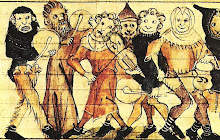
I'm so excited to share a recording of this performance of Sienna, Burnt and Raw by Safron Sonoda and Joana Izabelle, along with photographs of some of the cave paintings from Lascaux that served as inspiration for the piece.
You can find the music here.
Monday, July 28, 2025


Wednesday, July 23, 2025
An Epitaph for JDM

You can listen here.
A note for people who knew John David, but may not know the meaning of the letters F, A, and E in the music: F-A-E stands for "Frei aber einsam" (free but alone), the motto of Joseph Joachim, who was a close friend of Johannes Brahms, Robert Schumann, and Albert Dietrich. The three composers wrote a collaborative work for violin and piano in honor of Joachim. You can read about the F-A-E Sonata here.
The F-A-E Sonata was one of the first pieces I played together with John David, the first of hundreds.
Tuesday, July 22, 2025
Saying Good-bye to John David Moore

John David, who was a member of the Eastern Illinois University English Department, shared an office with Michael during their first years in town.
He was an erudite and brilliant person who had many literary interests, but I believe he was hired to teach children's literature. He preferred to teach Victorian children's literature, much to the suprise of the students, who might have signed up for his classes in order to read "easy" books.
When he started work at EIU he thought of himself as a person who was once a pianist, but eventually he bought a piano, and found his way back to music. After a short time he became the pianist of the Eastern Trio, and toured around the state with the group playing concerts. When the music department no longer supported the Eastern Trio, John David was left without a musical outlet.
In the early 2000s I was still a "child" violinist and violist. I found myself talking with John David during a parade one Fourth of July, and we decided to read some music together.
We started right away with serious repertoire, and played our first concert together in 2002 or 2003 (I can't seem to find the program).
But I do have programs for many of the thirty-some-odd concerts concerts we played between 2005 and 2018.
We rehearsed every week, and sometimes twice a week when we were preparing a concert. And we read through as much obscure music as John David could find by way of interlibrary loan. It was with John David that I first "met" a great many excellent composers of the past who have been neglected, including Amanda Maier.
It will take a long time for me to sift through the huge treasure chest of musical memories I have had with him. He was like a brother to me. And he was a good friend.
I have posted about our musical adventures over the years. You can read all those posts here. And you can read Michael's post about John David here.
Tuesday, July 15, 2025
The Very Best Week
It began with the Summer Strings concert, which, because of rain, was held indoors. Our conductor, a professor of meterology at the local university, was able to determine the necessity of using our rain location, a church with excellent acoustics, early in the day. The recording I made came out sounding really good.
You can hear the recording here.
And you can see the music on the program in the comments.
Everyone played their hearts out, and the audience (more than 200 people, I have been told) reflected that love of expression in a really big way. This, for me, is the height of musical experience. Our ensemble has three professional musicians in it. The rest do other things for a living, or else they are kids who are out of school during the summer. Some come from rural farming communities. All of them practice.
Immediately after the concert, after a short night of sleep, we headed off to New Jersey to see some good friends. We spent a day in Montclair and West Orange visiting a great bookstore, having fantastic ramen for lunch, and exploring the wonders of the Thomas Edison National Historical Park, which was an experience that will take me a long time to fully process. If you ever find yourself in that area of New Jersey, go there. And if you are a "senior" you can get a pass for $20 that will let you and three friends in. You can use that pass for every National Park in the United States.
The next day we headed off to Massachusetts for a wedding. We had a wonderful time celebrating the coming together of two wonderful families (one of them ours) on the most beautiful of days in the most beautiful of places.
Our return trip, which we divided between two days, featured a huge thunderstorm that we encountered while it was my turn to drive. I proudly navigated my way through it. That was a huge accomplishment for me.
Before leaving for our adventure I started working on a piece for the Los Angeles Jewish Symphony, and I did some work on it this morning. I have plans later today to practice the first violin part of Haydn Opus 74 no. 1, and get to play it tomorrow with friends.
I don't think that I have ever returned from a week away with such a full head and such a full heart.
You can hear the recording here.
And you can see the music on the program in the comments.
Everyone played their hearts out, and the audience (more than 200 people, I have been told) reflected that love of expression in a really big way. This, for me, is the height of musical experience. Our ensemble has three professional musicians in it. The rest do other things for a living, or else they are kids who are out of school during the summer. Some come from rural farming communities. All of them practice.
Immediately after the concert, after a short night of sleep, we headed off to New Jersey to see some good friends. We spent a day in Montclair and West Orange visiting a great bookstore, having fantastic ramen for lunch, and exploring the wonders of the Thomas Edison National Historical Park, which was an experience that will take me a long time to fully process. If you ever find yourself in that area of New Jersey, go there. And if you are a "senior" you can get a pass for $20 that will let you and three friends in. You can use that pass for every National Park in the United States.
The next day we headed off to Massachusetts for a wedding. We had a wonderful time celebrating the coming together of two wonderful families (one of them ours) on the most beautiful of days in the most beautiful of places.
Our return trip, which we divided between two days, featured a huge thunderstorm that we encountered while it was my turn to drive. I proudly navigated my way through it. That was a huge accomplishment for me.
Before leaving for our adventure I started working on a piece for the Los Angeles Jewish Symphony, and I did some work on it this morning. I have plans later today to practice the first violin part of Haydn Opus 74 no. 1, and get to play it tomorrow with friends.
I don't think that I have ever returned from a week away with such a full head and such a full heart.
Tuesday, July 08, 2025
Summer Strings Concert
Tonight's Summer Strings concert is not only going to be indoors, it is going to be live-streamed on Facebook. The concert begins at 7:00 p.m. Central Time, and should last around forty-five minutes.  https://www.facebook.com/share/p/1B7jXWDSvN/

Sunday, July 06, 2025
Windows on the World
Michael and I are making our way through a Penguin Classics set of eighty little books (each is fifty some-odd pages of text, and measures six and a half inches by four inches) that offer a great cross-section of written material translated into English, and served in portions just large enough to provide a "tasting menu" of human culture.
There are short stories, poems, excerpts from plays, words of wisdom from antiquity (occidental and oriental), and historical writings.
A lot of it is new to both of us. And reading Marco Polo's writings about his travels in India shows us just how, shall we say "unusual" much of the world has been and, in many ways, continues to be. After reading about Caligula in writings by Suetonius today it occured to me that we as a human race haven't "progressed" since the days of the Roman Empire.
But as individuals and as collectives of individuals we have, somehow, found ways to lasso, cultivate, and preserve the most marvelous extremes of what humanity has to offer, particulary in the practices of art and music (and, as this series also shows, in writing).
It feels like as a human society (globally, as far as I can see through my various digital windows) we are entering a very dark period. We have stepped through one of the doors over here in the United States of America. Many of us haven't stepped through voluntarily: we were pushed through. And the tide will take us to places that I imagine will get darker and darker. We are passing shadows on the walls that feel familiar because of the knowledge that some of us have of history, but a great deal of what has happened to humanity over the millenia hasn't been written down. And a great deal of what has happened in history has never been reported because nobody survived to tell the tales.
But during those dark times there must have been music. Love (romantic, friendship, and between family members) is built into us. Community has always created a (sometimes fleeting) feeling of safety. Beauty and wonder in nature has always been around us, as well as the ability to appreciate it.
The progress that has happened during my lifetime has been extraordinary. I feel that we have prioritized kindness in the generation of children who are in preschool and in the early primary grades. The majority of them have learned (especially in public schools) to be kind to one another, to value kindness, and to be tolerant of the fact that everybody is different and everybody needs to get along.
This is a big thing.
I gave out a lot of candy to kids while I was walking in the Fourth of July parade (wearing my "No Kings in America" shirt). Every child who was of speaking age said, "Thank you." And the parents of smaller children thanked me on behalf of their child.
This is enough to give me hope that the kindness that has been prioritized in education and in parenting will help us to be a more tolerant society even while we are faced with the darkness that is coming. Darkness can destroy a cruel society. But I would like to believe that a kind society might just have a chance.
There are short stories, poems, excerpts from plays, words of wisdom from antiquity (occidental and oriental), and historical writings.
A lot of it is new to both of us. And reading Marco Polo's writings about his travels in India shows us just how, shall we say "unusual" much of the world has been and, in many ways, continues to be. After reading about Caligula in writings by Suetonius today it occured to me that we as a human race haven't "progressed" since the days of the Roman Empire.
But as individuals and as collectives of individuals we have, somehow, found ways to lasso, cultivate, and preserve the most marvelous extremes of what humanity has to offer, particulary in the practices of art and music (and, as this series also shows, in writing).
It feels like as a human society (globally, as far as I can see through my various digital windows) we are entering a very dark period. We have stepped through one of the doors over here in the United States of America. Many of us haven't stepped through voluntarily: we were pushed through. And the tide will take us to places that I imagine will get darker and darker. We are passing shadows on the walls that feel familiar because of the knowledge that some of us have of history, but a great deal of what has happened to humanity over the millenia hasn't been written down. And a great deal of what has happened in history has never been reported because nobody survived to tell the tales.
But during those dark times there must have been music. Love (romantic, friendship, and between family members) is built into us. Community has always created a (sometimes fleeting) feeling of safety. Beauty and wonder in nature has always been around us, as well as the ability to appreciate it.
The progress that has happened during my lifetime has been extraordinary. I feel that we have prioritized kindness in the generation of children who are in preschool and in the early primary grades. The majority of them have learned (especially in public schools) to be kind to one another, to value kindness, and to be tolerant of the fact that everybody is different and everybody needs to get along.
This is a big thing.
I gave out a lot of candy to kids while I was walking in the Fourth of July parade (wearing my "No Kings in America" shirt). Every child who was of speaking age said, "Thank you." And the parents of smaller children thanked me on behalf of their child.
This is enough to give me hope that the kindness that has been prioritized in education and in parenting will help us to be a more tolerant society even while we are faced with the darkness that is coming. Darkness can destroy a cruel society. But I would like to believe that a kind society might just have a chance.
Friday, July 04, 2025
A Tale of Two T-shirts

The image on the shirt in the picture from July 4, 2023 was drawn by our daughter around a quarter of a century ago (her drawing won a local T-shirt contest).
I could wear my "Ring in a Century of Freedom" shirt proudly every Fourth of July until this year.
This year I'm wearing a "No Kings in America" shirt to march with the Coles County Democrats in the blaring heat of today's parade.
Sunday, June 29, 2025
All the weather, all at once
I wrote this piece back in March, during a crazy time when we had different weather every day. I finished it while in a "safe spot" during a tornado warning.
Michael Hall, the person I wrote it for, gave the piece its first performance last week, on the first day of summer. He will be making a recording of it at some point in the future, but because people are eager to know what the piece sounds like, I made a "demo" recording last night.
I love making slide shows to "illustrate" possibilities for musical imagery, so I made one for this piece. The images I used are not definitive ones: they are just images that work for me today, with the way I played the piece last night.
Please excuse the occasional foible: making a decent recording of even a short piece is difficult, particularly when that short piece is difficult to play. But I think that the challenges make the music better (particularly when played by a better violist than me).
You can find a PDF on this page of the IMSLP.
Michael Hall, the person I wrote it for, gave the piece its first performance last week, on the first day of summer. He will be making a recording of it at some point in the future, but because people are eager to know what the piece sounds like, I made a "demo" recording last night.
I love making slide shows to "illustrate" possibilities for musical imagery, so I made one for this piece. The images I used are not definitive ones: they are just images that work for me today, with the way I played the piece last night.
Please excuse the occasional foible: making a decent recording of even a short piece is difficult, particularly when that short piece is difficult to play. But I think that the challenges make the music better (particularly when played by a better violist than me).
You can find a PDF on this page of the IMSLP.
Friday, June 27, 2025
Truth
Besides inheriting Ashkenazic genes associated with longevity, a hard-wired need to express myself musically, short stature, and a metabolism designed to keep my body alive in times of famine, I believe I have inherited a sense of respect for the truth. And the general adulteration of the truth that I hear (mostly from political people) distresses me to the core of my being.
As I young person I was often confused about what I really was thinking. I don't think that this is at all uncommon in young people, and many well-meaning young people are drawn down paths that do not reflect their sense of what is right or what is true. Sometimes they/we (we, because we have all been there) realize that we are not in a place we want to be as a result of a less-than-well-thought-out decision. Time teaches us to be more careful, if we are lucky.
Music really helps to identify truth. Intonation is true. Sound is true. Rhythm is true. Physical form strives for truth. The direction of a phrase can go in many ways, and each one can have a trajectory of truth. There is no "right" way to play a phrase, but there are many true ways to play a phrase. Playing a phrase the way you really want it to go involves identifying the way you don't want it to go. I get great pleasure on aiming for musical truth on a daily basis.
I love privacy when I'm practicing: when I am not aware of anybody listening, I listen much more deeply to where I am (in a phrase or in a note), where I am going, and where I have been.
I think of practicing as a reinforcing of whoever it is I am, and combining that with a search for what is true in music.
When writing music I love the search for what is true and what is right. And I am glad that I am able, at this point, after many years of building the skills to do so, to know what to keep and what to discard. The floor around my desk, piano bench, and music stand is littered (figuratively, of course) with discarded pitches, rhythms, and measures.
I never received praise when I was a child, so I never knew if I had any talent. I knew what my shortcomings were (and still are), but I like to believe that my parents believed that they were being true to me by not encouraging me the way other parents encouraged their children. Both of them were child prodigies with exceptional talents that their parents "encouraged" with serious purpose. Maybe they wanted to spare me the pressure they felt as children. Maybe they wanted to let me be a "normal kid," not knowing that I would be a miserable failure in the world of kid normalcy.
So now as a grown-up person with grandchildren, who is basically happy with what I have contributed to the world (so far), I feel that I have told the truth.
What is true is, however, different from what is certain. I don't believe that anybody can predict anything with certainty. I feel (though I am not certain) that my quest to know the difference will continue through the many decades ahead of me during my long Ashkenazic life.
As I young person I was often confused about what I really was thinking. I don't think that this is at all uncommon in young people, and many well-meaning young people are drawn down paths that do not reflect their sense of what is right or what is true. Sometimes they/we (we, because we have all been there) realize that we are not in a place we want to be as a result of a less-than-well-thought-out decision. Time teaches us to be more careful, if we are lucky.
Music really helps to identify truth. Intonation is true. Sound is true. Rhythm is true. Physical form strives for truth. The direction of a phrase can go in many ways, and each one can have a trajectory of truth. There is no "right" way to play a phrase, but there are many true ways to play a phrase. Playing a phrase the way you really want it to go involves identifying the way you don't want it to go. I get great pleasure on aiming for musical truth on a daily basis.
I love privacy when I'm practicing: when I am not aware of anybody listening, I listen much more deeply to where I am (in a phrase or in a note), where I am going, and where I have been.
I think of practicing as a reinforcing of whoever it is I am, and combining that with a search for what is true in music.
When writing music I love the search for what is true and what is right. And I am glad that I am able, at this point, after many years of building the skills to do so, to know what to keep and what to discard. The floor around my desk, piano bench, and music stand is littered (figuratively, of course) with discarded pitches, rhythms, and measures.
I never received praise when I was a child, so I never knew if I had any talent. I knew what my shortcomings were (and still are), but I like to believe that my parents believed that they were being true to me by not encouraging me the way other parents encouraged their children. Both of them were child prodigies with exceptional talents that their parents "encouraged" with serious purpose. Maybe they wanted to spare me the pressure they felt as children. Maybe they wanted to let me be a "normal kid," not knowing that I would be a miserable failure in the world of kid normalcy.
So now as a grown-up person with grandchildren, who is basically happy with what I have contributed to the world (so far), I feel that I have told the truth.
What is true is, however, different from what is certain. I don't believe that anybody can predict anything with certainty. I feel (though I am not certain) that my quest to know the difference will continue through the many decades ahead of me during my long Ashkenazic life.
Thursday, June 26, 2025
Calico Pie
The only thing that seems to make sense to me these days is nonsense. So I have really been enjoying the nonsense poetry of Edward Lear, and this poem made its way into being a song. Doing this work over the past week (or so) has been a great distraction during a time when we all really need serious distraction. There is nothing that feels as good to me as getting the right notes to fit in their proper places.
I also made a video with the text and pictures (drawn by Edward Lear). The music is available on this page of the IMSLP.
I also made a video with the text and pictures (drawn by Edward Lear).

Wednesday, June 18, 2025
Asleep in the Deep from Down Under

The flutist Eliza Shephard, the soprano Judith Dodsworth, and the pianist Yasmin Rowe give the piece an absolutely stunning performance: everything I dreamed about in my mind's ear while working on it.
If you want to follow the score, you can find it on this page of the IMSLP.
Monday, June 16, 2025
The New Grown-Ups's New Recording

At any rate it is great, and it is available today via Bandcamp.
The New Grown-Ups is our son Ben Leddy's Boston-based band. He plays (mostly) mandolin, and sings, and some of the music they play and sing is written by him.
You can listen (or download) by way of this bandcamp page.
The Surgeon's Cut
I don't think I have watched a documentary series (four episodes on Netflix) that has made as great an impact on my consciousness as The Surgeon's Cut. Made in 2020, it follows the lives, careers, and in-operating-room activities of four surgeons. One is a brain surgeon who removes tumors, one performs surgery on fetuses in utero, one is a liver specialist who does live-donor transplants, and one is a heart surgeon who specializes in repairing holes in the hearts of small children.
The heart surgeon's practice is in India, where a large proportion of the population has congenital heart issues. India also has many languages (the doctor speaks to his patients in the languages that they communicate best in), a great deal of poverty (people can pay what they are able to pay when they go to his clinic for their operations), and several religions (it goes without saying that he respects all faiths).
The liver surgeon, the only American-born doctor in the bunch, is a perfectionist who likens the process of doing an operation to the process of playing music: for her it is an art. She is also talks about what it was like to go to medical school in the second part of the twentieth century, when only a small percentage of the students in medical school were women.
The brain surgeon was an undocumented migrant worker from Mexico who taught himself English as a young adult, got a university education, entered medical school, and then fell in love with the brain.
The doctor who performs fetal surgery invented the process of saving twins that share the same blood supply (in-utero) but do so unequally. Sometimes the process of cutting and reconnecting tiny blood vessels so that each baby has its own blood supply results in the delivery of two healthy twins, and sometimes it doesn't.
The scenes in the operating room are fascinating, and are filmed in such a way that they welcome you to look. I have no idea how the camera people managed to do it, but I am very grateful that they did.
If you need something to remind you of the greatness and nobility present in the human spirit, these four hours will do the trick.
The heart surgeon's practice is in India, where a large proportion of the population has congenital heart issues. India also has many languages (the doctor speaks to his patients in the languages that they communicate best in), a great deal of poverty (people can pay what they are able to pay when they go to his clinic for their operations), and several religions (it goes without saying that he respects all faiths).
The liver surgeon, the only American-born doctor in the bunch, is a perfectionist who likens the process of doing an operation to the process of playing music: for her it is an art. She is also talks about what it was like to go to medical school in the second part of the twentieth century, when only a small percentage of the students in medical school were women.
The brain surgeon was an undocumented migrant worker from Mexico who taught himself English as a young adult, got a university education, entered medical school, and then fell in love with the brain.
The doctor who performs fetal surgery invented the process of saving twins that share the same blood supply (in-utero) but do so unequally. Sometimes the process of cutting and reconnecting tiny blood vessels so that each baby has its own blood supply results in the delivery of two healthy twins, and sometimes it doesn't.
The scenes in the operating room are fascinating, and are filmed in such a way that they welcome you to look. I have no idea how the camera people managed to do it, but I am very grateful that they did.
If you need something to remind you of the greatness and nobility present in the human spirit, these four hours will do the trick.
Sunday, June 15, 2025
Father's Day 2025

I am forever grateful that my father gave the instrument to me, and that I am able to enjoy playing it all the time.
Saturday, June 14, 2025
The Wisdom of Rob Roy McGregor
I just finished listening to a conversation between Anthony Plog and Rob Roy McGregor from a 2021 episode of the podcast On Music. I learn something new about music from every episode (and there are many), and recommend this podcast highly. There is a serious emphasis on brass playing, particularly trumpet playing, but since brass playing is not something I do, and the brass-player's perspective is not something I have, it is very informative.
Rob Roy McGregor talks at length about the difficulties of being a music publisher in the episodes I linked to above. Sometime before 2021 he sold his thirty-year-old company, Balquhidder Music, to Carl Fisher, and is happily retired from both publishing and playing (he played in the trumpet section of the Los Angeles Philharmonic).
Here is the big take-away for me:
Rob Roy McGregor talks at length about the difficulties of being a music publisher in the episodes I linked to above. Sometime before 2021 he sold his thirty-year-old company, Balquhidder Music, to Carl Fisher, and is happily retired from both publishing and playing (he played in the trumpet section of the Los Angeles Philharmonic).
Here is the big take-away for me:
When money becomes involved, then you can be more easily disappointed.
Subscribe to:
Posts (Atom)