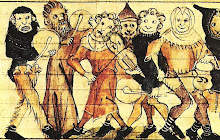
In honor of Father’s Day, which my father never celebrated when I was growing up, I am sharing this photo of him showing his true feelings about the viola d’amore, as prompted by the photographer, Bill Shisler, the Boston Symphony's librarian, to do so.
I am forever grateful that my father gave the instrument to me, and that I am able to enjoy playing it all the time.
Sunday, June 15, 2025
Saturday, June 14, 2025
The Wisdom of Rob Roy McGregor
I just finished listening to a conversation between Anthony Plog and Rob Roy McGregor from a 2021 episode of the podcast On Music. I learn something new about music from every episode (and there are many), and recommend this podcast highly. There is a serious emphasis on brass playing, particularly trumpet playing, but since brass playing is not something I do, and the brass-player's perspective is not something I have, it is very informative.
Rob Roy McGregor talks at length about the difficulties of being a music publisher in the episodes I linked to above. Sometime before 2021 he sold his thirty-year-old company, Balquhidder Music, to Carl Fisher, and is happily retired from both publishing and playing (he played in the trumpet section of the Los Angeles Philharmonic).
Here is the big take-away for me:
Rob Roy McGregor talks at length about the difficulties of being a music publisher in the episodes I linked to above. Sometime before 2021 he sold his thirty-year-old company, Balquhidder Music, to Carl Fisher, and is happily retired from both publishing and playing (he played in the trumpet section of the Los Angeles Philharmonic).
Here is the big take-away for me:
When money becomes involved, then you can be more easily disappointed.
Friday, June 13, 2025
Tomorrow
This is the sign Michael made. Mine is below. We are hoping to have a great turnout for "No Kings Day" here in Illinois 15.
Thursday, June 12, 2025
More new (old) pieces by Marshall Fine that are in the IMSLP
. . . and will be available soon.
While we wait for clearance you can also access them by way of this portal.
Lament of Daeron for Flute, Viola, and Harp
Vieuxtemps-Variations, Marshall's completion of the Henri Vieuxtemps Viola Sonata, Opus 60
Variations on a Theme of Gesualdo, Opus 37 (Score only)
Chorale Preludes for Viola and Chamber Orchestra (Score only)
Dumka for Viola and Piano
Missouriana (Score only)
Lament of Daeron for Flute, Viola, and Harp
Vieuxtemps-Variations, Marshall's completion of the Henri Vieuxtemps Viola Sonata, Opus 60
Variations on a Theme of Gesualdo, Opus 37 (Score only)
Chorale Preludes for Viola and Chamber Orchestra (Score only)
Dumka for Viola and Piano
Missouriana (Score only)
Marshall Fine String Quartet #2 "Songs of Love and Death"
I now have PDF copies of music that my brother Marshall sent to our father. It is a real honor to be able to make it available for people to play. This is the first of several pieces in manuscript I will be sharing this way.
You can find the score and the parts here, and on this page of the IMSLP.
Monday, June 09, 2025
Taking Stock
I decided yesterday to "take stock" and count the number of arrangements I have made for string orchestra over the years. And then I continued to count. Here is my "inventory" to date:
190 arrangements for string orchestraI have a bunch of string orchestra arrangements in the works to play next summer, and, hopefully, will come up with some ideas for new original pieces.
178 arrangements for string quartet
Six original pieces for string orchestra
Some of these are among the 128 arrangements of various pieces for various instruments that are on this page of the IMSLP, and the rest I share privately (in a way that doesn't involve money) with people who want to use them with their ensembles (please send me an email if you are interested in the link).
I have 81 pieces published by Subito, including three orchestral pieces, two operas, and a piece for large wind ensemble. Most of it is chamber music, solo instrumental pieces with piano, and a few sets of songs.
I have three pieces for published by Jeanne, and three songs published by North Star.
I have four books of solo violin and viola studies published by Mel Bay and four solo flute studies (two junior and two senior) that I wrote for the ILMEA (Illinois Music Teachers Association) auditions.
I also have a piece for cello and piano forthcoming in an anthology published by Schott, and a piece for solo viola that I will put into the IMSLP after it is premiered on June 21 by Michael Hall.
That new piece will join the 177 pieces of music that I make available in the IMSLP.
Thursday, June 05, 2025
A Piece of the Pie
". . . once again, the performances of 2 dead, white men outnumber all of the performances of 71 women composers."Sarah Baer and Liane Curtis made their report about the music programmed for the 2025-2026 concert season by the top twenty-one orchestras in the United States in the Women's Philharmonic Advocacy last month.
You can read the report here.
After the great cultural push made by so many people during the past few years to recognize that composing music is an activity that women and men are capable of doing equally well, the impact it seems to have made on the standard-bearers of classical music culture over here in America is truly disappointing.
I would like to believe that this is an American problem, and I would like to believe that this is a short-term problem, but I think that I might be expecting too much. I sincerely hope that time will prove me wrong.
I am deeply grateful to the Women's Philharmonic Advocacy for doing the work that they do to try to give women who write music recognition. Meanwhile, women who write music can only keep working while we wait for better days, days when we can feel as if we are something in the musical world other than "other."
Friday, May 30, 2025
AI (Actual Intelligence)
I hate the ways robotic entities have taken over so many parts of my life. I no longer memorize phone numbers, addresses, or even directions. If I need to look something up that could be found in a perfectly good dictionary (and we have many of the best in our house), I almost always look up what I need to know on my computer or my phone. It saddens me to say that I have found that the most up-to-date information about music and musicians of the past is online, making many of the music books that populate our bookshelves obsolete.
I get pleasure from wearing my Timex watch, from reading books on paper, from spending time talking with people in real time and, of course, from being able to read and play music on a handful of instruments with a great number of people.
A few years ago, when I started listening to the "Sold a Story" podcast, I found myself making a connection between the concept of children learning to read by using pictures and context clues rather than phonics, and learning to play an instrument (even at a high level) exclusively by listening and copying the playing and gestures of others, without learning how to read music.
As much as I enjoyed reading the Eri Hotta's book The Man & His Dream to Teach the Children of the World, I firmly believe that learning to play an instrument and learning to read music at the same time reinforces both the physical actions of playing and the mental activity of learning to understand what music is, and what music can be.
While I think it is great for kids to play at music (singing, using instruments to improvise, and even to finding tunes they know on them), I prefer to wait until children are of reading age before teaching them the "proper how" of playing an instrument. And I believe with all my heart that if a person can read words, they can read music.
I get pleasure from wearing my Timex watch, from reading books on paper, from spending time talking with people in real time and, of course, from being able to read and play music on a handful of instruments with a great number of people.
A few years ago, when I started listening to the "Sold a Story" podcast, I found myself making a connection between the concept of children learning to read by using pictures and context clues rather than phonics, and learning to play an instrument (even at a high level) exclusively by listening and copying the playing and gestures of others, without learning how to read music.
As much as I enjoyed reading the Eri Hotta's book The Man & His Dream to Teach the Children of the World, I firmly believe that learning to play an instrument and learning to read music at the same time reinforces both the physical actions of playing and the mental activity of learning to understand what music is, and what music can be.
While I think it is great for kids to play at music (singing, using instruments to improvise, and even to finding tunes they know on them), I prefer to wait until children are of reading age before teaching them the "proper how" of playing an instrument. And I believe with all my heart that if a person can read words, they can read music.
I taught myself to play the recorder when I was five or six. I learned how to play it and read music at the same time. I had a Hohner recorder that I bought using S&H Green Stamps. And after I could read the notes and rhythms on the recorder, learning to read music on the violin (which I did when I was seven, and by myself) was easy and made sense.
Recorder is a great gateway to playing any instrument. My return to the recorder happened when I was twenty. I got a teaching job in a music school in Schladming, Austria, and I expected that I would be teaching flute. But I learned on my first day there that I would be teaching thirty seven-year-olds to play recorder and two teenagers to play the flute.
There was a soprano recorder in the desk drawer, and the book that my students would be using.
Since I would be teaching my students in German, and since my German was extremely rudimentary at the time, re-learning the recorder and figuring out how to teach it was just one more thing on my “plate.”
I started practicing the recorder immediately, using the book I found in the drawer, and I fell instantly and totally in love with the instrument.
But I have digressed.
The point I set out to make earlier in this post is that reading music and playing music without the use of any kind of electronic device works for me as a protective umbrella against the joys of life being taken over (or compromised) by artificial intelligence. And combatting the onslaught using musical means feels more and more like a subversive act: an act of defiance.
I started a new student on the soprano recorder last month. She is the first non-music-reading beginner recorder student I have taught in a very long time.
Since I would be teaching my students in German, and since my German was extremely rudimentary at the time, re-learning the recorder and figuring out how to teach it was just one more thing on my “plate.”
I started practicing the recorder immediately, using the book I found in the drawer, and I fell instantly and totally in love with the instrument.
But I have digressed.
The point I set out to make earlier in this post is that reading music and playing music without the use of any kind of electronic device works for me as a protective umbrella against the joys of life being taken over (or compromised) by artificial intelligence. And combatting the onslaught using musical means feels more and more like a subversive act: an act of defiance.
I started a new student on the soprano recorder last month. She is the first non-music-reading beginner recorder student I have taught in a very long time.
The materials I used for teaching beginner recorder players thirty years ago did not work for her (or me), so I set to work writing a method that would.
It has worked like a charm to get my new student to count, breathe, practice, and to read music, so I’m hoping that it can be of use for other teachers and students.
I also hope that it might encourage people (grown-up people) who are of the "I can't read music" mindset to try their hands (and brains) at learning to read music. Like me, they might find it a buffer against the onslaught of more artificial intelligence influences creeping into our lives individually and globally.
You can find the book on this page of the IMSLP.
There is absolutely no reason that a teacher could not use this book to offer a student on another instrument (wind, string, or brass) to help with learning to read pitches or rhythms. Sometimes beginning with three-quarter time as the "default" can be a good way into the brains of people who have trouble counting.
Tuesday, May 20, 2025
The "L" Word
I got a box from my father's attic in the mail today. It had music that Marshall sent to our father in it, along with several pieces of music that I had sent him over the years. The pieces from Marshall were accompanied by letters that included birthday greetings.
The music has clearly never played. Neither his music nor mine.
One of the pieces was Marshall's Bass Sonata, which I ended up finding the music for several years after he died. During the last afternoon I spent with my father, we listened to the performance of the piece together (linked to above). I'm not sure what it meant to my father, but it meant a lot to me.
I will go through the rest of the music and get everything, particularly the physically larger pieces, properly scanned into PDF files, and then submit them to the IMSLP. Among other things, there's a concerto for two violas, and a viola concerto that look very interesting.
Reading the letters made me realize how desperately Marshall wanted to know that our father loved him. Our father never used "the L word." Now I wonder if he simply lacked the ability to love. He could be charming, clever, and even kind, but expressing love in spoken or written language was not part of who he was.
Marshall was drawn to the kind of "fatherly" love that is promised in Christianity, but my younger brother and I managed to find other ways to cope with the absence of paternal love in our lives.
I wonder how much of the dysfunction in the world has to do with people who, like my father, are unable to express love to the people closest to them. Maybe my father didn't use the word because he felt it was a false expression. Perhaps if love was something that my father was unable to feel, it was something that didn't really exist. And if he used the word, it would be a lie. My father was never good at lying.
I have experience with the use of the word love to manipulate and deceive. And I know that love can be obsessive, particularly when it is unrequited. (What else do we use the term "unrequited" for?)
For some people the pain of losing someone you love is the pain of losing love itself, and then comes the dread of living in a world without love. I know that the ability to let someone go, as in accepting the inevitability of someone's death, is an act of love. I experienced that together with my father when Marshall died.
The last thing I said to Marshall before he died was that I loved him.
I suppose I really learned how to love through knowing I was loved. I was so fortunate to meet Michael when I did, and am grateful that in our life together we have been able to have a relationship where the phrase "I love you" is part of our daily household vocabulary.
When our first child was born, her ability to love was beyond anything I had ever experienced. And then our second child taught us even more ways of expressing deep love. Both of our children have taught me how to love deeply and organically. The ability to love that both of them demonstrate as parents fills me with admiration and awe on a daily basis.
That I spent my childhood in a family that didn't express or recognize love and have been able to spend my adulthood in a family filled with feelings and expressions of love is really something to celebrate.
The music has clearly never played. Neither his music nor mine.
One of the pieces was Marshall's Bass Sonata, which I ended up finding the music for several years after he died. During the last afternoon I spent with my father, we listened to the performance of the piece together (linked to above). I'm not sure what it meant to my father, but it meant a lot to me.
I will go through the rest of the music and get everything, particularly the physically larger pieces, properly scanned into PDF files, and then submit them to the IMSLP. Among other things, there's a concerto for two violas, and a viola concerto that look very interesting.
Reading the letters made me realize how desperately Marshall wanted to know that our father loved him. Our father never used "the L word." Now I wonder if he simply lacked the ability to love. He could be charming, clever, and even kind, but expressing love in spoken or written language was not part of who he was.
Marshall was drawn to the kind of "fatherly" love that is promised in Christianity, but my younger brother and I managed to find other ways to cope with the absence of paternal love in our lives.
I wonder how much of the dysfunction in the world has to do with people who, like my father, are unable to express love to the people closest to them. Maybe my father didn't use the word because he felt it was a false expression. Perhaps if love was something that my father was unable to feel, it was something that didn't really exist. And if he used the word, it would be a lie. My father was never good at lying.
I have experience with the use of the word love to manipulate and deceive. And I know that love can be obsessive, particularly when it is unrequited. (What else do we use the term "unrequited" for?)
For some people the pain of losing someone you love is the pain of losing love itself, and then comes the dread of living in a world without love. I know that the ability to let someone go, as in accepting the inevitability of someone's death, is an act of love. I experienced that together with my father when Marshall died.
The last thing I said to Marshall before he died was that I loved him.
I suppose I really learned how to love through knowing I was loved. I was so fortunate to meet Michael when I did, and am grateful that in our life together we have been able to have a relationship where the phrase "I love you" is part of our daily household vocabulary.
When our first child was born, her ability to love was beyond anything I had ever experienced. And then our second child taught us even more ways of expressing deep love. Both of our children have taught me how to love deeply and organically. The ability to love that both of them demonstrate as parents fills me with admiration and awe on a daily basis.
That I spent my childhood in a family that didn't express or recognize love and have been able to spend my adulthood in a family filled with feelings and expressions of love is really something to celebrate.
Friday, May 16, 2025
ILMEA Flute Etudes played by Matthew Allison
In 2024 I wrote a set of four etudes, two lyrical, and two technical, for the Illinois Music Teachers Association to use for their state-wide auditions. One set is for the senior level, and one is for the junior level.
It was a thrill to be asked, and proved to be an interesting challenge to write pieces that would demonstrate necessary skills in a very short period of time. I wanted to make them interesting to practice (so that students would want to practice), and engaging to hear (since judging these things can prove tiring for the people who are charged with ranking students).
I am particularly thrilled that Matthew Allison is posting tutorials for them on his YouTube page.
I have no idea how to embed "short" videos, but you can hear him play the senior etudes through this link.
It was a thrill to be asked, and proved to be an interesting challenge to write pieces that would demonstrate necessary skills in a very short period of time. I wanted to make them interesting to practice (so that students would want to practice), and engaging to hear (since judging these things can prove tiring for the people who are charged with ranking students).
I am particularly thrilled that Matthew Allison is posting tutorials for them on his YouTube page.
I have no idea how to embed "short" videos, but you can hear him play the senior etudes through this link.
Thursday, May 15, 2025
How about a cleansing minuet?
Last night's playing of Haydn's Opus 71 Quartets (numbers two and three) was remarkably cleansing. The title phrase of this post was uttered by one of the violinsts (I was the other violinist) towards the end of the evening. We all smiled, and played on.
I had the comforting notion last night that these quartets have exercised their cleansing properties over generations and generations of musicians living in every corner of this round world. I think of the trials and tribulations associated with the changes in government we have to contend with these days, and that have proven to be a great drain on my psyche. But how many string players before me who have had to live their lives during the darkest days (months, years, decades) of history have found the same kind of respite from despair that I (and we) find in Haydn?
There are, of course, other areas of respite, but the Haydn seems to work its magic after the actual playing is over.
I have written a lot about Haydn in these "pages." You can read more, if you like, about my special relationship with him here.
I had the comforting notion last night that these quartets have exercised their cleansing properties over generations and generations of musicians living in every corner of this round world. I think of the trials and tribulations associated with the changes in government we have to contend with these days, and that have proven to be a great drain on my psyche. But how many string players before me who have had to live their lives during the darkest days (months, years, decades) of history have found the same kind of respite from despair that I (and we) find in Haydn?
There are, of course, other areas of respite, but the Haydn seems to work its magic after the actual playing is over.
I have written a lot about Haydn in these "pages." You can read more, if you like, about my special relationship with him here.
Tuesday, May 13, 2025
Hans Christian Andersen's "The Pen and the Inkwell"
Michael and I are reading all of Hans Christian Andersen's stories as part of our Four Seasons Reading Club (in the Haugaard translation).
Today we read "The Pen and the Inkwell," a story I set as an intermezzo for soprano, tenor, baritone, violin, and piano more than twenty years ago. It was published in 2003 by Subito.
Listening to the computer-generated recording makes me kind of sad, because I realize that even though it is (still) exactly the way I feel the story should be set, it hasn't, as far as I know, made its way onto any stage. My versions of the characters (the pen, the inkwell, and the narrator) have never been played by singers or even puppets.
And that means the piece has never been fully alive except inside my head.
You can find a link to the music here, and you can find a public domain translation of the story here.
Listening to the computer-generated recording makes me kind of sad, because I realize that even though it is (still) exactly the way I feel the story should be set, it hasn't, as far as I know, made its way onto any stage. My versions of the characters (the pen, the inkwell, and the narrator) have never been played by singers or even puppets.
And that means the piece has never been fully alive except inside my head.
You can find a link to the music here, and you can find a public domain translation of the story here.
Saturday, May 10, 2025
The Power of "NO"
Yesterday, after listening to an interview on The Bullwark podcast with Leah Greenberg and Ezra Levin, the founders of the Indivisible movement, I thought it might be a good idea to group the four piano waltzes I wrote in celebration of the Harris/Walz campaign back in the optimistic November of 2024 into a set of pieces to, perhaps, give a glimmer of hope for a future. Even if it is just for me, it is still a glimmer.
I'm proud of these pieces, and I think that they work well as a set. So I'm sharing them here. You can find a PDF here. and listen to the whole set here.
Wednesday, May 07, 2025
Subscribe to:
Posts (Atom)