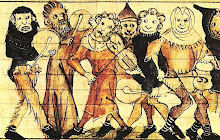
What a wonderful surprise to hear these two historians talk about the importance of last month's "Lizzo and the Crystal Flute" moment, and so much more.
You can listen through this link to this episode of "Now and Then" called The Meaning of Madison's Flute: Who Owns Music?
Wednesday, October 12, 2022


Tuesday, October 11, 2022
Dvořák Opus 100 in Beijing!
I love this performance by the Beijing RMO Chamber Orchestra of my arrangement of the first movement of Dvořák's Opus 100 Sonatina!
Progress and Regress
Is a certain amount of regress necessary in order to make progress? Does working really hard at things that are difficult involve more failure than success? Does the inner critic grow on its own, when we are (or I am) not paying attention? Should I show her the door, or should I endure her presence until she tires of me and leaves on her own?
I have read that repetition in play is more effective for learning than repetition in work. But a state of play is really difficult to generate when you are hard at work trying to teach your brain to connect itself to the movements of your hands and fingers on an instrument that you didn't learn to play in childhood.
I have read that repetition in play is more effective for learning than repetition in work. But a state of play is really difficult to generate when you are hard at work trying to teach your brain to connect itself to the movements of your hands and fingers on an instrument that you didn't learn to play in childhood.
Saturday, October 08, 2022
Changing the feed for this blog
For anyone who likes to read this blog via RSS (which means "really simple syndication"), I'm changing the feed (so it will work). Please add
https://musicalassumptions.blogspot.com/feeds/posts/default
to your reader. Thank you.
https://musicalassumptions.blogspot.com/feeds/posts/default
to your reader. Thank you.
Friday, October 07, 2022
Squeaky wheels, and trying to move forward
All of a sudden, with musical life returning to a degree of perceived normal, I find myself looking "back" at communicating by way of the internets.
Musical life and musical tastes have changed since those rec music newsgroups organized themselves into free forums for discussion among musicians. In those golden days of text-only communication it was possible to develop correspondences and grow friendships with like-minded people who it would be impossible to get to know in normal place-bound and class-bound life.
Then the blogosphere emerged, and it was a kind of paradise. I loved reading blogs by the musicologists who posted their unpublished papers from graduate school. I also loved reading posts by performing musicians and composers who wrote about their experiences with certain pieces of music, their daily lives, and their personal reflections on things musical.
Everyone was Ned Rorem until many would-be diarists found that keeping up a public diary requires a lot of work and commitment, and is usually done without compensation, unless you are Ned Rorem, and had early success with publication.
I started this blog as a way to connect and communicate about things musical with people who lived outside of the forty-mile listening area of mostly-rural Illinois covered by the radio station I used to work for. I made my first post in 2005. This is my 2970th post. I have never monetized this space, and never intend to. I have made the occasional post linking to something I have had published, but I do it only rarely, and I do it without expectation. Most of the links I post for music I have written go to entries in the IMSLP.
I have written a lot of music and made many arrangements. To date I have made 344 entries in my Thematic Catalog blog. Some entries are for individual pieces, and some are for sets of pieces. I am happy with much of the music. Some of it seems to be popular among musicians, and some of it doesn't. I have heard that audiences like music that I have written, which is always nice to hear.
But I just don't seem to have the kind of squeaky-wheelness to promote my work that I see from composers on Facebook. And I tend to look at things realistically: there is more music of quality available now than there has ever been before. And I have resigned myself to accept that the standard solo pieces, etudes, pieces of chamber music, and orchestral music written by composers who happen to be men will always outnumber the standard solo pieces, etudes, pieces of chamber music and pieces of orchestral music written by composers who happen to be women.
Every once in a while a piece or two by a woman has made it into the standard repertoire (like the Chaminade Concertino or the Clarke Viola Sonata), but, try as I might (and try as we might), pieces written by women are still programmed more often because they are pieces by women regardless of their value as pieces of music.
There are young people (well, people younger than me) dedicated to maintaining a social media presence for Clara Schumann and Fanny Mendelssohn (or Fanny Hensel), and excellent pianists who specialize in only performing music written by women. But I fear that these are flickers of a movement that won't flame unless there is a constant bellows (and many squeaky wheels) keeping them in the public eye.
There have been some baby steps taken towards "legitimacy" for music written by women: Ethel Smyth has finally had twenty-first-century performances of The Wreckers that have been noticed, written about, attended, and enjoyed. It would be great if it remains in the repertoire. The same with works by Pauline Viardot, who many people have come to know during the past two years.
For two years during the pandemic, when I connected with musicians on Facebook again, I found that my work was indeed useful for musicians who needed new music to keep them occupied. I had time, energy, and a sense of purpose, so I wrote a lot of solo music and music that could help connect musicians who were isolated from one another before vaccinations and good masks helped make rehearsals and concerts possible again.
While I believe that I have done my best work, it doesn't seem important at all (anymore) in the larger world of music. There is so much music readily available that is so much better than what I am capable of writing. And while I continue to grow as a musician, and am able to understand and appreciate more fully the compositional strengths of Johannes Brahms, Wolfgang Amadeus Mozart, Johann Sebastian Bach, Franz Schubert, Franz Josef Haydn, and, yes, Georg Philipp Telemann (all men, all dead, all European, all white, all Germanic), the work I have done seems rather insignificant. And for that reason I don't have it in me to use the squeaky wheels of Facebook and Twitter to promote my work the way I see other composers promote their work.
I think it will be a while before I write something new. Unless somebody asks me to. But I'm not holding my breath.
Monday, October 03, 2022
More About Lizzo and that Crystal Flute
My experience with Lizzo is probably typical of people of my age that occupy my usual musical world. It is also atypical, since I spent quite a bit of time playing the flute.
I first encountered Lizzo in a DIY video showing how you can transform a Barbie Doll into Lizzo, but I had no idea who Lizzo was. I did learn a few crafty tricks, though.
The next encounter was when she hosted Saturday Night Live, and played the flute. I rarely watch Saturday Night Live, and don't know most of the guest hosts, but I found Lizzo delightful.
When Lizzo played the few notes that the writers of the show allowed the audience to hear her play on the flute, she played them extremely well. I had a secret wish that she might use her celebrity to give a "traditional" flute concert somewhere, and let people know that there is something "there" in what consumers of popular culture often think of as an outmoded "kind" of music. I thought it would never happen. But earlier this week part of my dream came true. And it was all thanks to librarian Carla Hayden, who had the brilliant idea of inviting Lizzo to visit the collection at the Library of Congress when she was in town to perform.
You can see all the "specs" about this 1813 Claude Laurent flute as well as images of it on this page of the Library of Congress catalog.
You will notice that this flute does not have modern Boehm-system keys. And I know that it takes a long time to learn the necessary fingerings to play a pre-Boehm-system flute. Most flutists would have a difficult time with the size and shape of the emboucher hole as well. I imagine that Lizzo prepared for her moment with the instrument by practicing a great deal on a flute with a similar fingering system.
A kind person put a cellphone video of Lizzo playing the tune and a variation from the Carnival of Venice on instagram.
In addition to learning a new fingering system, Lizzo certainly had to consider ways to make her signature nails work with the wide-bored glass instrument without keys.
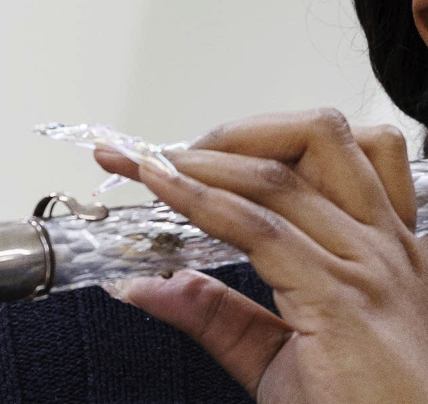
I give special "props" to the designer of her nails for this experience. Not only do her nails match the flute beautifully, but they are raised above the tips of her fingers, allowing for the full pads of the fingers to cover the holes.
I first encountered Lizzo in a DIY video showing how you can transform a Barbie Doll into Lizzo, but I had no idea who Lizzo was. I did learn a few crafty tricks, though.
The next encounter was when she hosted Saturday Night Live, and played the flute. I rarely watch Saturday Night Live, and don't know most of the guest hosts, but I found Lizzo delightful.
When Lizzo played the few notes that the writers of the show allowed the audience to hear her play on the flute, she played them extremely well. I had a secret wish that she might use her celebrity to give a "traditional" flute concert somewhere, and let people know that there is something "there" in what consumers of popular culture often think of as an outmoded "kind" of music. I thought it would never happen. But earlier this week part of my dream came true. And it was all thanks to librarian Carla Hayden, who had the brilliant idea of inviting Lizzo to visit the collection at the Library of Congress when she was in town to perform.
You can see all the "specs" about this 1813 Claude Laurent flute as well as images of it on this page of the Library of Congress catalog.
"This flute was presented to Pres. Madison by someone in France (Lafayette) as inscribed. It passed to Madison's adopted son Payne Todd; it was willed by the latter to Cornelius Boyle of Washington, D.C. and passed to his five heirs. It was purchased from them (Miss Fanny G. Boyle) for this collection. It had been exhibited in the National Museum prior to 1903." However, a letter recently found in the Madison papers at the Library of Congress documents that Laurent himself sent the flute to Madison. Letter from Claude Laurent to President Madison, 25 Mar. 1815: “A Monsieur Madison, Président des Etats Unis d’Amérique. Monsieur le Président, J’ai pris la liberté de vous adresser, il y a environ trois ans, une flûte en Cristal de mon invention. Veuillez bien me permettre de vous témoigner le desir que j’aurais d’apprendre si elle vous est parvenue & si ce faible hommage de mon industrie vous a été agréable. Je vous prie de vouloir bien agréer l’hommage de la considération la plus distinguée avec laquelle j’ai l’honneur d’être, Monsieur le Président, Votre très humble et très obeissant serviteur Laurent Quai de Givrer N° 34 Paris, le 25. Mars 1815.” Translation: “To Mr. Madison, President of the United States of America, Mr. President, I took the liberty of sending to you about three years ago, a crystal flute of my invention. Please allow me to express to you the desire that I would have to learn if it has reached you and if this feeble homage of my industry has been agreeable to you. I beg you to please accept the homage of the most distinguished respect with which I have the honor of being, Mr. President, your very humble and obedient servant Laurent Quai de Givrer N° 34 Paris, 25 March 1815.”
- Instrument type: Flute in C
- Materials: Clear glass, silver keys and ferrules, safety locks. Clear glass faceted end cap with hemispherical silver reflector behind, held in place by a silver ring.
- 4 sections. Clear glass exterior of recessed diamond-shaped faceting except at embouchure.
- Key Holes System: 4 keys, round flat curved flaps, post and rod on silver flanges.
- Mark Maximum: Laurent / à Paris, / 1813. (cursive)
- Mark Additional: Mark on lower body. Mark on head: A.S.E. James Madison / President des Etats=unis.
- Condition: Safety bracket detached from head joint ferrule.
- Provenance: Estate of Cornelius Boyle, Miss Fanny G. Boyle, Washington, D.C., 6 Nov. 1923. - Location: Whittall. When not on display, belongs in M16, where box and catalogue card are located.
- In English. (language)
- DCM 0378 (dcm)
You will notice that this flute does not have modern Boehm-system keys. And I know that it takes a long time to learn the necessary fingerings to play a pre-Boehm-system flute. Most flutists would have a difficult time with the size and shape of the emboucher hole as well. I imagine that Lizzo prepared for her moment with the instrument by practicing a great deal on a flute with a similar fingering system.
A kind person put a cellphone video of Lizzo playing the tune and a variation from the Carnival of Venice on instagram.
In addition to learning a new fingering system, Lizzo certainly had to consider ways to make her signature nails work with the wide-bored glass instrument without keys.

I give special "props" to the designer of her nails for this experience. Not only do her nails match the flute beautifully, but they are raised above the tips of her fingers, allowing for the full pads of the fingers to cover the holes.
Tuesday, September 27, 2022
French Chestnut

Monday, September 26, 2022
Audacity Updated for Monterey!
Anyone who has had to sacrifice using Audacity after updating to the Monterey operating system for the Mac can now use it again (as of today). Hooray! There is nothing like Audacity. You can download it through this link (for free). And we can all thank Michael (who just happened to be looking today).
Saturday, September 24, 2022
What Julius Baker didn't know he taught me
How can any teacher know what her or she ends up teaching a student? There is a great deal that goes on in the unconscious relationship between an adult teacher and a not-yet-fully-adult student, and my four-year-long student-teacher relationship with Julius Baker (who was born 107 years ago yesterday) mainly took place on a level far below the surface of flute playing. It was a different kind of relationship from the one (or ones) I observed he had with my peers, but then again he had a very strong psychic presence.
It was not the crystal-ball-gazing or tarot-card-reading kind of psychic presence, but rather the psychic presence you hear in his musical voice: light and airy, while at the same time filled with earth-bound gravity. A combination of the sentimental and the "no-nonsense," spinning with creativity and bound in discipline.
He was a man who was completely in love with the sound and character of the flute. He was also rather thrilled with the doors that playing the flute opened up for him. He told me once that if he hadn't played the flute, he wouldn't have gone to Curtis, and he wouldn't have gotten an education.
The beginning of my time at Juilliard coincided with Julius Baker's recovery from a life-changing heart attack. I didn't know him before the heart attack, but when I met him he was an avid jogger, and seemed to exist by eating cottage cheese and rotisserie chicken, and drinking coffee. He would send students out to get him a half chicken to have for dinner in his office on concert days. Lunch would be in the Juilliard cafeteria, and he would always ask some of his students to have lunch with him in the faculty part of the cafeteria, which was filled with luminaries. Some were visiting him.
In retrospect it seems that the Juilliard teaching experience for him was entirely social. It gave him a nice place to be on concert days when he had a rehearsal in the morning and a concert in the evening in return for what was probably a very low salary and low expectations from the administration. People would always come to Juilliard to study with him, and he had the knack of "smelling" talent. And those with ambition (everyone seemed to have ambition) would succeed with minimal intervention on his part.
[When I first met him he called me "a diamond in the rough." I was just sixteen, and had no idea what it meant, so I asked him. Later in our student-teacher relationship he said something about playing something "in your own inimitable way." It was another new word for me.]
He liked to learn about the "extra-flute" interests of his students, and liked to meet our friends. I introduced him to a singer friend of mine, a very smart woman who had gone to Yale and introduced me to "The Waste Land." She said that he WAS the god Pan. And he used to say that his name in Spanish was Julio Panera.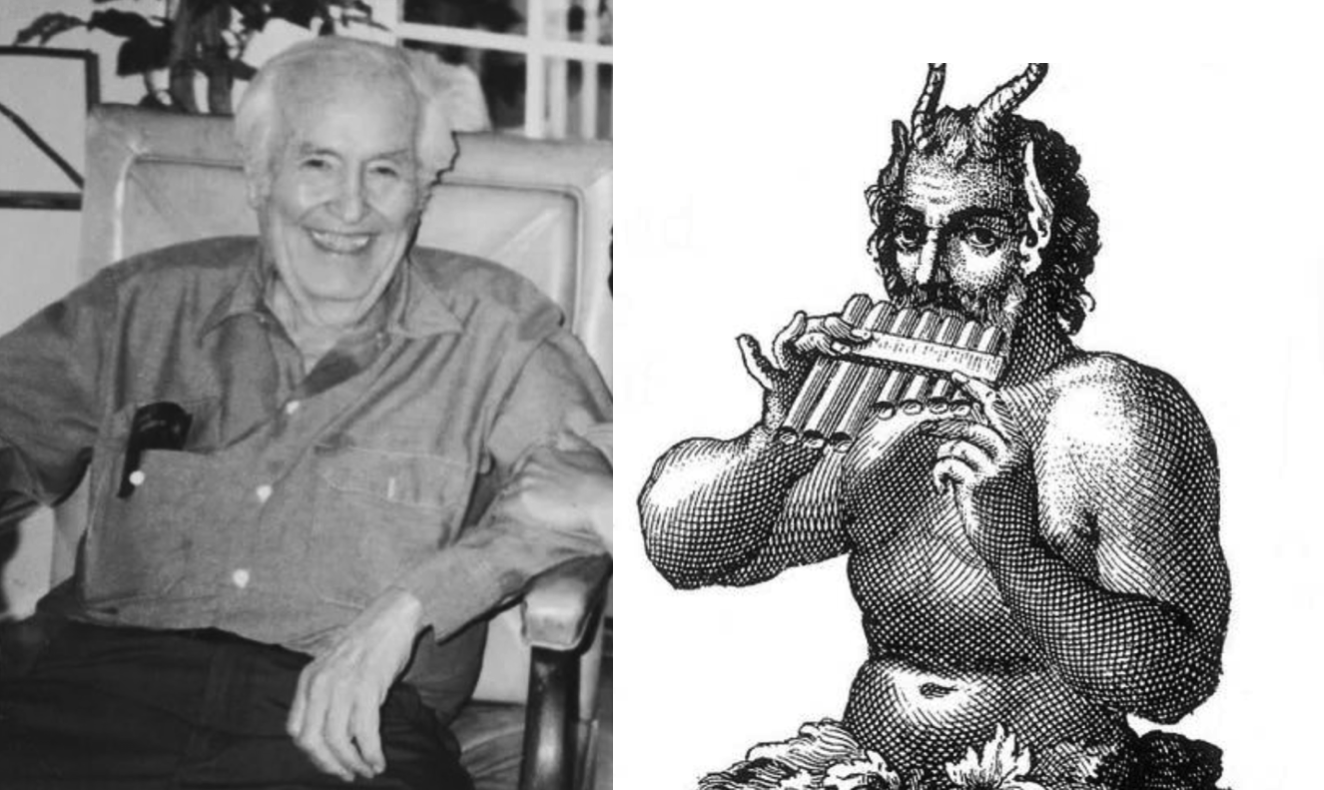 Julius Baker used to tell his students to listen to Heifetz recordings. I'm sure that most of them did, but try as I might (and I tried with all my might) I could not get my flute to sound like a violin or to sound like Heifetz. I listened to the whole of the Heifetz collection that was available during the late 1970s with my friend Danny Morganstern, and became obsessed with the Saint-Saëns D minor Sonata, which I transcribed for flute. None of my flute colleagues were impressed. And I think that Julius Baker knew that I was really a violinist at heart. The only thing I remember him saying about the Saint-Saëns (which I brought to a lesson because I was preparing it to play on a recital) was asking the question, "Why are you always playing Salon music?"
He was a man who was completely in love with the sound and character of the flute. He was also rather thrilled with the doors that playing the flute opened up for him. He told me once that if he hadn't played the flute, he wouldn't have gone to Curtis, and he wouldn't have gotten an education.
The beginning of my time at Juilliard coincided with Julius Baker's recovery from a life-changing heart attack. I didn't know him before the heart attack, but when I met him he was an avid jogger, and seemed to exist by eating cottage cheese and rotisserie chicken, and drinking coffee. He would send students out to get him a half chicken to have for dinner in his office on concert days. Lunch would be in the Juilliard cafeteria, and he would always ask some of his students to have lunch with him in the faculty part of the cafeteria, which was filled with luminaries. Some were visiting him.
In retrospect it seems that the Juilliard teaching experience for him was entirely social. It gave him a nice place to be on concert days when he had a rehearsal in the morning and a concert in the evening in return for what was probably a very low salary and low expectations from the administration. People would always come to Juilliard to study with him, and he had the knack of "smelling" talent. And those with ambition (everyone seemed to have ambition) would succeed with minimal intervention on his part.
[When I first met him he called me "a diamond in the rough." I was just sixteen, and had no idea what it meant, so I asked him. Later in our student-teacher relationship he said something about playing something "in your own inimitable way." It was another new word for me.]
He liked to learn about the "extra-flute" interests of his students, and liked to meet our friends. I introduced him to a singer friend of mine, a very smart woman who had gone to Yale and introduced me to "The Waste Land." She said that he WAS the god Pan. And he used to say that his name in Spanish was Julio Panera.

I don’t remember what my response was. I don’t know if I would have known what salon music was at that point.
Now, in retrospect, I really have to thank him for recognizing that I was not really a flutist, but rather a musician with a flute who tried her very best to make the most of what sometimes felt like a life sentence. I felt that I had failed musically (and intellectually) at everything else: I stopped playing violin as a child for dumb child-like "reasons," I couldn't play piano (maybe lessons might have helped), I couldn't sing (again, maybe lessons might have helped). But flute was easy for me, and easy, for me, doesn't mean much of anything.
There are people, like Julius Baker, and like my successful colleagues and friends who love playing the flute, for whom the flute is everything.
I am a person who likes to work hard at things that are really important to me. Things that come easily stay on the emotional surface for me. They always have, and they always will. And I have my experiences with Julius Baker to thank for eventually learning that playing the flute was indeed not important for me. And I have him to thank for finding my musical "home" in playing violin and viola, and writing music.
Friday, September 23, 2022
Leo Tolstoy, Guest Blogger
Tolstoy takes us to a concert for chapter five of the seventh section of Anna Karenina. The piece Konstantin Dmitrievich Levin hears seems to be a version of this piece by Balakierv:
.
At the concert in the afternoon two very interesting works were performed. One was a fantasia, King Lear in the Steppe; the other was a quartet dedicated to the memory of Bach. Both were new and in the modern style, and Levin was eager to form an opinion of them. After escorting his sister-in-law to her stall, he stood against a column and tried to listen as attentively and conscientiously as possible. he tried not to let his attention be distracted, and not to spoil his impression by looking at the conductor in a white tie, waving his arms, which always disturbed his enjoyment of music so much, or the ladies in bonnets, with strings carefully tied over their ears, and all these people either thinking nothing at all or thinking of all sorts of things except the music. He tried to avoid meeting music connoisseurs or talkative acquaintances, and stood looking at the floor straight before him, listening.We are reading the Modern Library Classics edition translated by Constance Garnett, and revised by Leonard J. Kent and Nina Berberova. This edition is hard to find in paperback, but I bet your public library has a copy or two. I love reading this novel. I know that it doesn't end well for the title character (perhaps the only things most people know about the book are the opening sentence and the ending), but what lies in between is a fascinating, engaging, maddening, heart-wrenching joy to read. I'm sorry that we are so near the end.
But the more he listened to the King Lear fantasia, the further he felt from forming any definite opinion on it. There seemed to be a continual beginning, a preparation for the musical expression of some feeling, but it fell to pieces again immediately, breaking into new expressions of emotions, or simply into nothing but the whims of the composer, exceedingly complex but disconnected sounds. And these fragmentary musical expressions, though sometimes beautiful, were unpleasant, because they were utterly unexpected and not prepared for by anything. Gaiety and grief and despair and tenderness and triumph followed one another without any connection, like the emotions of a madman. And those emotions, like a madman’s, sprang up quite unexpectedly.
During the whole of the performance Levin felt like a deaf man watching people dancing, and was in a state of complete bewilderment when the fantasia was over, and felt a great weariness from the fruitless strain on his attention. Loud applause resounded on all sides. Everyone got up, moved about, and began talking. Anxious to throw some light on his own perplexity from the impressions of others, Levin began to walk about, looking for connoisseurs, and was glad to see a well-known connoisseur in conversation with Pestsov, whom he knew.
“Marvelous!” Pestsov was saying in his mellow bass. “How are you, Konstantin Dmitrievich? Particularly graphic and sculpturesque, so to say, and richly colored is that passage where you feel Cordelia’s approach, where woman, das ewig Weibliche, enters into conflict with fate. Isn’t it?”
”You mean . . . What had Cordelia to do with it?” Levin asked timidly, forgetting that the fantasia was supposed to represent King Lear.
“Cordelia comes in . . . see here!” said Pestsov, tapping his finger on the satiny surface of the program he held in his hand and passing it to Levin.
Only then did Levin recollect the title of the fantasia, and made haste to read in the Russian translation the lines from Shakespeare that were printed on the back of the program.
“You can’t follow it without that,” said Pestsov, addressing Levin, because the person he had been speaking to had gone away, and he had no one to talk to.
In the entr’acte Levin and Pestsov fell into an argument upon the merits and defects of the Wagner school of music. Levin maintained that the mistake of Wagner and all his followers lay in their trying to take music into the sphere of another art, just as poetry goes wrong when it tries to paint a face, which is what should be left to painting, and as an instance of this mistake he cited the sculptor who carved in marble certain shadows of poetical images floating around the figure of the poet on the pedestal. “These shadows were so far from being shadows that they were positively clinging to the ladder,” said Levin. The comparison pleased him, but he could not remember whether or not he had used the same phrase before, and to Pestsov, too, and as he said it he felt embarrassed.
Pestsov maintained that art is one, and that it can attain its highest manifestations only in conjunction with all kinds of art.
The second piece that was performed Levin could not hear. Pestsov, who was standing beside him, was talking to him almost all the time, condemning the music for its excessive affected assumption of simplicity, and comparing it with the simplicity of the Pre-Raphaelites in painting. As he went out, Levin met many more acquaintances, which whom he talked of politics, of music, and of common acquaintances. Among others he met Count Bohl, whom he had utterly forgotten to call upon.
“Well, go at once, then,” Madame Lvova said when he told her; “perhaps they’ll not be at home, and then you can come to the meeting to fetch me. You’ll find me still there.”
Monday, September 19, 2022
Summer Music for Viola and Piano (Before Summer is Over)
I was planning to play this piece as part of a local concert yesterday (for which I made the last post's baton), but my pianist friend was unable to play, so Summer Music (in its transcription for viola and piano) was left off the program. Today, before the gates of summer are closed (and before the vaccines I got made me woozy), I made a video.
A new operating system on my computer has forced me to learn to use some unfamiliar technology, but I was happy that, with a great deal of trail and error, I was able to get the human-generated viola playing track and the computer-generated piano track lined up. I hope you enjoy the resulting (slightly imperfect) recording.
You can find the music on this page of the IMSLP.
Thursday, September 15, 2022
Need a Baton in a Pinch? Here's a DIY Solution


I cut the cork in half, and cut out a groove in both halves.

Then I stuck the hair and a bit of the ferrule between the cork halves, applied some glue, and secured the handle parts together with some rubber bands.

I was planning to sand it, but it looks and feels really good as is! Total cost? $4 for the paintbrush. Corks are, of course, priceless.
Tuesday, September 13, 2022
What I Have Learned from Practicing the Piano
I am not a piano native. I knew where the notes on the keyboard were when I was a child, but never learned to play without looking at my fingers. I could always instinctively "find" tunes on the piano, but, even though I intellectually understood harmony, could never "feel" the shapes of chords and produce them by instinct on the piano. The pathways between my ears and my hands, arms, eyes, and fingers have been forged in different directions.
When playing flute and recorder the fingers of both hands need to cooperate in order to make pitches with the air (and the mouth, diaphragm, and tongue). Both hands work as equals supporting the instrument, covering the holes with the fingers, or pressing the keys. When I played flute and recorder exclusively my hands felt the same: same weight, same temperature, same sense of feeling in my fingertips.
As soon as I reconnected with my childhood string-player self (when I was thirty-one or so), I noticed that my hands started to feel different from one another. They have always been different sizes (my left is bigger than my right), but now, after thirty-odd years of playing as an adult, my left hand has a broader palm, and a whole lot more veins. The air around each of my hands feels different, and even as I type the sensitivity of my fingertips feels different. My left hand is a whole lot heavier than my right.
I have been practicing the piano with the intention of becoming a better pianist for a few years now. For the past year or two I have been practicing every day, and I am finally beginning to see (and hear) results. For the longest time I felt like I was clearing space in my brain to focus right and left (the way one clears brush). Trusting distances and the size of intervals (which do not change from octave to octave on the piano) always felt random. I felt no real connection to the piano as something to make living musical phrases on, though I certainly wanted to. But these things can't be forced. My adult growth as a string player has taught me that. Basics are everything, and paying attention to basics from the vantage point of physical ability on an instrument is an entirely different experience from paying attention to basics when learning to play a new instrument.
I now am starting to feel that my hands can work in concert with one another. (Not the "concert" that means playing for people--that is not one of my piano-playing goals.) I can play chords as chords, and do not have to think about them as stacks of individual pitches. I'm starting to be able to make physical phrases by allowing the weight of my hands guide the notes, and I am starting to feel that my fingers are more connected to my ears. I have also built up a greater awareness of the piano fourth finger, which I used to avoid using. And I can finally trill with my right hand while playing an Alberti bass with my left hand.
And, most surprising of all, when I sit down at the piano to play a Mozart Sonata and listen in my head for the first note, it is often right. It doesn't work for me when I am sitting elsewhere or doing something else, or trying to produce a pitch out of thin air.
This has happened occasionally when I am holding a violin or a viola, and used to happen with the flute, but never with the piano. Never until now. I wonder if it has something to do with temperament, which makes keys (meaning tonalities) on the piano have colors that are different from other keys (tonalities) on the piano.
It is such a gift to be able to grow as a musician in a new way, and spending quality time with Mozart (my current piano pal), Haydn, Bach, and Beethoven. Schubert is in the far distance, behind the mountains of Chopin, the Schumanns (Clara and Robert), and the Mendelssohns (Fanny and Felix).
Wednesday, September 07, 2022
A Star is Born, Sometimes

Monday, September 05, 2022
Musical Detachment
I saw a video the other day in the musical corridors of Facebook that seems to have been taken down. I'll describe it. Imagine, if you will, a three-year-old child playing the Suzuki Book Two version of "Witches' Dance" remarkably well in tune, with a beautiful left-hand position, an excellent bow arm, and a decent sound. (There's a wrong pitch, but I think that it is probably hard-wired into the teacher as well as the student--it's a common error). The child is wearing a very cute dress, and there is a blue potty in the background. Her playing is absolutely mechanical.
She is crying her eyes out while she is playing. The deep emotions that she is feeling do not make it in any way, shape, or form into what is coming out of her instrument. It is really painful to watch. And it is painful to think that any parent would, first of all, take a video of a child feeling so distressed while playing, and then share it with the larger world. I wonder if this was put into the internets as a form of punishment.
Using music as a way to exploration and express of feelings is the main reason to play (or sing). Actually, it is the only reason for me. I can imagine that there are people who get enjoyment out of doing things right. There are people who like playing because of the praise or attention they get. And there are people who get motivated to play so that they can communicate with others in a way that doesn't involved conversation, kicking or throwing a ball, or dancing.
If this child is already so disconnected from her feelings when she plays, I wonder how difficult a time her future teachers will have teaching her to connect her feelings with her playing.
Subscribe to:
Posts (Atom)