Wednesday, August 17, 2022

Suzuki: The Man & His Dream to Teach the Children of the World

Suzuki: The Man & His Dream to Teach the Children of the World 
Eri Hotta
Harvard University Press [240 pages] 
For release November 15, 2022

Eri Hotta is a historian who specializes in writing about world events from a Japanese perspective, and this book about Shinichi Suzuki (1898-1998) is as much a book about Suzuki’s life and work as it is about, culture, business, and education in the twentieth century.

Shinichi Suzuki’s family was part of the Samurai class, the top six percent of Japan’s population. Shinichi's father, Masakichi Suzuki, owned a violin factory in Nagoya, and Shinichi was one of thirteen children that Masakichi had with his wife, Nobu, and his mistress, a geisha named Ryo (Ryo was Shinichi’s mother).

The family was cultured and literate, and Shinichi enjoyed reading works of Tolstoy, Francis Bacon, and Benjamin Franklin, and he also enjoyed reading about Shushogi Buddhism. Shinichi helped out in his father's violin factory as a child, but didn’t fall in love with the violin until, at the age of seventeen, he heard a phonograph recording of Misha Elman. Suzuki taught himself to play by immitating Elman's playing, and then took lessons from Ko Ando, who had studied in Berlin with Joseph Joachim.

A wealthy family friend paid for Shinichi to go traveling around the world, and he ended up staying in Germany. He lived there during the best years of the Weimar Republic, and he lived well because the Yen was strong against the German Mark, and great violin playing was everywhere. Suzuki became friends with the fellow violinist and music lover, Albert Einstein, studied privately with Karl Klinger, and married a German woman named Waltraud Prange. The one available recording of Suzuki from that period shows that he was a respectable violinist. And it seems from all accounts that he was a lively and charismatic person.

Shinichi returned to Japan in 1928 and formed a string quartet with three of his brothers. It wasn’t until the 1930s that Shinichi needed to work for a living, so during the Great Depression, which started the Showa Depression in Japan, he began teaching. He started working with teenagers, and was fortunate to have the chance to get to know the twelve-year-old Nejiko Suwa, a great violinist, who was the daughter of music-loving parents who participated directly in their daughter’s study. From observing this family, he decided that parental involvement was key to musical development. This is not a new idea, but it was a new idea for Suzuki, who wanted to change the the world through music.

As a beginning teacher he made things up as he went along. Through a mixture of will, trial and error, devotion to his mission, and personal dedication, he had success. He also had the great fortune to work with young people who loved music as much as he did, and was able to realize his vision of a applying a kinder way of teaching than the authoritarian model he would have witnesed in Germany. He also believed that playing music was something that should be experienced by everyone, not just the “gifted,” and believed that anyone could develop musically to the best of his or her ability, as long as the learning environment was filled with love. He believed that teaching with love should be used for areas outside of music too.

He started teaching violin to very young children because he could. His brother ran the family's violin factory, and was able to produce large numbers of fractional-sized violins for the smallest children. It was a beneficial situation for all involved.

Eri Hotta’s account of post World War II Japan is remarkable. I was particularly moved by her image of Shinichi Suzuki foraging in the mountains for edible plants to feed his family. After the war Waltraud Suzuki established herself as a businesswoman, and moved to Tokyo. She thought of Japan’s defeat as her liberation. For ten years Shinichi lived with his sister in Matsumoto, became very influential as a teacher, and was successful at “growing” a new generation of teachers. When Waltraud returned to Matsumoto, she established herself as the worldwide spokesperson for Shinichi’s “Talent Education Movement.” She used her substantial business skills to promote the movement, while Shinichi remained devoted to the work of the students who used his method. Deep into his old age he listened every night to tapes of the Suzuki repertoire that children sent him, and he returned the tapes with his own hand-painted and signed watercolor certificates. By the 1970s, through Waltraud’s hard work, Suzuki's name was a major “brand” in American musical education. Now it is ubiquitous.

Reading Eri Hotta’s beautifully written book about Suzuki's life in relation to twentieth-century Japan, early-twentieth-century Germany, and later twentieth-century America, is a tremendous pleasure. Hotta is a great historian, an excellent writer, and has significant personal experience with music and with the Suzuki Method. She is the perfect tour guide. I would recommend this book to every twenty-first-century musician, anyone interested in Japanese culture and history, and any teacher of any subject, in any country of the world.

It is available to pre-order from Amazon.

Monday, August 15, 2022

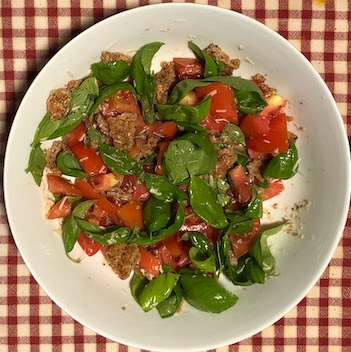
If I could only post the flavor . . .

Words and pictures fail, but I'll do my best:

Some fresh tomatoes (brought over yesterday by a student's grandmother) cut into pieces

Some fresh basil (from a plant on the window sill)

Some good, strong, grated parmesan

Two Ryevita crackers, broken into pieces. I imagine that non-rye crackers or croutons would do, but I love these rye crackers, and think that their amazing taste in context is what makes this salad sing.

Some extra-virgin olive oil

Some white balsamic vinegar

I had this for lunch yesterday, and will have it for lunch tomorrow, and maybe even the next day.

Still more reflections from April 2020

[Part Three in a series of posts]

April 9, 2020

I have a history of being an anti-technologist. The first personal computers for home use came out in the early 1980s. I used a Displaywriter for work, so I did not have the fascination that Michael did for having one for his own use. We bought a computer for him, and a baroque flute for me. I needed to grow musically more than I needed to grow technologically. And growing musically for me meant going back to basics.

We had to return the computer because something about it didn't work, so we ended up with an electronic typewriter that had a pretty nifty memory feature, where you could store a few lines of text. Michael used that until we got an Apple //c.

I have still been on my quest to grow musically, and that growth is a slow process. I spend my practice time trying to get from one note to the next in a satisfying and meaningful way. I spend my teaching time asking my students to do the same. When they listen to what I tell them to do and do it, they sound pretty good. I think.

I say, "I think," because I can only hear them through the microphone on their phone, tablet, or computer, a signal (that is often too weak) that is transmitted up to a satellite, and delivered to me through the speakers of my iPad. But all I can really give them is feedback about their intonation and their rhythm. I can see (and hear) if their bows slide on the string, and can ask them to concentrate. I can help the beginners learn to read music, and I can advise more advanced students about playing the correct notes.

April 10, 2020

I watched and listened to a broadcast of the Bach St. John Passion from Leipzig. One singer, one percussionist, and one harpsichordist who also played organ. They were performing a good distance from one another. And then there was a chorus of five or six singers also spaced at least six feet apart. The chorales were assembled videos of singers from different choirs, who made videos of themselves from home.

It looks like we won’t need to go to the grocery store for another day or two, so we are staying home, with a forty-five minute walk. The Spring is really beautiful. The pink and white flowering trees are doing their pink and white flowering. The grass is green, and, aside from one hot day, things are still pretty cool. I made meatloaf for dinner, and that’s what we’re going to have tomorrow too. We are down to about six bottles of wine.

Bernie Sanders suspended his campaign on Thursday, and now he is trying to figure out how best to keep his “our revolution” platform going, even though he is not the candidate. I’m hoping it will work. I’m spending too much time checking Facebook, Twitter, and Gmail, and that is starting to feed my isolation. Lots of superficial contact is not equal to a little bit of substantial contact.

April 12, 2020

Michael and I watched a live-streamed violin and piano concert played by Igor Kanlin and Rochelle Sennet on the iPad today. It was the same program that we heard played in person about six weeks ago. The playing was wonderful—perhaps even better than the concert we heard before, but the audio quality of the live stream was not great. It didn’t do the playing justice at all.

I miss hearing music played in real space. The only music I hear in real time and real space is played by me.

I imagine that with all this violin practice and all this technique-building stuff I’m doing, I am getting to be a better violinist. But I’m no Igor.

We have seven cases of Covid 19 in Coles County now. I’m feeling lousy, but I don’t think what I have is Covid. But I haven’t been exposed to any germs that live outside of the house, so it isn’t another virus. Perhaps it is just stress-induced vertigo combined with some aches and pains from practicing and not sleeping well. I had a long phone conversation with a good friend today. I think using the phone to talk to people is a good thing.

April 15, 2020

Yesterday, after a FaceTime lesson, my student’s mother told me that the mother of another of my students, whom she knew from a student recital back in February, was one of the first two people diagnosed with Covid19 in the county. She is apparently recovering well, but I haven’t heard from her personally (I sent a text message yesterday). I had played with my student (her daughter) at a family funeral on March 13 (and wrote about it in my first entry). I’m not quite sure how the math works, but, with the number of people (many from out of town) who came to the funeral, it is possible that she caught the virus there. Or, since she had what appeared to be a cold, she might have had the beginnings of her disease then and there.

I kept my distance from my student's mother, but, since I was playing with my student, was unable to keep distance from my student. I certainly hope that the rest of the family is OK.

I have been dealing with dizziness (vertigo) for about a week now. I don’t know if it is my reaction to having the virus, but I think that it might be unrelated. Michael is not sick, and I feel tired and dizzy, but basically well.

April 17, 2020

I have been spending the last few days hard at work on a “Birthday Piece” for viola d’amore and piano. I have been doing this every year for the last twelve years, and now that I have reached a nice round number, both in number of pieces and in age (I’ll be 61), I’m finishing the set. Today I’m going to try to make a video recording of it with viola d’amore and computer-generated piano.

I gave myself a haircut today (I did the front, but Michael did the back) so I look a little less of a mess, so now all I have to do is play well on an instrument that I haven’t actually practiced on in a long time. I use it as a viol for collegium, but don’t really have to use its chromatic powers for that.

April 21, 2020

It is a beautiful day in Charleston, and I will spend some of it outside mowing. The rest I will probably be spending inside practicing or reading. Michael and I are reading Jane Eyre, which is a real delight. No news from my student’s mother, but one of the people who had the two first Covid-19 cases has recovered. I take that to be her. I’m afraid that I won’t be seeing my student again though, since her grandfather was the engine behind her violin playing, and he is no longer alive.

Maybe she will return. These are not the best of circumstances, though.

I finished my “Birthday Piece,” and find it to be dark and gloomy. I tried making a recording with viola d’amore and computer-generated piano, but it just didn’t sound right. I settled for a computer-generated one. But what can I expect. Darkness and gloom hover even though the day may be beautiful. Nature has a way of continuing to do her thing. I suppose that the virus is part of nature as well.

I’m glad that at least some of the people in the county are being sensible and not getting antsy about this “opening the state” nonsense. I don’t think I will be going anywhere without a mask anytime in the future. Not until there is a vaccine, and everyone is vaccinated.

April 22, 2020

Today was crazy town on the television. Trump held court during the dinner hours for what seemed like an eternity (it was actually around two hours—his usual time for spewing propaganda and lies). It is just one crazy claim followed by another. Saying something, and then saying the opposite. Reading prepared statements (statements prepared for him) and then ad-libbing whatever he feels like saying. He moved the person in charge of developing a vaccine elsewhere because that person said something negative about the “wonder drug” that Trump had been touting (in reality it has been proven ineffective, and has killed people who used it). And then the head of the Centers for Disease Control warned that there would be a second wave of the virus coming concurrently with the flu. Trump made him say something different for this television audience.

April 25, 2020

Trump craziness: the other day he started “ad-libbing” about treating Covid with bleach, suggesting that if it could be used inside the body to kill the virus that could be a good thing. Yes. There were people who drank bleach after he said that on television. What a sorry lot the American people are. Maybe it is just a flaw of human nature to follow a leader—even a completely crazy one.

Here, inside the house, with only the windows of the various screens to show us the outside world, we are bearing up. I have been writing violin studies—miniatures that use limited sets of notes. There will be twelve in all. I’m working on numbers four and five now. I also got a commission to write a piece for euphonium and woodwind quintet. So I have lots of things to do.

We had our first Covid-19 death on the county yesterday. I feel that we as a community all feel extremely sad, even though nobody knows who this person is, or what part of the county s/he is from. I really feel for the hospital workers who are working so hard to keep this virus contained.

Sunday, August 14, 2022

More reflections from April 2020

[Part two in a series of posts]

April 5, 2020

Today, after spending around two years away, I re-joined Facebook. Everything there was still intact, and I was able to get in instant touch with my friends from long ago and far away, and could see how they are doing in their various places of isolation. I left Facebook so that I could engage more in real life relationships—actual experiences with people, and now that such relationships are not possible I’m very grateful that Facebook is there. Wherever there is. I practiced the last two movements of Beethoven Opus 59/1 today, and will be ready to play it with a recording (my own personal Beethoven year project) by the end of the week. It is hard and high, and some parts go really fast.

Michael and I went to get gas for our mowers today, and there were more cars on the streets in Charleston than you would probably see in New York, Chicago, Boston, or Los Angeles. I learned from a Facebook friend that 53% of people in Charleston are staying home. I’m not sure where that number comes from, or how true it is. Tonight, with mask and gloves, Michael is going to pick up take-out food from El Rancherito. Our kids, who grew up eating there, are very excited. We will send pictures that they can see in their homes in Los Angeles and Boston.

April 6, 2020

I like to imagine a future where we can play music together again, but I fear that the changes that will happen in the musical world after the virus has been eradicated will be lasting. It took more than ten years for musical life in my part of the country to recover from the audience loss that happened as a result of the recession. How can we be sure that people who like to go to concerts will have the money to support performing organizations, or even buy tickets, once we are able to play concerts again?

The online professional musical possibilities for musicians are expanding, I guess. More and more people are figuring out how to teach through various video platforms. Some people boast of their great success. What if this becomes the new normal after the virus is gone? What will happen to the profound kinds of musical interactions that happen between students and teachers when they can play together and make one another's instruments vibrate because of resonance. Not being able to really hear what is coming out of a student's instrument because of the lack of high-quality reception means that I am not able to accurately tell if a solution I suggest is really working. Do other people experience this as a frustration, or am I just a fish out of water, a relic of an older kind of musical life. And now is as good a time as any for a passage from Fernando Pessoa:
I'm like a playing card belonging to an old and unrecognizable suit--the sole survivor of a lost deck. I have no meaning, I don't know my worth, there's nothing I can compare myself with to discover what I am, and to make such a discovery would be of no use to anyone. And so, describing myself in image after image--not without truth, but with lies mixed in--I end up more in the images than in me, stating myself until I no longer exist, writing with my soul for ink, useful for nothing except writing. But the reaction ceases, and again I resign myself. I go back to who I am, even if it's nothing. And a hint of tears that weren't cried makes my stiff eyes burn; a hint of anguish that wasn't felt gets caught in my dry throat. But I don't even know what I would have cried over, if I'd cried, nor why it is that I didn't cry over it. The fiction follows me, like my shadow. And what I want is to sleep.

[Section 193 of "A Factless Autobiography” from The Book of Disquiet translated by Richard Zenith]

Friday, August 12, 2022

Reflections on life during the pandemic

As the larger world is aiming towards a post-pandemic mindset, I find myself thinking back over how I spent the past couple of years, and the way the early months of what some people referred to as "lockdown" gave me a great deal of incentive to work hard at my various musical crafts. Even though my local musical activities came to a virtual standstill, I felt like I had a lot of meaningful musical contact with people online, and I got a taste of how important musical communication is, even if it is not happening in real time.

Our university library asked people in the commmunity to keep a diary for the six months between March 13, 2020 when the first cases of Covid came to downstate Illinois, and the end of November 2020.

I was a pretty faithful writer, and my journal (all seventeen pages of it) is available to read through the university website. I am both surprised and not surprised that out of the whole university community only five people submitted journals. Four of them were students (and one is a violinist).

I posted some of the entries I made in this journal in "real time" as blogposts, so I haven't duplicated them in this series of posts:

April 3, 2020

By the academic year of 2019, musical life in Central Illinois had finally lost the shackles of the Great Recession, and concert attendance was up, participation in music ensembles was up, and the number of young people studying stringed instruments was up. In Charleston we were at a kind of “golden” spot where the performing organizations connected with Eastern were increasing in quality. The concert series at Doudna, which included excellent out-of-town musicians and excellent faculty musicians (finally, we have a faculty filled with people who really can play—and sing), was impressive. Between playing with the Champaign-Urbana Symphony, the Eastern Symphony, and the new Eastern Camarata, my schedule of orchestral playing in March and April was packed. I play in a Renaissance and Medieval ensemble, the Charleston Consort, that was planning on playing a concert of Senfl in June, and play in a string quartet, the Wild Indigo Quartet, that was planning a concert of Haydn Quartets in April. It was going to be our first concert together. My viola and piano duo with John David Moore had a concert of Irish music scheduled on St. Patrick’s day, and another concert on May 29th of music by Smyth, Bosmans, and Barns as part of Women’s History and Awareness Month.

On Friday afternoon, March 13th I played with a student at her grandfather’s funeral. We were already wary that the virus might be lurking, but since no cases had been reported in the county, people were still hugging one another. I kept my distance, but observed a rather loud man in his 60s proclaiming, as he hugged the widow, “Everyone’s going to get it anyway.”

Later that evening the first case of Covid-19 was reported at Sarah Bush Lincoln Health Center. The infected person, who lived in Cumberland County, was told to stay isolated at home. The next morning John David Moore and I thought it would be best to postpone our March 17th concert.

By the middle of the next week all concerts had been cancelled. Spring break was extended for an extra week, and then university students were told not to return to campus. Our governor closed all the public schools.

Restaurants were only open for take out. Banks did all their business through drive-up windows.

I started teaching all my lessons via FaceTime on March 15th. My students, who didn’t have any activities outside of schoolwork that they were doing at home had time to practice. The struggles I have with remote teaching (having to evaluate sound through computer microphones, having the signal cut out from time to time, not being able to play with my students, having to rely on them to write fingerings and bowings in their music) are kind of balanced by the fact that they are all spending serious time with their instruments, and are making improvement.

It is hard to plan for the future musically. Our Summer Strings orchestra, which was going to begin the last week in May, will not be happening this year. People of all ages from all over the area (some drive more than an hour to Charleston) look forward to Summer Strings as a way to play music together. Terry Coulton and I always enjoy having the chance for our students to play together with other people for fun, without the pressures of performing in solo recitals. This is the first time in more than ten years that Summer Strings will not be happening.

There were also concerts scheduled around the world of pieces I have written. One was a premiere in Chicago of “Nuit de Vielle” played by the people I wrote it for. I was also supposed to be given an award for things I have done in the community musically by the Coles County Arts Council. Everything was cancelled.

My Downstate Strings Quartet has weddings scheduled for July, September, and October. We don’t know if any of these will be possible.

I have been spending my time doing what I normally do, but with some modifications. I don’t have the heart to practice viola, so I have been practicing violin. I have been fairly disciplined in my practice, working on solo Bach, Rode Etudes, and the first violin parts of the Beethoven Opus 18 Quartets. I have written one piece for string quartet, and, at the request of a friend in Italy, made an arrangement of the Finale of Tchaikovsky’s Sixth Symphony for string sextet. I made arrangements for solo viola of “Amazing Grace” and “Scarborough Fair,” for the March 13th funeral, and I made those, along with the string quartet piece and Tchaikovsky arrangement, available in the IMSLP. Michael and I continue to read together every day. We see our children and grandchildren via FaceTime. We take a two or three mile walk every day. Michael talks to his mother on the phone every day, does the crosswords, and makes daily posts on his Orange Crate Art blog. We watch movies together, and try to only watch a little of the news on television. We both read the New York Times and spend more time online than we normally would. Many members of our family live in areas that are densely populated, and, in spite of the fact that they are diligent about remaining safe, we still worry.

The actions of our federal government are shameful. We feel helpless to have the fate of so many in the hands of people who stretch the meaning of incompetence and personal greed to new lengths. And they seem to do it daily.

The Illinois map of Covid-19 activity is filling up quickly, but Coles County is still free of the virus. It is probably because (for the most part) people have been keeping their distance when outside, and staying home as much as possible. Michael and I have the leisure to do so since we are both retired and our expenses are low. It is strange to observe just how little money we spend these days. We have gone to the grocery store once since March 13th, and spent $250.00 or so on groceries. We have a full tank of gas in our car, and will need to get some gas to fill our mower soon. We get take-out once a week from the Thai restaurant, and are planning to get take-out form El Rancherito on Sunday. We hope that we can help keep these businesses solvent. We give them big tips.

I made some face masks for Michael and me to wear next time we go to the store, which might happen in the coming week, and I made one for our son Ben in Boston, which I put in the mail today.

So I’m up to speed for the day. I started working on the Bach Chaconne this morning, so I think I’ll go back to it this afternoon.

April 4, 2020

It’s odd the way you look at objects in a time of crisis. Last night I saw a video about how to make a very simple face mask out of a normal bandana and two rubber bands. I showed Ben how to do it (Michael made a video) so that if he wanted to go out this weekend, before the mask I sent to him yesterday arrived, he could. Today I noticed that one of my favorite linen shirts had sprouted holes. I immediately thought about using it as mask material, but the weave of linen is to loose to be effective. I threw it away. Yesterday the president made an announcement about the CDC recommendations for everyone wearing masks, whether they feel sick or not. He said that he wasn’t going to wear one. I will wear mine proudly in defiance of him.

Practicing the Bach C major solo sonata this morning was very rewarding. So often, in times of playing concerts, practicing is about learning a specific set of pieces in order to play it, at a minimum, correctly and at a maximum beautifully. Sometimes it means staying in shape between concerts and rehearsals so that when the onslaught of work comes, you don’t injure yourself.

But practicing in a time where there are no concerts in the foreseeable future is different. Practicing becomes more of a means to a personal end. A chance to have some satisfaction and personal/musical happiness. A chance to accomplish something—to finally actually practice passages that have bothered me for years. A chance to feel the pleasure of being able to play Bach, and have it sound good—as if all the years I have spent practicing have brought me to this time and this moment.

I heard a comedian on the radio today who said that really dark comedy about the Coronavirus is healing for a lot of people, because it makes them laugh, and thus gives them some “dopamine squirts.” Watching someone laugh is not the same as laughing yourself. Watching or listening to someone play, no matter how beautiful it is, does not give me the same pleasure as playing myself. I am so thankful to Bach for giving us musicians this way to make daily affirmations about how valuable for our sanity his music is.

Wednesday, August 10, 2022

sdawkcab gnicitcarp (practicing backwards)

Molly Gebrian, a terrific violist and a superb teacher (of subjects musical as well as subjects neuroscientific) talks about the way the brain processes patterns after doing an activity. After playing a series of pitches, for example, the brain will play that series back many times, and at a super-high speed. If you make an intentional pause for ten seconds or so in your practice, it gives the unconscious mind a chance to work through the pattern. This time of inactivity is apparantly where the actual learning takes place. It is as if the mind gets a chance to separate itself from the body in order to work out the most efficient way of executing the pattern at hand.

The brain plays the pattern in a backwards direction as well. Molly says that nobody knows why. So I have been trying to think of reasons why the brain would do such a thing.

My friend and teacher Danny Morganstern taught me to practice passages both forwards and backwards on the viola and the violin, and I find that doing so really helps me "hear" with my left hand, which helps make my intonation more secure. I do it with my students too, and it works wonders.

Today, after considering that nifty Haydn Minuet from the 26th Piano Sonata, I posted about the other day, I gave practicing backwards on the piano a try. I combined it with Molly's ten-second pause, so my backwards playing would "play" forwards in my brain while I was resting between repetitions. (I did it with a different piece, since the A Major Minuet makes complete musical sense both ways.)

It is quite challenging to do with two voices, particularly because flipping the rhythms so that the beginnings of notes sound together complicates the task. Anyway, when I played passages forwards after playing them backwards, I found that it was much easier to play accurately than before I did my two-handed backwards practice.

I wonder if our brains are "wired" to backtrack when we make a journey so that we can find our way home. I have, particularly while walking in the woods, found myself recognizing landmarks on a return trip that I didn't particularly notice on the forward trip. Isn't a musical journey through passages of pitches similar to a journey through physical space?

Also, when we build or assemble things like houses, clothes, or machines, we sometimes need to take them apart in order to clean them, repair them, or simply figure out how they work. We sometimes have to reverse our steps when we are trying to locate a lost object, and it is often not as difficult to do as we might have anticipated.  

Monday, August 08, 2022

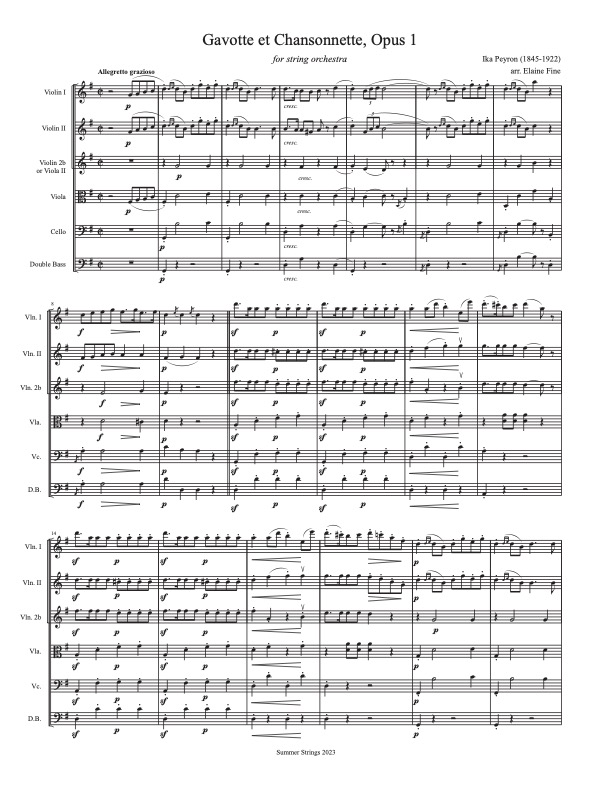
Ika Peyron Gavotte et Chansonette

The Swedish composer Ika (Fredrika) Peyron (1845-1922) began her musical life as a pianist. In 1865 she married a merchant who became a Member of Parliament, and lived in Stockholm with him and their three sons. She studied piano, harmony, and counterpoint, and wanted to compose, but found little encouragement because she was a woman. During the 1870s attitudes towards music written by women had changed (as evidenced by the carer of Amanda Maier), and Ika Peyron devoted her time to writing and performing her music in the Stockholm salons.

She wrote songs, music for violin, and mostly music for piano. Altogether we know of forty pieces.

This charming Gavotte et Chansonette, her Opus 1, works very nicely for strings. A PDF of this arrangement (as well as the piano original) is available on this page of the IMSLP. You can also find this arrangement here.

You can listen to a computer-generated recording here.

Sunday, August 07, 2022

More Fun with Haydn

I always have fun with Haydn, but I have a particulary good time when Haydn has fun with me (and by extension us). Imagine how thrilled I was to come across this Minuet that he tucked into his 26th Piano Sonata from 1773:
He originally wrote the Minuet in the key of G major in 1772, and used it in his Symphony #47, which has been appropriately nicknamed "palindrome."

Haydn didn't write out the realization (the forwards and backwards directions) in the original score and parts. The piano manuscript doesn't include the Minuet movement, so we (who don't have access to the manuscript of Haydn's A major Minuet piano transcription) will never know if he intended pianists to try reading the piano music backwards as well as forwards. I also wonder about the form of this piano edition (and the piano edition I play from).

Should the repeat of each section backwards be the repeat? Or should the forward section be played twice, followed by two statements of the backwards section, with the trio played in the same way, making the Minuet twice as long as it otherwise would be? And what do you do with the da capo?

I think that following the form of the original orchestral version would be the better choice.

Tuesday, July 26, 2022

The 1950s housewife in 1950s media

Food for thought: a great many of the actors and models used in media (films, television, magazines) promoting the idea that married women in the 1950s should give up aspirations of having a profession (even if they worked during the war) were professional women who had jobs as actors and models. 

Sunday, July 24, 2022

Using Scale Tales with Students

It has been about half a year since Violin Scale Tales came into print, and I have not yet seen any kind of printed review. So in this post I will show how I use the material with students.

I currently have three students working in this book. One is advanced, and can make her way around the fingerboard in the first six positions. The other two have not yet learned to shift out of first position.

My more advanced student is working on the pieces in the book in order, beginning in A minor with "Atlas Moth." As you can see from the first two lines, the piece uses a mixture of sixteenth notes, eighth notes, triplets, and longer note values that require the student to count and change the speed of the bow in order to follow the dynamic contours of the piece. This piece includes a mixture of meters. These changes of meter are necessary for the musical line, and offer a good way to teach the "why" of meter in addition to the "what" of meter.

There are also places in the piece that proceed as normal scales would, with regular rhythm:

Phrasing is built into the music, and dynamics and textures keep things interesting. Thinking about the appearance and behavior of the animals stimulates the musical imagination.  It is fun, for example, to imagine how this very large moth might act during its short life.

The other eleven moth pieces (Elephant Hawk Moth, Io Moth, Rosy Maple Moth, Luna Moth, Garden Tiger Moth, Dysphania Militaris Moth, Cecropia Giant Silk Moth, Twin-Spotted Sphynx Moth, Comet Moth, Cinnabar Moth, and Giant Leopard Moth) bear a family resemblence to the Atlas Moth piece, but each has its own character. "Waltz of the Moths," which comes at the end of the book, an elaboration on "Twin-Spotted Sphinx Moth," makes its way through all of the minor keys beginning in F minor, and going through the circle of fifths.

I started one of my less-experienced students with "Ostrich" in the key of G major. This one is totally in the three-quarter time, and incorporates a chipper tune as well as left-hand pizzicato:
It ends with a scale that uses the whole first-position range of the violin:
"Komodo Dragon," in D major, also uses left-hand pizzicato. It has a lot of drama, because the Komodo Dragon is a dramatic creature. This piece incorporates a more extended scale passage than the other portraits of lizards in the collection ("Armadillo Girdled Lizard," in B major, and "Eastern Collared Lizard," in F-sharp major).
"Emu" is an E-major waltz that is similar to the G-major "Ostrich" above (those large running birds are somewhat similar). And at the end of the book, right before the "Waltz of the Moths,"  a "Waltz of the Emus" runs its way through all the major keys.

All the animals in the collection, including the Green Sea Turtle, Galápagos Tortoise, Royal Python, Barred Owl, Scaly-Breasted Woodpecker, Dwarf Scaly-Tailed Squirrel, and the Screaming Hairy Armadillo are animals that have scales.

I'm having as much fun practicing and teaching these pieces as I did writing them.

There are twenty-eight more musical portraits of animals with scales in the second volume, Advanced Violin Scale Studies, a book that uses the whole range of the violin and twenty-four keys (alternating minor and major, like the first volume). The first-position book can also be used to great advantage on the viola, particularly for violists eager to practice in the second, third, fourth, and fifth positions. They are great for practicing intonation because each piece remains in a single key (though the mode of the major pieces sometimes shifts to the natural minor). Pitches move stepwise up and down, repeat at the unison, or jump the octave. Even in keys with many sharps or many flats it is still easy to hear where the next pitch is going to be.

My hope with this book is that it will help students find that scale playing can be enjoyable, imaginative, and even entertaining. I also hope that it can help "normalize" keys that have many sharps or many flats, and that it can help introduce elements of very basic music theory into lessons.

Wednesday, July 13, 2022

Lift Every Voice and the Convergence of Things

"Everything that rises must converge," the title story of Flannery O'Connor's 1965 collection of short stories, comes from "Omega Point" (an idea I don't necessarily ascribe to) by the French philosopher Pierre Teilhard de Chardin. In it he writes (translated here by our friends who wrote the Wikipedia article about him),"Remain true to yourself, but move ever upward toward greater consciousness and greater love! At the summit you will find yourselves united with all those who, from every direction, have made the same ascent. For everything that rises must converge."

Last night's Summer Strings concert was one of those rising and converging moments, though the rising and converging happened among people who would not necessarily agree with de Chardin, if they even knew who he was (I didn't until I started writing this post). In six ninety-minute-long rehearsals over a period of six weeks, this group of east-central-Illinois musicians of all ages and all abilities, managed to pull off a one-hour-long program of music that was filled with musical challenges of all stripes (including expressive ones).

The program began with an arrangement of "Lift Ev'ry Voice and Sing" that you can hear here. There were a few moments of wind that challenged the microphone, but it was a small price to pay for having absolutely perfect weather for this concert.

As some people who read this blog know, Michael and I live in what has become an epicenter for the kind of political thought that is minority thought in the coastal and urban parts of the country that we are more aligned with. But we do what we can, and give what we can to the community where we live. And in this ensemble, which is a mixture of not only people of all ages and abilities, but of people on all sides of the political spectrum, everyone is giving the best part of themselves to the music at hand, and enjoying the better parts of all of their neighbors.

This is what music does. And it is, for me, the best part of making music.

Another "arm" of this musical convergence for me is a book I am reading that I will be writing a post about closer to its release date in November of this year. Suzuki: the man and his dream to teach the children of the world, by the historian Eri Hotta, puts Shinichi Suzuki's life, with component parts that I never knew about, into the framework of Japanese history as well as twentieth-century world history. Suzuki's idea (or one of Suzuki's ideas, borrowed from his extra-musical process of self-education) that music can make the world a better and kinder place resonated loudly (and sometimes whispered softly, because dynamics were at play) with me last night.

If you go to this post, there is a link at the bottom to a folder that has recordings of everything we played.

Thursday, July 07, 2022

Gregory Wiest Concert Sunday July 10

I'm very excited to hear tenor Gregory Wiest and pianist Akane Kubo perform my "Impressions" song cycle on this recital.

It begins at 12:30 US Central Time (1:30 Eastern Time). Also on the program are "Songs of the Woods" by James Devor and "Birds gone South" by Travis Reynolds.

You can hear it archived through the window below:


Here is a link to the program that has the texts in English and in an Italian translation. And you can find the music for "Impressions" on this page of the IMSLP.

Tuesday, July 05, 2022

Nobu Koda

I just came across Nobu Koda's name in a book I am reading by Eri Hotta about Sinichi Suzuki (the book will be available in November of this year), and found a recording of this lovely violin sonata on YouTube:


Koda (1870-1946) is acknowledged as the first Japanese person to write music in the western classical tradition. She graduated from the New England Conservatory in 1889, and then studied at the Vienna Conservatory.

You can read more about her here. Her two Sonatas, published in Japan by Schott, are available in a handful of libraries.

Saturday, July 02, 2022

A New Day at the Museum

Michael and I went to the Krannert Art Museum yesterday. It was our first museum-going experience since the beginning of the pandemic. We were greeted with a work that Joan Thorne (born in 1943) painted during the 1980s called "Topog." The photograph I took of it does not do the work justice, but it is in the same vein as the cover painting on her website.

All of a sudden I realized that this museum was changing, and that I was going to see a lot more work in it by women than I had ever seen in the past.

Yes, indeed! Many of the new acquisitions were works by women. And a African mask exhibit had work by women, as did a ceramics exhibit. The "old masters" area had a large sign explaining why there were no works by women in it, and the antiquities area had a sign explaining that the museum was no longer buying antiquities.

Nobody is getting rid of old stuff and replacing it with new stuff. They are simply expanding their collection in order to make the museum a more meaningful place to experience art.

I look forward to our next visit!

Friday, July 01, 2022

Aspirations

As a child I would often fantasize about moving to a new place and to start over. I had very little in childhood to affirm my personal worth. The people around me (in my family) seemed more important (smart, gifted, demanding of attention), so I learned not to expect attention.

Instead of crumbling, I was somehow able to create my own happiness by giving without expecting anything in return.

The first time I followed my childhood fantasy was at twenty. After graduating from Juilliard, where I believed that the only reason anyone wanted to be my friend was because of my father's status in the musical world, I went off to Austria to play flute in a summer festival and find a way and a place to build a musical life. I lived the dream (new language, no history) for a while, but the job I found in rural Austria was not sustainable.

I went off to Vienna, where I ended up being accepted in a somewhat elite musically oriented society because of my father's status in the musical world. After my time in Austria and then time in Hong Kong (where I ended up not getting an orchestral piccolo job, and could not find permanent work that would grant me a visa), I moved back to Boston and learned to type. Then I got married and moved with my husband to Illinois, where I hoped to start our new life in a university town in relative anonymity. But my family reputation preceded me.

While in Boston I gave flute lessons to a retired doctor who was married to a violist who studied with my father. The 1985 viola congress happened to be in Boston, and a violist who lived in Charleston (my university town in Illinois) was there. She struck up a conversation with a fellow audience member at the conference who just happened to be my student's wife. My student's wife mentioned that I was moving to Charleston in a few weeks.

It was nice to be welcomed to town, but I had to give up my childhood anonymity fantasy, and go about life as an adult. I taught a bunch of flute students, and got a job at the university radio station. I enjoyed the work of motherhood, partly because it requires a great degree of selflessness to do it well. I had selflessness to spare. And I love the adults (and parents) that our kids have become. I remember being physically exausted for at least a decade, but I always had emotional energy in full supply.

But I needed to do something for myself, so when our younger child was three I returned to string playing (I had played violin from age seven to eleven).

I left the radio station when it became clear that they didn't want to continue having a classical music program, and I began a master's degree program. The faculty at the time must have either been unimpresed or intimidated by the work I did, because, with rare and fleeting exceptions (that I was not equipped to recognize at the time), nobody did anything to let me know that it was of any value.

One of my classmates asked me to take over a job she had teaching music appreciation at a nearby community college. I taught there for many years. Once the class was no longer required for education majors, demand for it dwindled, and my classes were eliminated.

I retired with a pension equal to the salary I earned while working (not much, but not nothing either). And I have managed over the decades to become (without holding a real job with any level of prestige) a competent professional string player, a CD reviewer, a good teacher, a good arranger, and a decent composer (as well as a decades-long blogger). I have been engaged for decades in community music. I have written music that seems to please people, developed relationships with publishers, made music available to people through both publishers and through the IMSLP. I have made meaningful and lasting friendships (musical and otherwise) with people all over the world, and finally, at the age of sixty-three, and after "slaying dragons" I have carried around since childhood, I feel a solid sense of self worth.

I suppose a lot of musicians seek out a path towards fame and fortune, and they do what they can to make their way professionally. It often requires a lot of self-promotion and constant public-relations-oriented work in order to remain visible and relevant in a crowded world. Location matters too. I don't have the energy for that kind of work, and am comfortable in my low-cost-of-living life, with time to write what I want, when I want to. I'm happy that I can do work that is good and useful, and that I can play an active part in musical life.