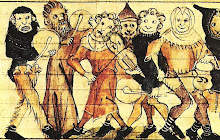
One would think that with all the music he wrote in the key of D major, he wouldn't have the vitamin deficiency that William Grant and Stefan Pilz believe might have caused his early death.
Read about it here!
There were probably an awful lot of people who didn't get outside much during the winter of 1791, so I don't give too much weight to this argument. But it is something to ponder.
Sunday, August 28, 2011


Saturday, August 27, 2011
Interview with Myself
I: What inspired you to do a self interview for your blog?
E: I was inspired by my friend Marjorie Kransberg-Talvi’s interview about performing the Beethoven Violin Concerto that she put on her blog. I have been practicing the Beethoven Violin Concerto during the past week or so, and I thought it might be a nice starting point for a discussion.
I: Are you working on it for a particular performance?
E: Oh no! I’m working on it partly because I want to become stronger playing in the violin’s high register, and that piece requires real strength up in the higher ledger lines of the treble clef. I’m actually playing two concerts this fall of music by 20th-century British composers who love to write in that register. As a violist who plays the violin for fun, it’s a real challenge to find comfort in the flute register.
I: Didn’t you used to play the flute?
E: It’s a very different experience playing up high in the flute register from playing up high on the violin. It’s almost like they are opposite experiences. It requires real strength to get a good sound in the violin’s high register, while the flute’s high register just requires a bit of force and a lot of support. It’s almost impossible to play a true pianissimo above high G on the flute, while there are a whole range of dynamics below mezzo forte in the register surrounding high G on the violin. Dynamic levels above mezzo forte in that register, with my fiddle, are still something I hope to be able to reach.
I: You seem to add tools for musical expression every ten years or so. You started playing the violin at 7, stopped at 11, started flute at 13, added recorder at 21, added baroque flute at 25, went back to violin at 31, added viola at 33, began composing seriously at 40, and added viola d’amore at 48. Do you have any reasonable explanation for this pattern?
E: I’m fickle and restless. Because I live in a place with little stress, and I'm often underemployed, I need to do things that stimulate my mind. I usually concentrate on practicing one stringed instrument at a time (I never touch the flute, unless I’m writing music for it). I play my recorders and my viola d’amore every Friday with my collegium.
I: Your collegium?
E: Yes. I meet with a group of 6 or 7 friends, and we play Renaissance and Medieval music.
I: How do you find 6 or 7 people to play Renaissance music on recorders in your remote Illinois town of 20,000 people?
E: One is my recorder student, and another is my former composition professor. One moved back to town after many years away (once, many years ago, this town was a relative hotbed of musical activity). Two others (a married couple) are instrument collectors. Both were music majors in college and graduate school, but ended up doing other things for a living. The last member of the group is a university student. He's a euphonium player who appreciates the real musical education he gets from playing great music on recorders and his new rackett.
I: And you also play in a string quartet?
E: Yes. We have played together for years, and because we are dispersed between Illinois and Indiana, we now play mainly for weddings. I enjoy making arrangements for the group. I find that writing arrangements is a wonderful way to exercise creativity while not really being bound to do anything really original. I find it a relaxing pastime, and, because the people in my quartet are such fine musicians (they really are) the arrangements always sound good. They make the people getting married and their guests happy, and they make us happy.
I: Do you find that it is work to write music?
E: I find that it’s a wonderful pleasure to write music. When I am writing something I can make all sorts of decisions without having to compromise or consult with anyone. I am the CEO of my musical domain. I can also be expressive and critical at the same time, and I can allow myself to feel the physicality of what I am writing. If I’m setting a text, I allow myself to explore that text much more deeply than I would if I were simply reading. I also get a real kick out of the idea of making something totally new; something that has never been written before. I often have to make sure that a significant amount of time passes between finishing one piece and beginning another, just to make sure that I'm actually writing something new and not just an extension of my last piece.
I: Would you like to be able to make a living from your compositions?
E: I would love to, but I know that it is a total impossibility. I consider myself an accomplished composer, and I’m very proud of the work I have done, but I find it very difficult to think of it as something of a set monetary value that I can sell. I have a lot of music published by publishers that own the rights to what I have written. From that I see very little in the way of royalties. Royalties for composers come to about 10% of the price that a person buying a piece of music pays. When I began working with my first publisher, Raoul Ronson, I saw considerable royalties. My first royalty check, which came after 6 months, was for $500.00, which meant that the music I wrote generated $5,000.00 in revenue. This went on for a while, but after Raoul Ronson died, and his company, See Saw Music, was sold to Subito, royalties have trickled down to around $25.00 every year or so.
I: Have you thought of starting your own publishing company?
E: I have. I even thought of a good name. But I don’t have any sort of business sense, and I'm sure that I would fail as a publisher. Publicity and promotion is the way of the 21st century, and the closest I can really get to self promotion is by posting this interview with myself on my blog. I have always believed that if what I write is of any quality, and if it is the kind of music people will want to play, they will seek it out if I make it available without selling it. I make everything new that I have written available in the Werner Icking Music Archive, which is now about to merge with the ISMLP's Petrucci Library. I do hope that musicians won't think less of me as a composer because I do my work in a non-commercial way, and do not spend the money that I would otherwise make (perhaps) on hiring a professional publicist and someone to do my accounting.
I: Isn’t composing without monetary compensation doing a lot of work for very little in return?
E: Absolutely not. The greatest return for me is to hear a performance of something I have written. It is far more valuable than money. Unfortunately success has come to be measured in dollars and cents (not so much cents anymore, I suppose), but I don't measure it that way. I measure it through doing something that gives me true satisfaction. Another benefit I find (in the abstract much of the time) is to help people communicate with one another musically, and perhaps even communicate with me. I keep hoping that some old friend will come across a piece of music I have written, will play it, and will get in touch with me. People so often think of composers as dead people or people who are inaccessible. I pride myself on my accessibility and enjoy the fact that I’m still alive.
I: That’s probably a good place to end this interview. I’m glad you took the time to talk with me.
E: I enjoyed our conversation too.
E: I was inspired by my friend Marjorie Kransberg-Talvi’s interview about performing the Beethoven Violin Concerto that she put on her blog. I have been practicing the Beethoven Violin Concerto during the past week or so, and I thought it might be a nice starting point for a discussion.
I: Are you working on it for a particular performance?
E: Oh no! I’m working on it partly because I want to become stronger playing in the violin’s high register, and that piece requires real strength up in the higher ledger lines of the treble clef. I’m actually playing two concerts this fall of music by 20th-century British composers who love to write in that register. As a violist who plays the violin for fun, it’s a real challenge to find comfort in the flute register.
I: Didn’t you used to play the flute?
E: It’s a very different experience playing up high in the flute register from playing up high on the violin. It’s almost like they are opposite experiences. It requires real strength to get a good sound in the violin’s high register, while the flute’s high register just requires a bit of force and a lot of support. It’s almost impossible to play a true pianissimo above high G on the flute, while there are a whole range of dynamics below mezzo forte in the register surrounding high G on the violin. Dynamic levels above mezzo forte in that register, with my fiddle, are still something I hope to be able to reach.
I: You seem to add tools for musical expression every ten years or so. You started playing the violin at 7, stopped at 11, started flute at 13, added recorder at 21, added baroque flute at 25, went back to violin at 31, added viola at 33, began composing seriously at 40, and added viola d’amore at 48. Do you have any reasonable explanation for this pattern?
E: I’m fickle and restless. Because I live in a place with little stress, and I'm often underemployed, I need to do things that stimulate my mind. I usually concentrate on practicing one stringed instrument at a time (I never touch the flute, unless I’m writing music for it). I play my recorders and my viola d’amore every Friday with my collegium.
I: Your collegium?
E: Yes. I meet with a group of 6 or 7 friends, and we play Renaissance and Medieval music.
I: How do you find 6 or 7 people to play Renaissance music on recorders in your remote Illinois town of 20,000 people?
E: One is my recorder student, and another is my former composition professor. One moved back to town after many years away (once, many years ago, this town was a relative hotbed of musical activity). Two others (a married couple) are instrument collectors. Both were music majors in college and graduate school, but ended up doing other things for a living. The last member of the group is a university student. He's a euphonium player who appreciates the real musical education he gets from playing great music on recorders and his new rackett.
I: And you also play in a string quartet?
E: Yes. We have played together for years, and because we are dispersed between Illinois and Indiana, we now play mainly for weddings. I enjoy making arrangements for the group. I find that writing arrangements is a wonderful way to exercise creativity while not really being bound to do anything really original. I find it a relaxing pastime, and, because the people in my quartet are such fine musicians (they really are) the arrangements always sound good. They make the people getting married and their guests happy, and they make us happy.
I: Do you find that it is work to write music?
E: I find that it’s a wonderful pleasure to write music. When I am writing something I can make all sorts of decisions without having to compromise or consult with anyone. I am the CEO of my musical domain. I can also be expressive and critical at the same time, and I can allow myself to feel the physicality of what I am writing. If I’m setting a text, I allow myself to explore that text much more deeply than I would if I were simply reading. I also get a real kick out of the idea of making something totally new; something that has never been written before. I often have to make sure that a significant amount of time passes between finishing one piece and beginning another, just to make sure that I'm actually writing something new and not just an extension of my last piece.
I: Would you like to be able to make a living from your compositions?
E: I would love to, but I know that it is a total impossibility. I consider myself an accomplished composer, and I’m very proud of the work I have done, but I find it very difficult to think of it as something of a set monetary value that I can sell. I have a lot of music published by publishers that own the rights to what I have written. From that I see very little in the way of royalties. Royalties for composers come to about 10% of the price that a person buying a piece of music pays. When I began working with my first publisher, Raoul Ronson, I saw considerable royalties. My first royalty check, which came after 6 months, was for $500.00, which meant that the music I wrote generated $5,000.00 in revenue. This went on for a while, but after Raoul Ronson died, and his company, See Saw Music, was sold to Subito, royalties have trickled down to around $25.00 every year or so.
I: Have you thought of starting your own publishing company?
E: I have. I even thought of a good name. But I don’t have any sort of business sense, and I'm sure that I would fail as a publisher. Publicity and promotion is the way of the 21st century, and the closest I can really get to self promotion is by posting this interview with myself on my blog. I have always believed that if what I write is of any quality, and if it is the kind of music people will want to play, they will seek it out if I make it available without selling it. I make everything new that I have written available in the Werner Icking Music Archive, which is now about to merge with the ISMLP's Petrucci Library. I do hope that musicians won't think less of me as a composer because I do my work in a non-commercial way, and do not spend the money that I would otherwise make (perhaps) on hiring a professional publicist and someone to do my accounting.
I: Isn’t composing without monetary compensation doing a lot of work for very little in return?
E: Absolutely not. The greatest return for me is to hear a performance of something I have written. It is far more valuable than money. Unfortunately success has come to be measured in dollars and cents (not so much cents anymore, I suppose), but I don't measure it that way. I measure it through doing something that gives me true satisfaction. Another benefit I find (in the abstract much of the time) is to help people communicate with one another musically, and perhaps even communicate with me. I keep hoping that some old friend will come across a piece of music I have written, will play it, and will get in touch with me. People so often think of composers as dead people or people who are inaccessible. I pride myself on my accessibility and enjoy the fact that I’m still alive.
I: That’s probably a good place to end this interview. I’m glad you took the time to talk with me.
E: I enjoyed our conversation too.
Friday, August 26, 2011
New Definition of Artist
"You only get to be an artist like that by turning everything in your life upside down, by making horrible, ugly, mistakes, by doing things so differently that people will never be able to figure you out. By failing, cheating, lying, having everyone hate you, and coming out the other side with a little bit more wisdom than the rest."James Altucher made this comment in relation to his claim that Steve Jobs is the greatest artist that ever lived. You can read his (rather interesting) article about Steve Jobs here. I really can't stand the way the word "artist" has been abused, misused, and diluted during the past forty years. When I was growing up, the word "artist" defined a person who produced pieces of art: paintings, drawings, or sculpture. The term was also used to describe how a person who did anything well could be an artist at it, but it was usually reserved for activities that involved expression, like music, poetry, dance, and acting. In other words, it described artistry.
When the term began to be used to define the "talent" in commercial recordings, anyone who stood in front of a microphone could be an artist. It took me years to understand that this term, one I reserved for people I held in the highest esteem, had become a term used to define a performer's role in packaging and selling recorded music, regardless of the quality. The first time someone in the music business referred to me as an "artist" I took it as a compliment. I later realized that the term "artist" was one he used for any person who performed, and I felt kind of stupid. The term "fine artist" is now, I suppose, the operative one for people who used to be normal "artists," though the term "performance artist" does not give the impression that the person doing the performing is doing it in any sort of "conventional" sense.
The issue I question is not the value and quality of Steve Jobs' work. I take issue with Altucher's claim that he is the greatest artist that ever lived (and I imagine Jobs would too). Altucher's definition of an artist is one I have never encountered before (and I have encountered many people I would consider artists--the kinds of artists who use brushes, pens, voices, and bows). I just don't understand the cheating and lying part. Real artists do not cheat and lie their way to gaining the ability to express themselves concisely and truthfully through their particular medium.
Failure for an artist is a relative term (Bizet considered himself a failure), and having everyone hate you is something that cannot be proven or even measured. What is Altucher talking about? Who is "everyone?" What is the "other side," and what is this wisdom of which he speaks?
Thursday, August 25, 2011
When is a door not a door?
When it's a coincidence!
Yesterday, after putting the last coat of paint on the side door to our garage, I entered the house, paintbrush in hand, to the sound of a ringing phone. It was my friend Margie, calling from New York. She asked how I was, and my response was, "Great! I just finished painting a door." Margie told me that she was waiting for someone to come and paint HER door (which was suffering from a deep cat scratch), but she didn't know if he was actually coming. We talked for a bit, but had to end the conversation abruptly when her door painter came to her door.
What are the odds of this bit of coincidence?
Yesterday, after putting the last coat of paint on the side door to our garage, I entered the house, paintbrush in hand, to the sound of a ringing phone. It was my friend Margie, calling from New York. She asked how I was, and my response was, "Great! I just finished painting a door." Margie told me that she was waiting for someone to come and paint HER door (which was suffering from a deep cat scratch), but she didn't know if he was actually coming. We talked for a bit, but had to end the conversation abruptly when her door painter came to her door.
What are the odds of this bit of coincidence?
Tuesday, August 23, 2011

Sunday, August 21, 2011
The Streets of Persia, the Streets of Paris
Now that I finally know how to pronounce Koechlin's name, I can share this bit of musical coincidence (though I believe it is pure influence).
[Listen carefully from 21:45 minutes in until the end ("A travers les rues"), and see if there is anything that sounds familiar, particularly having to do with orchestral color.]
Now listen to this piece, written ten years later in 1928:
[Listen carefully from 21:45 minutes in until the end ("A travers les rues"), and see if there is anything that sounds familiar, particularly having to do with orchestral color.]
Now listen to this piece, written ten years later in 1928:
The Morini Strad
I just heard about a production of Willy Holzman'splay The Morini Strad that will be opening in Portland, Maine on September 27 and will run until October 23. The role of Erica Morini will be played by Laura Esterman.
The play is about the relationship between Morini and violin maker Brian Skarstad, and the mysterious disappearance of her instrument, a 1727 Stradivarius, from a closet in her apartment, while she was in the hospital.
You can read more musical assumptions about Morini here.
The play is about the relationship between Morini and violin maker Brian Skarstad, and the mysterious disappearance of her instrument, a 1727 Stradivarius, from a closet in her apartment, while she was in the hospital.
You can read more musical assumptions about Morini here.
Saturday, August 20, 2011
Amanda Maier's Grave

This is a picture of Erika Vermeulen-Illes, a violinist from Amsterdam, who is playing Amanda Maier's Sonata for Violin and Piano there on September 13th. She sent me this picture of herself standing next to Maier's grave, and I haven't been able to successfully e-mail a note of thanks. So I'm voicing my thanks here. Perhaps, if you would Erika, you could send me details about where your performance is, and I can include a notice about it on this post.
Friday, August 19, 2011
Symphony of Living
Symphony of Living is a charmingly clumsy movie from 1935 about an aging violinist, Professor Grieg, who can no longer play, so he opens a teaching studio. His son uses his father's studio as a front for a get-rich-quick scheme, and the rest of his children treat him horribly. One day Professor Grieg's grandson (who he doesn't know is his grandson) comes for a lesson, and it turns out he's a terrific violinist. The movie is rich with violin playing and teaching, not to mention trombone teaching, and an unintentional building-wide jam session, along with boy students in knee pants and a gum-chewing student who takes her gum out of her mouth and puts it on the back of her violin.

[Carl's mother tells him, "You should give up music."]

[Professor Grieg in his studio, where nobody uses a shoulder rest.]

["My dog ate the top half of my music, so I could only play what was on the bottom of the page."]

[Carl plays the Bach Chaccone.]

[Professor Grieg and Carl find out that they are grandfather and grandson.]

[The film ends with a triumphant concert.]
The violinists in this movie (as well as the other musicians) do their own stunts. Young Carl is played by Lester Lee, which might have been the stage name for Ron Carver (but I can't find out anything about a violinist named Ron Carver).


[The other musicians in the building all unwittingly jam together (in separate studios) on "Melody in F."]
What are you waiting for? You can see the whole movie on line!

[Carl's mother tells him, "You should give up music."]

[Professor Grieg in his studio, where nobody uses a shoulder rest.]

["My dog ate the top half of my music, so I could only play what was on the bottom of the page."]

[Carl plays the Bach Chaccone.]

[Professor Grieg and Carl find out that they are grandfather and grandson.]

[The film ends with a triumphant concert.]
The violinists in this movie (as well as the other musicians) do their own stunts. Young Carl is played by Lester Lee, which might have been the stage name for Ron Carver (but I can't find out anything about a violinist named Ron Carver).


[The other musicians in the building all unwittingly jam together (in separate studios) on "Melody in F."]
What are you waiting for? You can see the whole movie on line!
Wednesday, August 17, 2011
Rearrangement: A Yardstick for Progress
Very soon after I began playing in a string quartet, during the early 1990s, I started making arrangements. You could say that it was my "gateway drug" to composing. A wedding request came in today for the Schubert Serenade, and when I realized that the arrangement I had in hand (the one I made back in 1995) was really not something I thought would sound very good, I decided to revise it. Rather than making my re-arrangement from the arrangement I made (below), I started from scratch and used the original vocal score.


I was 36 in 1995. I was an adult. I had a degree from Juilliard, and I had a lot of professional playing experience (at least as a flutist and a recorder player) to my credit, but clearly I had no idea how to make an arrangement for string quartet. I plowed ahead anyway, and after 16 years of playing in a string quartet and writing for string quartet, I'm kind of proud to say that now, looking at the arrangement I made today, I have made some progress.
Here's a link to the whole score and a set of parts.


I was 36 in 1995. I was an adult. I had a degree from Juilliard, and I had a lot of professional playing experience (at least as a flutist and a recorder player) to my credit, but clearly I had no idea how to make an arrangement for string quartet. I plowed ahead anyway, and after 16 years of playing in a string quartet and writing for string quartet, I'm kind of proud to say that now, looking at the arrangement I made today, I have made some progress.
Here's a link to the whole score and a set of parts.
Sunday, August 14, 2011
Procrastination Par Excellence
I have never been one to procrastinate, but the situation is extreme, and after writing this blog post I will be getting down to work. The work at hand is writing program notes for a concert of Beethoven's Ninth Symphony and his Egmont Overture. Of course I have done a bunch of reading (score and otherwise), but I haven't actually written anything.
To make matters just a little extreme, I have been spending the weekend alone. Michael is returning tonight from driving Ben to Boston, and in his absence I have put off working on my program notes by keeping myself really busy. The empty nest has to be feathered as well as a full one. Here's how I spent yesterday and today:
1. I powerwashed the deck
2. I cut down weeds
3. I powerwashed the house
4. I painted the house numbers
5. I painted the mailbox
6. I organized two closets
7. I washed the floors
8. I cleaned the bathrooms
9. I vacuumed the carpets
10. I cleaned the kitchen
11. I finished my syllabus for the fall semester
12. I wrote three CD reviews
13. I wrote three blog posts
I guess I'll wait to make muffins until after I finish writing my notes.
To make matters just a little extreme, I have been spending the weekend alone. Michael is returning tonight from driving Ben to Boston, and in his absence I have put off working on my program notes by keeping myself really busy. The empty nest has to be feathered as well as a full one. Here's how I spent yesterday and today:
1. I powerwashed the deck
2. I cut down weeds
3. I powerwashed the house
4. I painted the house numbers
5. I painted the mailbox
6. I organized two closets
7. I washed the floors
8. I cleaned the bathrooms
9. I vacuumed the carpets
10. I cleaned the kitchen
11. I finished my syllabus for the fall semester
12. I wrote three CD reviews
13. I wrote three blog posts
I guess I'll wait to make muffins until after I finish writing my notes.
Saturday, August 13, 2011
Name That Manuscript


[Make sure to click on the pictures for a larger view.]
I find the handwriting very hard to read, but I imagine the notes are very important. I would love to have help deciphering them, so if you have any ideas, please leave them in the comments.
Your answer (at least for the identity of the manuscript) is below.
The manuscript is in the Petrucci Library.

The Bain of My Existence
When I returned to America after spending time in Austria and Hong Kong (where I did manage to keep my twenty-something self afloat by playing and teaching), I found myself smack in the middle of the "Great Recession." Knowing how dead Boston was in the summer musically (and it was back in the 80s) I spent the summer in New York, which was equally bleak. I got one or two jobs, and taught a couple of students, but almost every "day" job mentioned in the newspaper (that I could do) required typing, and I had never learned to type without looking at my fingers. I recall that there were also lots of jobs for escort services (for women who couldn't type, I suppose).
I went back to Boston, where I stayed with my father, his new wife, and my two-year-old half brother. There wasn't much on the horizon flute-wise or teaching-wise in Boston, so I swallowed my pride and decided to go to typing school. My classmates were mostly products of "Reaganomics." Proposition 2 1/2 (in the 1980s people didn't use decimal points the way they do now) made severe cuts in education, so at least half of them were out-of-work teachers. Most of them had college degrees, some had advanced degrees, and some were multi-lingual.
I learned to run an IBM selectric, and once I hit 40 words per minute, I went to the temporary agencies in town, and got "hired." Being "hired" meant that you waited by the phone to get called for temporary typing jobs. One agency had just gotten an IBM displaywriter, and were interested in filling calls for "operators," so the manager asked me if I would like to learn to use it. I did a couple of tutorials, and was then "sold" as an expert.
My first full time displaywriter job was at Bain and Company. I was hired there as a long-term "temp," and because of the size of the workload, my temporary position became permanent. The company was structured traditionally. There was the professional staff:
President
Vice Presidents
Managers
Consultants
Research Associates
The "professional" support staff
1 Office Manager
1 Computer person
Half a dozen accountants
Secretary to the President
2 or 3 Secretaries to the Vice Presidents
4 or 5 Secretaries to the Managers
5 or 6 Production Assistants (they made celluloid pie charts for the Consultants and answered phones)
The "unprofessional" support staff
3 or 5 Receptionists (they answered calls and took messages for the Consultants and the Research Associates)
2 Mail room workers
A cleaning crew
1 Word Processor Operator, before I arrived. And then there were 2.
Aside from the people in the accounting department, the mail room, the cleaning crew (who I never saw), and the computer person, every member of the support staff, at the time I arrived, was female. Bain promoted a male mail room worker to the level of PA when they got their very first computer-graphics equipment (which was also THE very first computer graphics equipment available). I don't think he could type.
Even though there was no opportunity for any kind of advancement for me, I actually enjoyed my job for a while. Consultants and Research Associates gave me things to type, and I typed them. I invented all sorts of nifty ways of organizing files, I could listen to my Walkman cassette player with headphones while I typed.
I kind of liked the way people responded to me when I mentioned I worked at Bain. One realtor rented me and Michael a very nice apartment in Brookline because he was impressed by the fact that I worked at Bain. I had good health care, something that I was unable to get as a temporary worker, paid vacation, and I got to work in a nice office with (mostly) highly-educated people. All of the RAs were Ivy League graduates (mostly Harvard), and if I recall correctly, they were on their way to Harvard Business School. They all worked extremely hard for little pay, but they knew that eventually they would work hard for lots of pay. The consultants were all Harvard Business School graduates. I had little to talk about with most of the people who worked at Bain because very few of them were interested in music (you know, the "classical" kind), literature, or culture. When I heard the expression "Bain Culture," I got a little excited at first, but I soon found that the word "culture" means different things to different groups of people. I did get invited to the apartment of one RA who confided to me that she and her husband were active in Oxfam America, and that she felt very out of place at Bain & Company.
I typed and I typed. I typed reports that introduced the concept of "downsizing." There were efficiency studies, and proposed ways of speeding up production in order for companies to save money. My only exposure to this type of thing before my time at Bain & Company was in The Pajama Game (the song begins at 37 seconds--you can save time by scrolling right to it).
There were discussions concerning what we now know as "outsourcing." These people "crunched" numbers (I had never heard that term before working at Bain), and flew all over the world to help their clients run "leaner" companies and make more money.
Somebody once mentioned that Bill Bain, the president of the company, could be the president of the United States. I couldn't see a connection between the job of being president of the United States and being president of a company that made money by showing other companies how to save money by downsizing and automating. I always thought that the best kind of president was the kind who understood the law, and cared about fairness and the well being of people. I also, in my naive way, thought that it might someday be possible to live in a country where someone with my background (a degree from Juilliard) could find a way to be self supporting and lead a good life. People like me were not important to people at Bain & Company, except for the fact that people like me happened to be consumers like everyone else.
I started to have serious ethical qualms about the things I was typing. I had issues with some of the companies that were clients of Bain & Company, and it started to really get to me. I found another displaywriter job at another company, and I left Bain.
I believe I left at a good time. The secretaries were all getting IBM personal computers, with a "Displaywrite 2" program, so I knew that my displaywriting days there were going to come to an end anyway. I doubt that I would ever have gotten promoted to the level of secretary or PA, and I assumed that my job would be the first to be downsized. I have no regrets about leaving.
Every time I see Mitt Romney, the "company" in Bain & Company, on the television, I am reminded of my days at Bain. I am reminded of the great divide between those that "have" and those that do not have. Mitt Romney sees the world through Bain-colored glasses. I always got the impression, from the reports I typed, that his view of the world was like a person's view of the landscape from an airplane. Or a Ferris wheel.
I went back to Boston, where I stayed with my father, his new wife, and my two-year-old half brother. There wasn't much on the horizon flute-wise or teaching-wise in Boston, so I swallowed my pride and decided to go to typing school. My classmates were mostly products of "Reaganomics." Proposition 2 1/2 (in the 1980s people didn't use decimal points the way they do now) made severe cuts in education, so at least half of them were out-of-work teachers. Most of them had college degrees, some had advanced degrees, and some were multi-lingual.
I learned to run an IBM selectric, and once I hit 40 words per minute, I went to the temporary agencies in town, and got "hired." Being "hired" meant that you waited by the phone to get called for temporary typing jobs. One agency had just gotten an IBM displaywriter, and were interested in filling calls for "operators," so the manager asked me if I would like to learn to use it. I did a couple of tutorials, and was then "sold" as an expert.
My first full time displaywriter job was at Bain and Company. I was hired there as a long-term "temp," and because of the size of the workload, my temporary position became permanent. The company was structured traditionally. There was the professional staff:
President
Vice Presidents
Managers
Consultants
Research Associates
The "professional" support staff
1 Office Manager
1 Computer person
Half a dozen accountants
Secretary to the President
2 or 3 Secretaries to the Vice Presidents
4 or 5 Secretaries to the Managers
5 or 6 Production Assistants (they made celluloid pie charts for the Consultants and answered phones)
The "unprofessional" support staff
3 or 5 Receptionists (they answered calls and took messages for the Consultants and the Research Associates)
2 Mail room workers
A cleaning crew
1 Word Processor Operator, before I arrived. And then there were 2.
Aside from the people in the accounting department, the mail room, the cleaning crew (who I never saw), and the computer person, every member of the support staff, at the time I arrived, was female. Bain promoted a male mail room worker to the level of PA when they got their very first computer-graphics equipment (which was also THE very first computer graphics equipment available). I don't think he could type.
Even though there was no opportunity for any kind of advancement for me, I actually enjoyed my job for a while. Consultants and Research Associates gave me things to type, and I typed them. I invented all sorts of nifty ways of organizing files, I could listen to my Walkman cassette player with headphones while I typed.
I kind of liked the way people responded to me when I mentioned I worked at Bain. One realtor rented me and Michael a very nice apartment in Brookline because he was impressed by the fact that I worked at Bain. I had good health care, something that I was unable to get as a temporary worker, paid vacation, and I got to work in a nice office with (mostly) highly-educated people. All of the RAs were Ivy League graduates (mostly Harvard), and if I recall correctly, they were on their way to Harvard Business School. They all worked extremely hard for little pay, but they knew that eventually they would work hard for lots of pay. The consultants were all Harvard Business School graduates. I had little to talk about with most of the people who worked at Bain because very few of them were interested in music (you know, the "classical" kind), literature, or culture. When I heard the expression "Bain Culture," I got a little excited at first, but I soon found that the word "culture" means different things to different groups of people. I did get invited to the apartment of one RA who confided to me that she and her husband were active in Oxfam America, and that she felt very out of place at Bain & Company.
I typed and I typed. I typed reports that introduced the concept of "downsizing." There were efficiency studies, and proposed ways of speeding up production in order for companies to save money. My only exposure to this type of thing before my time at Bain & Company was in The Pajama Game (the song begins at 37 seconds--you can save time by scrolling right to it).
There were discussions concerning what we now know as "outsourcing." These people "crunched" numbers (I had never heard that term before working at Bain), and flew all over the world to help their clients run "leaner" companies and make more money.
Somebody once mentioned that Bill Bain, the president of the company, could be the president of the United States. I couldn't see a connection between the job of being president of the United States and being president of a company that made money by showing other companies how to save money by downsizing and automating. I always thought that the best kind of president was the kind who understood the law, and cared about fairness and the well being of people. I also, in my naive way, thought that it might someday be possible to live in a country where someone with my background (a degree from Juilliard) could find a way to be self supporting and lead a good life. People like me were not important to people at Bain & Company, except for the fact that people like me happened to be consumers like everyone else.
I started to have serious ethical qualms about the things I was typing. I had issues with some of the companies that were clients of Bain & Company, and it started to really get to me. I found another displaywriter job at another company, and I left Bain.
I believe I left at a good time. The secretaries were all getting IBM personal computers, with a "Displaywrite 2" program, so I knew that my displaywriting days there were going to come to an end anyway. I doubt that I would ever have gotten promoted to the level of secretary or PA, and I assumed that my job would be the first to be downsized. I have no regrets about leaving.
Every time I see Mitt Romney, the "company" in Bain & Company, on the television, I am reminded of my days at Bain. I am reminded of the great divide between those that "have" and those that do not have. Mitt Romney sees the world through Bain-colored glasses. I always got the impression, from the reports I typed, that his view of the world was like a person's view of the landscape from an airplane. Or a Ferris wheel.
Friday, August 12, 2011
Empty Nest, Full Heart
It's a little after six in the morning, and I'm thinking about the fact that one of my children is as far west as you can get in the continental United States (Los Angeles), and the other is journeying (as I write) as far east as you can get (Boston). Michael and Ben are in a fully-loaded Prius, getting what I imagine to be 57 miles per gallon, while I am here In the mid-west, fulfilling obligations (I have a wedding to play this evening), and contemplating the space and the relative silence around me.

It's only relative silence because I hear the early chattering of other mothers who, perhaps, have just seen the last of their fledglings fly off for the first time. I feel a sense of pride that both our fledglings are making their way in the world, and that they are both fully equipped to have their grown-up adventures and make their own grown-up decisions. My nest may be empty, but my heart is very full.
If you haven't heard them before, you can listen to my fledglings sing.

It's only relative silence because I hear the early chattering of other mothers who, perhaps, have just seen the last of their fledglings fly off for the first time. I feel a sense of pride that both our fledglings are making their way in the world, and that they are both fully equipped to have their grown-up adventures and make their own grown-up decisions. My nest may be empty, but my heart is very full.
If you haven't heard them before, you can listen to my fledglings sing.
Thursday, August 11, 2011
On John Simon's Obituary for the Art of Letter Writing
I just read John Simon's Requiem for the Longhand Missive, and though I would like to respond to him by personal letter, I'm doing it by blog post. I would do it by hand, but his postal address is not posted on his blog page, and if I were to write a handwritten letter, I wouldn't be able to share his post (and my response) with you.
Before the invention of bloggery, and before I learned to type (in my mid 20s), I wrote lots and lots of letters. And I got lots of letters. I had close friendships conducted in good part by transcontinental letter, and I have many of those letters still. After I learned to type, and when I worked in an office that had a typewriter in it, I typed lots of letters. I actually like the physical act of typing--particularly on a typewriter, so, being a child of the automated age, I can be emotionally connected when I type. I can also be emotionally connected when writing on a computer. I guess I just like the act of writing.
But there's something different about handwriting. There's something about having a pen connect to paper (I always write with a fountain pen--other pens just don't do it for me) that feels more honest. Less calculated. Once I make a mistake, or formulate a sentence incorrectly, I'm stuck. I have to wangle my way out of it in order not to botch the readability of the whole letter. I have to look up words before I set them down on paper, rather than correcting them afterwords. (Oy, after words--will the puns never stop?)
I can type very fast. Almost as fast as I can speak. I have to slow down when I write a letter by hand. Sometimes, when I'm writing a letter by hand (which happens only rarely these days, and almost never at length) I forget the direction of my train of thought. I have to make sure I'm thinking at the same speed I'm writing, which is difficult to do when I am so used to doing everything at lightening speed. Walking to a destination a mile away takes 20 minutes, and driving takes less than 5. The walk is certainly a more all-encompassing experience than the drive. The journey is often more meaningful than the destination. Sometimes we do the journey just for the sake of the journey.
So these days my handwriting is reserved for taking notes, drafting things that I'm writing, like program notes, reviews, and the occasional blog post. I also write really personal stuff (like journal-appropriate stuff that I don't want to share, but need to write down so it doesn't fade from memory) by hand.
Now it's time to take a walk.
Before the invention of bloggery, and before I learned to type (in my mid 20s), I wrote lots and lots of letters. And I got lots of letters. I had close friendships conducted in good part by transcontinental letter, and I have many of those letters still. After I learned to type, and when I worked in an office that had a typewriter in it, I typed lots of letters. I actually like the physical act of typing--particularly on a typewriter, so, being a child of the automated age, I can be emotionally connected when I type. I can also be emotionally connected when writing on a computer. I guess I just like the act of writing.
But there's something different about handwriting. There's something about having a pen connect to paper (I always write with a fountain pen--other pens just don't do it for me) that feels more honest. Less calculated. Once I make a mistake, or formulate a sentence incorrectly, I'm stuck. I have to wangle my way out of it in order not to botch the readability of the whole letter. I have to look up words before I set them down on paper, rather than correcting them afterwords. (Oy, after words--will the puns never stop?)
I can type very fast. Almost as fast as I can speak. I have to slow down when I write a letter by hand. Sometimes, when I'm writing a letter by hand (which happens only rarely these days, and almost never at length) I forget the direction of my train of thought. I have to make sure I'm thinking at the same speed I'm writing, which is difficult to do when I am so used to doing everything at lightening speed. Walking to a destination a mile away takes 20 minutes, and driving takes less than 5. The walk is certainly a more all-encompassing experience than the drive. The journey is often more meaningful than the destination. Sometimes we do the journey just for the sake of the journey.
So these days my handwriting is reserved for taking notes, drafting things that I'm writing, like program notes, reviews, and the occasional blog post. I also write really personal stuff (like journal-appropriate stuff that I don't want to share, but need to write down so it doesn't fade from memory) by hand.
Now it's time to take a walk.
Subscribe to:
Posts (Atom)