What a great surprise and delight it was to hear Jim Lehrer read this set of PBS NewsHour principles on television this evening. It is the perfect antidote to my recent off-topic rant, and a great set of guidelines to help me to improve the integrity of everything I do (although, unlike Mr. Lehrer, I suppose I am in the entertainment business).
Do nothing I cannot defend.
Cover, write, and present every story with the care I would want if the story were about me.
Assume there is at least one other side or version to every story.
Assume the viewer is as smart and as caring and as good a person as I am.
Assume the same about all people on whom I report.
Assume personal lives are a private matter until a legitimate turn in the story absolutely mandates otherwise.
Carefully separate opinion and analysis from straight news stories and clearly label everything.
Do not use anonymous sources or blind quotes except on rare and monumental occasions. No one should ever be allowed to attack another anonymously.
I am not in the entertainment business.
(Thanks to Michael for finding the list on line and posting it here.)
Friday, December 04, 2009


Repeating myself: a few thoughts on minimalism
A.C. Douglas set forth a mini rant after listening to a maximal amount of minimalism on WQXR Q2. Too much of anything (especially repetition) can get on anyone's nerves. Staying in the same key for too long can make a few minutes seem like an eternity. Minimalism is a good tool for messing with our sense of time, kind of like repetitive patterns used in decorating can mess with our sense of space.
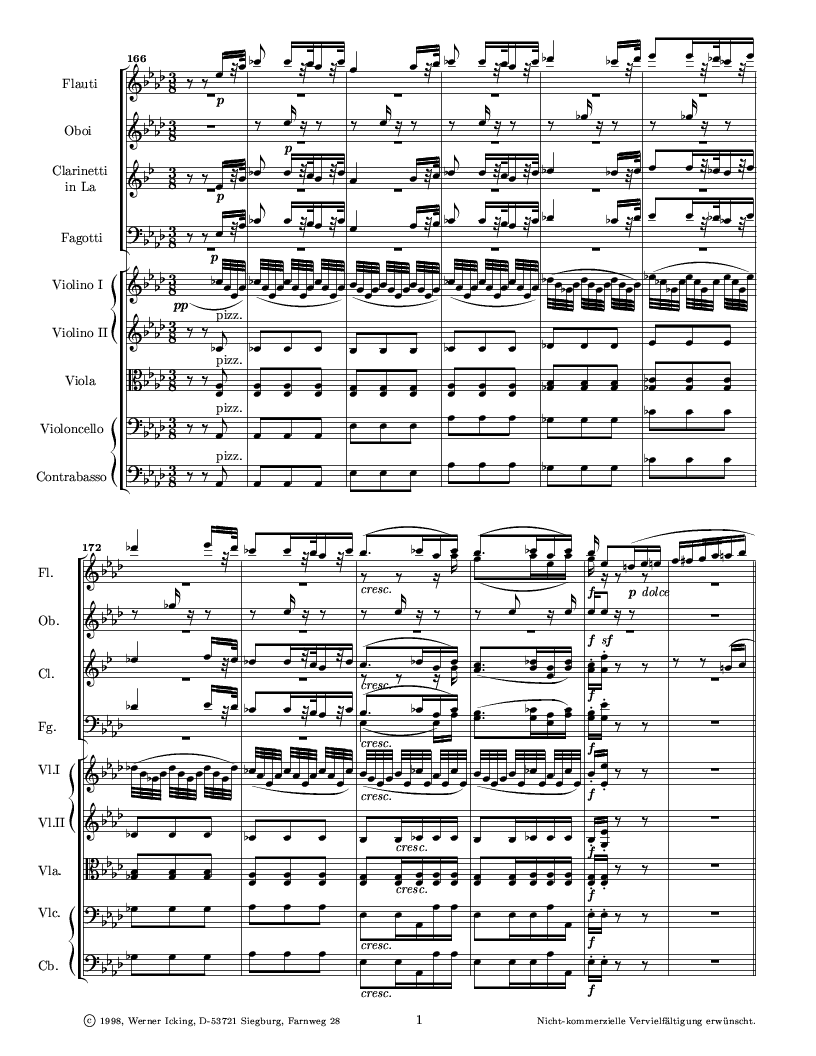
I have used minimalism, but only in context and for specific purposes. In the case of this moment in my Snow Queen opera, Gerda, while en route to find her friend Kay, is stuck for what might be eternity in a magic garden. The concept of eternity looms large in the opera, and the above excerpt happens in the opera's temporal center. The text comes from a passage in Richard Jefferies' The Story of My Heart, which was published in 1883.
Minimalism can be hypnotic, and minimalism can be abused. Repetition can be effective, and repetition, if it isn't used in a context where it serves a purpose, can be downright boring. Repetition, however, has always been a part of the heart and soul of all music. Consider (in Western music) the song forms from the Middle Ages, dance forms from the Renaissance and the Baroque, the major classical forms, and dance forms (from all over both Eastern and Western Europe) used in the 19th and 20th centuries.
Ostinato was (and still is) an important element in music of the early 20th century (consider Bolero and the Rite of Spring). Perhaps ostinato might have even spawned the technique of minimalism, at least in Western musical practices. Perhaps minimalism, which could be viewed as a kind of hyper-tonality, was an appropriate reaction to the dominating dodecophonic music (which restricts repetition of pitches) that only a few composers have had actual musical success with. Many composers have had huge amounts of success (deserved and otherwise) with minimalism, so I believe it is best not to throw the musical baby out with the musical bathwater.
I have used minimalism, but only in context and for specific purposes. In the case of this moment in my Snow Queen opera, Gerda, while en route to find her friend Kay, is stuck for what might be eternity in a magic garden. The concept of eternity looms large in the opera, and the above excerpt happens in the opera's temporal center. The text comes from a passage in Richard Jefferies' The Story of My Heart, which was published in 1883.
It is eternity now. I am in the midst of it. It is about me in the sunshine; I am in it, as the butterfly in the light-laden air. Nothing has to come; it is now.The idea here is to make a minute and forty-four seconds seem like a huge amount of time: to mark the moment of now in music that, by its very nature, consists of a series of events that take place over time. This is, of course, distinctly different from the real (or imaginary) moment of actual "now."
Minimalism can be hypnotic, and minimalism can be abused. Repetition can be effective, and repetition, if it isn't used in a context where it serves a purpose, can be downright boring. Repetition, however, has always been a part of the heart and soul of all music. Consider (in Western music) the song forms from the Middle Ages, dance forms from the Renaissance and the Baroque, the major classical forms, and dance forms (from all over both Eastern and Western Europe) used in the 19th and 20th centuries.
Ostinato was (and still is) an important element in music of the early 20th century (consider Bolero and the Rite of Spring). Perhaps ostinato might have even spawned the technique of minimalism, at least in Western musical practices. Perhaps minimalism, which could be viewed as a kind of hyper-tonality, was an appropriate reaction to the dominating dodecophonic music (which restricts repetition of pitches) that only a few composers have had actual musical success with. Many composers have had huge amounts of success (deserved and otherwise) with minimalism, so I believe it is best not to throw the musical baby out with the musical bathwater.
Thursday, December 03, 2009
Wednesday, December 02, 2009
Take Heart: another off-topic rant
For those readers who are disappointed in President Obama's decision on Afghanistan, have a look at this, and keep an open mind. Most of us are ill equipped to make any kind of intelligent evaluation concerning the situation in Afghanistan. Most of us do not have the necessary information to even begin to make an informed military decision. And even if we had all the necessary information, very few of us would have the courage to take the responsibility for making a decision that has so many far-reaching consequences.
The talking heads (as we call them in our house) feel obliged to evaluate this military decision on a very superficial level. They are required to do so in order to entertain their viewers and keep a lot of people watching their cable channel so that the people who buy commercial time will continue to buy commercial time. When it comes to situations like this one, their comments are as meaningless as mine are. I imagine that even with their inflated egos they know how meaningless and how pathetic their evaluations are. Perhaps we should pity them.
Those people are entertainers. All of them, left, right, and center. President Obama is not. He is an extremely intelligent person who is willing to do the most difficult job in the world, and I believe with all my heart that he is trying to do what is right, what is fair, and what is just. Say what you will (but not here, please), but don't dismiss the hope that so many of us had during the election and during the inauguration.
Tuesday, December 01, 2009
Who Could Ask For Anything More?
The only thing better than hearing this (played so well), seeing the score, and seeing its graphic interpretation would be playing it myself. For my 60th birthday (which is in 9 1/2 years), I want to play this piece. Opus 60. Get it?
I'm not kidding either. I missed the boat on Opus 25 and 26, because I didn't play any of the requisite instruments.
Monday, November 30, 2009
Musical Rehabilitation
I just read about this Alaskan string orchestra. They are playing a concert next week.
Saturday, November 28, 2009
Finding My Own Kind
Back when our kids were little, we used to get a book out of the library that had, as one its characters, a bird that would fly far and wide searching for its own kind. My family knew that I identified with that bird, and they even used to kid me about it.
While I was growing up I never "fit in." I wanted to find people who shared my interests and attitudes, but I was often disappointed when they thought of me as "odd" or "other," or simply too difficult to deal with. Perhaps that is why I stopped doing facebook: it is too personally painful to look back and, once again, feel like an outsider (though, in retrospect, I imagine it was often by choice). It is not that I am a snob. I am functionally social, and have conversations with neighbors I meet in the store and people who go to concerts. I also try to keep up with local and non-local happenings, both musical and non-musical. I do have friends, but, perhaps out of self-preservation (and also out of impossibility), they tend not to be like me. They also tend to live in other places.
When I was a young adult I had the opportunity to leave my life and language behind and build a whole new life from scratch in a new country and speaking a new language. The first several months were filled with wonderful adventures: even the most mundane tasks were fascinating, and even the most uninteresting people were fascinating because everything I talked about with them was in my unschooled German. The excitement faded, however, when my German became functional enough to say pretty much the same things I would say in English. I was faced, once again, with myself.
Dragging that self along with me through the various stages of my life that I have enjoyed since I stopped living it in German, has finally become kind of fun. I have come to like the person I have grown into, and, perhaps, I would be really freaked out if I were to meet someone now who happened, in this world of zillions of people, to be just like me. Still, occasionally, I find myself on the lookout for another of my own kind.
While casually moving through the internets, I happened upon a person who shares my name. She is a painter in England, and her paintings seem to share some of the properties of some of the music I write. My own kind? I highly doubt it, but it is still interesting to contemplate the idea.
Friday, November 27, 2009

Thursday, November 26, 2009
Things I'm Thankful for
Thanksgiving used to be a horrible holiday for me (those who were close to me in my younger years know why), but now, and particularly this year, it is my favorite holiday. I love the idea of having a day to give formal thanks for all that I have and all that I love. Here's my short list:
1. My husband and children (and we are all here together this Thanksgiving)
2. Music (something the four of us share in its--and our--various combinations)
3. Health (something never to be taken for granted)
4. Happiness (the product of points 1, 2, and 3)
5. Our little town, which is rather pretty this time of year, and very quiet on Thanksgiving
6. The ability to live life in a way that is virtually free from compromise
7. The chance to cook and share really good seasonal food
8. Having a day with nowhere to be except at home
9. Good wine and
10. Good pie
Wednesday, November 25, 2009
Vibrato, not just a good idea
From a post on the Vocalist by David Kastrup:
Vibrato is caused when the air flow exceeds the resistance of the folds. The Hagen-Poiseuille Law references that when the airflow becomes greater than the resistance of the conduit, laminar flow is terminated and turbulent flow begins. The trachea terminates as a conduit when the vocal folds come into play. Please understand there is a difference in the definition of the gas law and the physiologic application of the gas law.So much for not using vibrato in baroque music, huh? Vibrato is not just a good idea. Like gravity, it's the law.
Saturday, November 21, 2009
Corolla Deluxe
Last night Michael and I were driving through the East-Central Illinois fog, listening to the syndicated radio program "Radio Deluxe," hosted by John Pizzarelli and Jessica Molaskey. The program presents the aural illusion of being broadcast from a penthouse on Lexington Avenue in New York (though the program is produced on the west coast), and claims to feature what people like to refer to as the "Great American Songbook." The hosts sure spend a great deal of time making sure the audience knows who they are, but last night they neglected to give what would have been some much-appreciated information about the music they were playing.
They played, among other things, a recorded performance of "Oh Well" from Leonard Bernstein's On The Town (the 1944 stage production--the song never made it into the movie) by Tony Bennett and Bill Evans. Michael noticed that Evans was substituting the chords from his "Peace Piece" in his accompaniment (the chord progression is also used in "Flamenco Sketches" on Miles Davis' Kind of Blue). I knew the song as a Bernstein duet, and appreciated Evans' extended harmonies, but didn't recognize them as belonging to another piece (or two). Michael knows a lot of things that I don't know (so reader, I married him), but he didn't know that the song was written by Leonard Bernstein.
Though Pizzarelli and Molaskey waxed on and on about what a well-written song it was, they didn't even mention the name of the composer, or that the lyrics were by Betty Comden and Adolph Green. Pizzarelli and Molasky also mentioned nothing about Evans' harmonic interpretation of the song.
With all the information available at the touch of a button, why do these people (who are musicians themselves) feel that it is acceptable to give so little information about the music they play? Who do they think their audience is? Perhaps Michael and I should start broadcasting radio programs from our 1996 Corolla. We could call it Corolla Deluxe.
Thursday, November 19, 2009
Two Gnomes of (G)note
György Cziffra's performance of Liszt's Gnomenreigen is really sensational, but today, on a lark, I also shared this performance by the eight-year-old Umi Garrett (who has been playing the piano for four years) with my classes. Unlike many of the very young pianists I have heard play "big" repertoire, this one really has something far beyond precision and cuteness. It won't be long before she has the strength of Cziffra, and I intend to keep an eye (and an ear) on her. I thought I'd share this video here.
You can see and hear more here.
You can see and hear more here.
Playing the Fool for Hundreds of Years

La Folia, that is. This website gives information about every known setting of the famous tune, and even goes out on a limb to suggest that Beethoven stuck a Folia between measures 166 through 173 of the the second movement of his Fifth Symphony. The page is certainly worth exploring, particularly the nifty chronological map.
Wednesday, November 18, 2009
Sketching (or rather rambling on) the Trajectory of Classical Music
There has been a lot of blog-talk on the internet concerning the ebbs and flows of what people call "classical music," which is really more a reflection of the business of classical music as reflected in ways of measuring its popularity in financial terms. Writers look at the musical world from where they sit, and watch it march by and change, while they, either seeking to participate in the moments of "upswing," or trying to make their case for viable alternatives to "tradition," attempt to find something that resembles temporary truth.
The problem is that there are so many exceptions to all rules in the world of creativity, particularly musical creativity, that it is impossible to see the musical world from one spot. We live in a world where people try to chronicle history as it is happening, and that same desire to chronicle events that might one day be considered historical, is at play in the people who write about music.
I'm just as guilty as the rest of the bunch. I see musical history through a slightly different lens from anyone else because of my experience. You see musical history through a slightly different lens from anyone else because of your experience. Norman Lebrecht sold a lot of books because of his observations from his insider position, and falsely (but eloquently) pronounced classical music dead. He was talking about the classical music business as he knew it.
Classical music as I know it is not dead. It is something that takes up the majority of my time, heart, and soul. There are just as many young people who have feelings about music that are similar to the feelings I have as there were when I was a young person. The fact that there are now exponentially more musicians than there are jobs for them doesn't seem to deter them from being musicians, even if they don't end up doing it for their livelihoods.
I used to bemoan change. I used to insist that people don't play "the way they used to." Now I entertain the idea that maybe people who try to play the way "they used to" are, perhaps, not being true to who they are as people. We have been fortunate as a culture (and I do believe that it is correct to talk about the musical culture in the collective sense, even if not everybody participates in it) to have recordings and films that show us music making that is truly great. It is certainly possible (given ample instrumental technique) to try to imitate what we experience as musical greatness--to attempt to capture the surface of what Milstein does, or what Heifetz does (I say does, because while we listen and watch it is happening in the now for us), what Richter does, what Arrau does, what Fritz Wunderlich does, and what a long list of other great musicians do. What is not possible is to imitate the life experience and the particularly musical intelligence, hard won through discipline and struggle, that serves as the backbone of what blooms on the surface.
I personally don't want the struggles of the past. I don't want to deal with the narrow-minded attitudes and loss of personal as well as musical freedom that musicians who were Jewish had to contend with during the first half of the 20th century. I don't want to deal with attitudes that women, both as performing musicians and as composers, were inferior to men (with a few exceptions held by the more generous). I don't want to deal with narrow-minded attitudes towards race that still get in the way of cultural development, but have improved a great deal in the world of classical music during my lifetime.
There have always been people who know how to treat classical music as a commodity. There are recording companies like Naxos that have taken advantage of the global market for classical music, and have done extremely well--expanding far beyond even their wildest dreams. I watched it from the beginning. I have seen it change. I haven't heard anybody complain.
There are people who buy their classical music recordings the way they buy designer clothes, shoes, or purses. It all has to do with the promotion. Those people have always been there: buying Rampal and Galway flute recordings in the 1970s and 80s, buying well-marketed recordings (sometimes even "crossover" recordings) of Yo-Yo Ma and Thomas Hampson, as well as a whole stable of attractive and competent (and often very good) performing musicians who make a lot of money from appearing as soloists. There are always people who will go to the "symphony" for the enjoyment of the whole experience: dressing up, going with friends, hearing something they might know, or something new, and seeing other "like-minded" people to schmooze with. Audience schmoozing is one of the side benefits from going to concerts, and I believe that it always has been. And there are audiences everywhere--not just in big cities, where many of the cultural critics live.
So where am I going with this? My contention is that "classical music" isn't making a comeback because it never died. My contention is that "classical music" is getting better because we have more access to more music than we ever had before, and we have more access to it immediately and for free, thanks to the internet. The self-discipline that goes into "growing" musicians of merit is something that not everyone has, but for the people who have it and have the desire to learn everything there is to know about music we have resources that were unimaginable to previous generations. The Petrucci Library is now up to 43,000 pieces of music (I just noticed that the Suk Meditation of the Old Chorale, Opus 35a was just added, and just in time too. My old copy has practically turned to dust)). There is also a 104-page book on singing by Pauline Viardot that I am excited about reading. Thanks to YouTube, we have, among other more obvious applications, a way to listen to traditional music from parts of the world that I never knew had extremely musical cultures. It is even possible to find musical inspiration in a post office in Ghana! (thanks, Daniel)
I could go on, but I have a rehearsal. This morning we are reading a pile of new-old music for a concert in March of music written by women. There is enough music available now (from many eras) that we get to pick and choose! Now that's progress!
Sunday, November 15, 2009
Felix Mendelssohn: his feelings of inadequacy aren't like your feelings of inadequacy
I have been reading a bit about Felix Mendelssohn's inadequate feelings about his Fourth Symphony, and how they mystified critics, like Donald Francis Tovey, who considered it a most perfect piece of music. I think that the answer is that Mendelssohn's feelings of inadequacy are simply on a higher level than the feelings of inadequacy enjoyed by most composers and most critics (particularly people like Tovey who were both). It is a little bit like the charming intel commercial that has been circulating on line.
Mendelssohn was a conductor who held Bach, Mozart, and Beethoven as his ideal composers. But Mendelssohn was working in a different time, and his music demanded different harmonic configurations. Some of his harmonic configurations and modulations are difficult for an orchestra to get the first time (or the second, or the third), and some of his string parts (particularly the viola part of this piece, which I am playing) are downright uncomfortable to play for those same harmonic reasons. As a conductor/composer, and as a gentleman (which we knew he was), and considering the fact that he was working with the finest musicians in Germany, he knew that he couldn't blame the musicians for playing that was less expressive or less pristine than what he had in mind. He also knew from conducting the works of Beethoven and Mozart that it was possible to write music in such a way that everything could be a total pleasure for all the musicians to play.
Playing through this piece from the standpoint of a violist, and keeping Mendelssohn's ideals in mind, I can understand his pain, but before playing the viola part of the piece (I have played the flute parts), I had no idea why he would feel the way he did about the Symphony, which he never published during his lifetime.
It is interesting to contemplate the relationship of this Symphony to Fanny's "Das Jahr" cycle of piano music that I love so much. These few sentences from a letter that Felix from to Fanny make me wonder if he might have been inspired to write an Italian symphony by the quality of her musical impressions of her year in Rome for piano.
“The ‘Italian’ symphony is making great progress. It will be the jolliest piece I have ever done, especially the last movement. I have not found anything for the slow movement yet, and I think that I will save that for Naples.”There is something about the relationship between Felix and Fanny that makes me very sentimental. She was his older sister, and she was his very closest friend, and probably his greatest constant living musical inspiration, from very early childhood, and into their very short periods of adulthood.
Subscribe to:
Posts (Atom)