Sunday, January 31, 2021
All the world through a window
Monday, January 25, 2021
Dorothy Fox Andante from 5 Pieces, Op. 11
Here is the information that Phillip Sear put in the notes that accompany this video (copied here so that it might be found by other Fox hunters):
Phillip Sear plays a piece from around 1925 by the short-lived English composer K. Dorothy Fox (1894-1934).
There seems to be very little information available on K(alitha) Dorothy Fox. As you can see from her brief Wikipedia page she wrote a few pieces of piano and chamber music in her short life. She was born in Kensington, London, and must have been a prodigy, as her first piece was published at the age of just 12. She took her unusual first name from her mother, born Kaletha Marianne Childs. Some of her scores were published in Paris, and she was certainly living there around 1927 (her family seem to have moved overseas in the early 1900s), and she spent her last years living with a friend in Amersham, Bucks.
She died in a hotel in Windsor, Berkshire (she sadly hung herself with a silk scarf), having gone there to escape the noise from pneumatic drills at her home, and had some incomplete manuscripts with her at the time. The beneficiary of her will (and dedicatee of her viola sonata - see here for some programme notes from a 2017 performance (Ooh! that's a link to this blog!) was her brother Gerald Hugh Borlase Fox (1900-95). I put these details here in the hope that people with more information on her might find this description and be able to add to what is known of her life.
The '5 Pieces' were dedicated to another little-known British woman composer, and fellow member of the Society of Women Composers, the harpsichordist Dorothy Erhart (1894-1971).
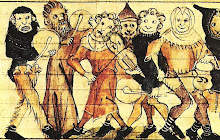
My thumbnail shows a colourized detail from a photo in Amersham Museum of the 1934 Boxing Day hunt in the Broadway, an event Dorothy might well have witnessed as she was living in Amersham at the time.
And then there's this obituary from the Times that Mr. Sear sent:
INQUEST ON WOMAN COMPOSER
THE CORONER'S COMMENTS ON NOISE
The inquest was held at Windsor yesterday on the body of Miss K. Dorothy Fox, of Hyde Park Square, London, W., who was found hanging by a silk scarf at an hotel at Windsor on Saturday. She had been at the hotel about a fortnight, coming, is is stated, from a country town. Miss Fox was a talented composer, and a number of half-finished manuscripts were found in here luggage.
Dr. Edward Arthur Gibson, of Cleveland Square, London, said Miss Fox was 40 years old, and of independent means. Her father was abroad. She was highly strung, temperamental, and artistic.
The DEPUTY CORONER, Mr. J..A. Leonard, said that a quantity of drugs had been found in Miss Fox's room, and asked Dr. Gibson to say what they were.
Dr. Gibson examined several bottles and boxes and said they appeared to be harmless.
Miss Christabel Lowndes Yates, of Windsor House, Amersham, a novelist, said in evidence that Miss Fox had been living with her for about seven years. They met in France, where it was considered Miss Fox had only three months to live unless she could be looked after better. Miss Fox got better, but suffered from nerves. She had taken a medicinal on a doctor's prescription, but she had never threatened to take her life. She had, in fact, gone to the doctor's when she saw this drug on a list of dangerous drugs, and asked him if it would give her an urge in the direction of suicide. Thee witness did not know what the reply was, but the drug was not withdrawn.
Continuing, the witness said that Miss Fox was very small, and at one period only weighed 5st. 6oz. or 7oz. She was a very fine musician. Her work had been broadcast in several countries, and a concert of her work was given in London about a month ago, and another work was to be published in this country, France, and Germany. She was considered to be an extraordinarily promising composer. She had no love affairs so far as the witness knew, and no financial trouble.
"INCREDIBLE NOISE"
Miss Fox had left her house a fortnight before because oof the unbearable noise from the road repairs, the witness went on. There were about eight pneumatic drills, two engines, and other noisy things, and the vibration was so bad that they had to open the windows for fear they would be broken, dismantle the wireless, and pack up the piano and the china. They could not speak on the telephone. The noise was incredible. The witness received a letter from Miss Fox posted the night before her death, and it was perfectly cheerful and normal.
The CORONER--Do you think this pneumatic drill got on her nerves?
Miss Yates--While she was there, but I don't think so after she had gone
The CORONER said that a good deal of prominence had been given to Miss Fox's death, possibly from a feeling of indignation against "these nerve-shattering machines," which were one of the many tribulations of this age of noise. But he thought in this case the noise of the pneumatic drill was a very small link in the chain of events leading to Miss Fox's unhappy ending. It was evident that Miss Fox was of an artistic and perhaps somewhat neurotic temperament. He recorded a verdict of "Suicide while of unsound mind."
Tuesday, January 19, 2021
The U.S. Marine Band will perform music by Adolphus Hailstork at President Biden's Inauguration
Norfolk, Va., Jan. 19, 2021 (GLOBE NEWSWIRE) -- A composition by Adolphus Hailstork, Eminent Scholar and professor emeritus of music at Old Dominion University, will be performed at Wednesday’s inauguration of Joe Biden and Kamala Harris.
Fanfare on “Amazing Grace” is scheduled to be performed as the second piece of the inaugural prelude.
This marks just the second time that music by a contemporary African American composer has been selected to be part of the repertoire performed at a presidential inauguration, according to Africlassical.com, a website on African heritage in classical music. It is scheduled to be performed by “The President’s Own” U.S. Marine Band.
Hailstork came to Old Dominion in 2000. He writes in a variety of forms and styles: symphonic works and tone poems for orchestra; two concertos (for piano and for violin) and numerous chamber works; duos for such combinations as horn and piano, clarinet and piano, flute and piano; numerous songs, including those for soprano, baritone, mezzosoprano, some with piano and others with orchestra or chamber group; band works and transcriptions; and many pieces for piano and pipe organ. He retired Jan. 1.
He is working on a requiem cantata for George Floyd, “A Knee on the Neck,” one of many compositions that reflect his engagement with Black history. He expects to complete it in April.
“My poet friend Dr. Herbert Martin (who also wrote the text for Hailstork’s cantata ‘Crispus Attucks’) one day sent me – I mean it was so fast, within a week of Floyd’s murder – a complete script and called it ‘A Requiem.’ And I looked at it and said, ‘I can use this,’ and started setting it,” Hailstork said in an interview with San Francisco Classical Voice in June. “It captures a lot of things that should be mentioned and are universal. That’s why the whole world is upset over watching that murder.”
Along with a University faculty research award, Hailstork has received the ALLI AWARD for lifetime achievement from the Cultural Alliance of Greater Hampton Roads, the Outstanding Faculty Award from the State Council of Higher Education for Virginia, and the Charles O. and Elisabeth C. Burgess Award for Faculty Research and Creativity from ODU's College of Arts and Letters.
The University maintains the Adolphus Hailstork Collection in the special collections area of the F. Ludwig Diehn Composers Room in the Diehn Fine and Performing Arts Center.
Saturday, January 16, 2021
Thinking about the Sea Shanty in 2021
Monday, January 11, 2021
British Composer Lucy Hale
N.B. There happens to be a Lucy Hale who is an actress and pop music singer (same year of birth, but very different trajectory because of many factors), who has a huge on-line presence, which makes this Lucy Hale harder to find in the internets.
JANUARY 12th UPDATE: Here is a wonderful tribute to Lucy Hale by Becky Morris Knight of Drake Music.
Superb readings of all of Bach's Well-Tempered Clavier in animated graphical videos
Malinowski uses recordings made by the pianist Kimiko Ishizaka for Book I, and uses recordings made by the harpsichordist Colin Booth for Book II.
Here is a screenshot of some of the thumbnails:
Saturday, January 02, 2021
Beethoven Matters in 2021
Wednesday, December 30, 2020
Monday, December 28, 2020
Swann's Way and Proust's wisdom
But when a belief disappears, there survives it--more and more vigorous so as to mask the absence of the power we have lost to give reality to new things--a fetishistic attachment to the old things which our belief once animated, as if it were in them and not in us, that the divine resided and as if present lack of belief had a contingent cause, the death of the Gods.
Friday, December 25, 2020
In Search of Lost Tune
Proust refers to specific pieces of music by Liszt, Chopin, and Wagner, Gluck, and Beethoven, but he never mentions Mendelssohn, at least not in the first two volumes.
After reading the passage on page 362 of the Lydia Davis translation of Swann's Way
When, after the Verdurin evening, he had had the little phrase played over for him, and had sought to disentangle how it was that, like a perfume, like a caress, it encircled him, enveloped him, he had realize that it was to the closeness of the intervals between the five notes that composed it, and to the constant repetition of two of them, that was due this impression of frigid and withdrawn sweetness . . .I knew I had found a clue. An odd set of circumstances followed. At least odd for me. I thought of the usual suspects from the French Violin Sonata repertoire, and couldn't think of a “stand-out” tune that would fit that description. But, when I reached for my copy of the Mendelssohn Violin Concerto (you can listen to the whole piece here), which I only thought of practicing today because of some technical things regarding shifting and bowing I have been working on lately, I found that the tranquillo theme in the first movement that gets developed through all three movements fits the bill.
Here it is in a higher register which further illustrates this description, “What had happened was that the violin had risen to a series of high notes on which it lingered as though waiting for something, holding on to them in a prolonged expectancy, in the exaltation of already seeing the object of its expectation approaching, and with a desperate effort to try to endure until it arrived, to welcome it before expiring, to keep the way open for it another moment with a last bit of strength so that it could come through, as one holds a trapdoor that would otherwise fall back.”
Further evidence of the Mendelssohn Violin Concerto as the model for the Venteuil Sonata comes from these passages in Swann's Way:
“It was the andante from the Sonata for Piano and Violin by Vinteuil.”
[The second movement of the Mendelssohn Concerto is marked “Andante.”]
“He would begin with the sustained violin tremolos that are heard alone for a few measures, occupying the entire foreground . . . ” “But they fell silent; under the agitation of the violin tremolos which protected it with their quivering . . .”
“The beautiful dialogue which Swann heard between the piano and the violin at the beginning of the last passage” has to refer to this statement of a variation of the melody in the last movement, which is an emotional high point of the piece:
At any rate, I think that in pages 362 through 366 Proust describes the Mendelssohn Violin Concerto as accurately as he describes the depths of the human heart. I will leave you with this. It's time to make some coffee and read more Proust!
Thursday, December 24, 2020
Christmas Eve einmal anders
Wednesday, December 23, 2020
Jingle All the Way!
And a video of the version for violin:
Here's a festive video with percussion from Judith Ingolfsson,
and further arranged as a duet:
Sunday, December 20, 2020
Now is the time of monsters
Heather Cox Richardson's post for today, written about yesterday in the wee hours of this morning, begins with a quote from the Italian philosopher Antonio Gramsci, "The old world is dying, and the new world struggles to be born: now is the time of monsters."
She presents the events of the day (and I mean THE actual previous day) in a way that manages to distill and organize the confusion of what we read, hear, and see on the news, and she puts everything in true historical perspective.
Today's lesson in historical perspective involves Joe Biden's nomination of Representative Deb Haaland from New Mexico to be the Secretary of the Interior. She explains why having a person who was a tribal leader of the Laguna Pueblo people before becoming a member of congress in that position is a "recognition of 170 years of American history and the perversion of our principles by men who lusted for power," and "a sign that we are finally trying to use the government for the good of everyone."
Saturday, December 19, 2020
In for the long haul: In Search of Lost Time and The Life and Opinions of the Tomcat Murr
Michael and I finished Robertson Davies's The Cornish Trilogy a couple of weeks ago, and then, because he knew I wanted to read it, Michael gave me (as a thoughtful gift) a copy of E.T.A. Hoffmann's The Life and Opinions of the Tomcat Murr, which figures prominently, along with E.T.A. Hoffmann, in The Cornish Trilogy.
Tomcat Murr (or Kater Murr in the original German) is an unwitting collaboration between a cat who has taught himself to read and write, and his master, who has (unknowingly) provided the reverse sides of some of the pages for a book he is writing about a composer named Kreisler. So we get two stories that break off and switch suddenly. Fortunately the editor, who happens to be one "E.T.A. Hoffmann," has indicated in the text where the breaks occur. I'm only about forty pages in, but I am confident that the rest of the novel will be as entertaining and engaging as the beginning.
And then there's the Proust. Michael has read the whole series of novels twice, and I have "read at" it over the past several decades, but never in this wonderful Lydia Davis translation, and never with the readerly experience I have acquired during my time as a "mature" adult.
Proust writes about music from the standpoint of a highly sensitive listener who is not a musician himself, which is always a good perspective for those of us who are in the business of creating and recreating music to keep in mind. Rather than write "about" what I am reading, I'll just leave a sample from the section called "Swann in Love" here.
He would find several of her favorite pieces open on the piano: the “Valse des Roses” or “Pauvre Fou” by Tagliafico (which should, according to her wishes, which she had put into writing, be performed at her funeral); he would ask her to play instead the little phrase from Vinteuil’s sonata, even though Odette played very badly, but the loveliest vision of a work of art that remains with us is often the one that transcended the wrong notes coaxed by unskillful fingers from an out-of-tune piano. For Swann the little phrase continued to be associated with the love he felt for Odette. He was aware that this love was something that did not correspond to anything external, anything verifiable by others besides him; he realized that Odette’s qualities did not justify his attaching so much value to the time he spent with her. And often, when Swann’s positive intelligence alone prevailed, he wanted to stop sacrificing so many intellectual and social interests to this imaginary pleasure. But as soon as he heard it, the little phrase had the power to open up within him the space it needed, the proportions of Swann’s soul were changed by it; a margin was reserved in him for a bliss that also did not correspond to any external object, and yet, instead of being purely individual, like the enjoyment of that love, assumed for Swann a reality superior to that of concrete things. The little phrase incited in him this thirst for an unfamiliar delight, but it did not give him anything precise to assuage it. So that those parts of Swann’s soul from which the little phrase had erased any concern for material interests, any considerations that were human and valid for all people, it left vacant and blank, and in them he was free to write Odette’s name. Moreover, where Odette’s affection might seem somewhat limited and disappointing, the little phrase came along to add to it, to amalgamate with it its mysterious essence. From the sight of Swann’s face as he listened to the phrase, one would have said he was absorbing an anesthetic that allowed him to breathe more deeply. And the pleasure which the music gave him, and which was soon to create in him a true need, did indeed resemble, at those moments, the pleasure he would have found in testing fragrances, in entering into contact with a world for which we are not made, which seems formless to us because our eyes do not perceive it, meaningless because it evades our understanding, which we can attain only through a single sense. What great repose, what mysterious renewal for Swann—for him whose eyes, though refined lovers of painting, whose mind, though a shrewd observer of manners, bore forever the indelible trace of the aridity of his life—to feel himself transformed into a creature strange to humanity, blind, without logical faculties, almost a fantastic unicorn, a chimerical creature perceiving the world only through his hearing. And since he still searched the little phrase for a meaning to which his intellect could not descend, what strange drunkenness he felt, as he divested his innermost soul of all the help of reason and forced it to pass alone through the sieve, through the dark filter of sound! He began to become aware of all that was painful, perhaps even secretly unappeased in the depths of the sweetness of that phrase, but it could not hurt him. What did it matter if it told him love was fragile, his own love was so strong! He toyed with the sadness it diffused, he felt it pass over him, but in a caress that only deepened and sweetened his sense of his own happiness. He made Odette play it ten times, twenty times, demanding that while she did so she should not stop kissing him. Each kiss summons another. Ah, in those first days of our love, kisses come so naturally! So closely, in their profusion, do they crowd together; and it would be as hard for us to count the kisses we give each other in an hour as the flowers of a field in the month of May. Then she would make as if to stop, saying: “How can you expect me to play if you hold on to me? I can’t do everything at once.”