Tuesday, July 26, 2022
The 1950s housewife in 1950s media
Food for thought: a great many of the actors and models used in media (films, television, magazines) promoting the idea that married women in the 1950s should give up aspirations of having a profession (even if they worked during the war) were professional women who had jobs as actors and models.


Sunday, July 24, 2022
Using Scale Tales with Students
It has been about half a year since Violin Scale Tales came into print, and I have not yet seen any kind of printed review. So in this post I will show how I use the material with students.
I currently have three students working in this book. One is advanced, and can make her way around the fingerboard in the first six positions. The other two have not yet learned to shift out of first position.
My more advanced student is working on the pieces in the book in order, beginning in A minor with "Atlas Moth." As you can see from the first two lines, the piece uses a mixture of sixteenth notes, eighth notes, triplets, and longer note values that require the student to count and change the speed of the bow in order to follow the dynamic contours of the piece. This piece includes a mixture of meters. These changes of meter are necessary for the musical line, and offer a good way to teach the "why" of meter in addition to the "what" of meter.
There are also places in the piece that proceed as normal scales would, with regular rhythm:

Phrasing is built into the music, and dynamics and textures keep things interesting. Thinking about the appearance and behavior of the animals stimulates the musical imagination. It is fun, for example, to imagine how this very large moth might act during its short life.
The other eleven moth pieces (Elephant Hawk Moth, Io Moth, Rosy Maple Moth, Luna Moth, Garden Tiger Moth, Dysphania Militaris Moth, Cecropia Giant Silk Moth, Twin-Spotted Sphynx Moth, Comet Moth, Cinnabar Moth, and Giant Leopard Moth) bear a family resemblence to the Atlas Moth piece, but each has its own character. "Waltz of the Moths," which comes at the end of the book, an elaboration on "Twin-Spotted Sphinx Moth," makes its way through all of the minor keys beginning in F minor, and going through the circle of fifths.
I started one of my less-experienced students with "Ostrich" in the key of G major. This one is totally in the three-quarter time, and incorporates a chipper tune as well as left-hand pizzicato: It ends with a scale that uses the whole first-position range of the violin:
 "Komodo Dragon," in D major, also uses left-hand pizzicato. It has a lot of drama, because the Komodo Dragon is a dramatic creature. This piece incorporates a more extended scale passage than the other portraits of lizards in the collection ("Armadillo Girdled Lizard," in B major, and "Eastern Collared Lizard," in F-sharp major).
 "Emu" is an E-major waltz that is similar to the G-major "Ostrich" above (those large running birds are somewhat similar). And at the end of the book, right before the "Waltz of the Moths," a "Waltz of the Emus" runs its way through all the major keys.
All the animals in the collection, including the Green Sea Turtle, Galápagos Tortoise, Royal Python, Barred Owl, Scaly-Breasted Woodpecker, Dwarf Scaly-Tailed Squirrel, and the Screaming Hairy Armadillo are animals that have scales.
I'm having as much fun practicing and teaching these pieces as I did writing them.
There are twenty-eight more musical portraits of animals with scales in the second volume, Advanced Violin Scale Studies, a book that uses the whole range of the violin and twenty-four keys (alternating minor and major, like the first volume). The first-position book can also be used to great advantage on the viola, particularly for violists eager to practice in the second, third, fourth, and fifth positions. They are great for practicing intonation because each piece remains in a single key (though the mode of the major pieces sometimes shifts to the natural minor). Pitches move stepwise up and down, repeat at the unison, or jump the octave. Even in keys with many sharps or many flats it is still easy to hear where the next pitch is going to be.
My hope with this book is that it will help students find that scale playing can be enjoyable, imaginative, and even entertaining. I also hope that it can help "normalize" keys that have many sharps or many flats, and that it can help introduce elements of very basic music theory into lessons.
I currently have three students working in this book. One is advanced, and can make her way around the fingerboard in the first six positions. The other two have not yet learned to shift out of first position.
My more advanced student is working on the pieces in the book in order, beginning in A minor with "Atlas Moth." As you can see from the first two lines, the piece uses a mixture of sixteenth notes, eighth notes, triplets, and longer note values that require the student to count and change the speed of the bow in order to follow the dynamic contours of the piece. This piece includes a mixture of meters. These changes of meter are necessary for the musical line, and offer a good way to teach the "why" of meter in addition to the "what" of meter.

There are also places in the piece that proceed as normal scales would, with regular rhythm:

Phrasing is built into the music, and dynamics and textures keep things interesting. Thinking about the appearance and behavior of the animals stimulates the musical imagination. It is fun, for example, to imagine how this very large moth might act during its short life.
The other eleven moth pieces (Elephant Hawk Moth, Io Moth, Rosy Maple Moth, Luna Moth, Garden Tiger Moth, Dysphania Militaris Moth, Cecropia Giant Silk Moth, Twin-Spotted Sphynx Moth, Comet Moth, Cinnabar Moth, and Giant Leopard Moth) bear a family resemblence to the Atlas Moth piece, but each has its own character. "Waltz of the Moths," which comes at the end of the book, an elaboration on "Twin-Spotted Sphinx Moth," makes its way through all of the minor keys beginning in F minor, and going through the circle of fifths.

I started one of my less-experienced students with "Ostrich" in the key of G major. This one is totally in the three-quarter time, and incorporates a chipper tune as well as left-hand pizzicato:


All the animals in the collection, including the Green Sea Turtle, Galápagos Tortoise, Royal Python, Barred Owl, Scaly-Breasted Woodpecker, Dwarf Scaly-Tailed Squirrel, and the Screaming Hairy Armadillo are animals that have scales.
I'm having as much fun practicing and teaching these pieces as I did writing them.
There are twenty-eight more musical portraits of animals with scales in the second volume, Advanced Violin Scale Studies, a book that uses the whole range of the violin and twenty-four keys (alternating minor and major, like the first volume). The first-position book can also be used to great advantage on the viola, particularly for violists eager to practice in the second, third, fourth, and fifth positions. They are great for practicing intonation because each piece remains in a single key (though the mode of the major pieces sometimes shifts to the natural minor). Pitches move stepwise up and down, repeat at the unison, or jump the octave. Even in keys with many sharps or many flats it is still easy to hear where the next pitch is going to be.
My hope with this book is that it will help students find that scale playing can be enjoyable, imaginative, and even entertaining. I also hope that it can help "normalize" keys that have many sharps or many flats, and that it can help introduce elements of very basic music theory into lessons.
Wednesday, July 13, 2022
Lift Every Voice and the Convergence of Things
"Everything that rises must converge," the title story of Flannery O'Connor's 1965 collection of short stories, comes from "Omega Point" (an idea I don't necessarily ascribe to) by the French philosopher Pierre Teilhard de Chardin. In it he writes (translated here by our friends who wrote the Wikipedia article about him),"Remain true to yourself, but move ever upward toward greater consciousness and greater love! At the summit you will find yourselves united with all those who, from every direction, have made the same ascent. For everything that rises must converge."
 Last night's Summer Strings concert was one of those rising and converging moments, though the rising and converging happened among people who would not necessarily agree with de Chardin, if they even knew who he was (I didn't until I started writing this post). In six ninety-minute-long rehearsals over a period of six weeks, this group of east-central-Illinois musicians of all ages and all abilities, managed to pull off a one-hour-long program of music that was filled with musical challenges of all stripes (including expressive ones).
The program began with an arrangement of "Lift Ev'ry Voice and Sing" that you can hear here. There were a few moments of wind that challenged the microphone, but it was a small price to pay for having absolutely perfect weather for this concert.
As some people who read this blog know, Michael and I live in what has become an epicenter for the kind of political thought that is minority thought in the coastal and urban parts of the country that we are more aligned with. But we do what we can, and give what we can to the community where we live. And in this ensemble, which is a mixture of not only people of all ages and abilities, but of people on all sides of the political spectrum, everyone is giving the best part of themselves to the music at hand, and enjoying the better parts of all of their neighbors.
This is what music does. And it is, for me, the best part of making music.
Another "arm" of this musical convergence for me is a book I am reading that I will be writing a post about closer to its release date in November of this year. Suzuki: the man and his dream to teach the children of the world, by the historian Eri Hotta, puts Shinichi Suzuki's life, with component parts that I never knew about, into the framework of Japanese history as well as twentieth-century world history. Suzuki's idea (or one of Suzuki's ideas, borrowed from his extra-musical process of self-education) that music can make the world a better and kinder place resonated loudly (and sometimes whispered softly, because dynamics were at play) with me last night.
If you go to this post, there is a link at the bottom to a folder that has recordings of everything we played.

The program began with an arrangement of "Lift Ev'ry Voice and Sing" that you can hear here. There were a few moments of wind that challenged the microphone, but it was a small price to pay for having absolutely perfect weather for this concert.
As some people who read this blog know, Michael and I live in what has become an epicenter for the kind of political thought that is minority thought in the coastal and urban parts of the country that we are more aligned with. But we do what we can, and give what we can to the community where we live. And in this ensemble, which is a mixture of not only people of all ages and abilities, but of people on all sides of the political spectrum, everyone is giving the best part of themselves to the music at hand, and enjoying the better parts of all of their neighbors.
This is what music does. And it is, for me, the best part of making music.
Another "arm" of this musical convergence for me is a book I am reading that I will be writing a post about closer to its release date in November of this year. Suzuki: the man and his dream to teach the children of the world, by the historian Eri Hotta, puts Shinichi Suzuki's life, with component parts that I never knew about, into the framework of Japanese history as well as twentieth-century world history. Suzuki's idea (or one of Suzuki's ideas, borrowed from his extra-musical process of self-education) that music can make the world a better and kinder place resonated loudly (and sometimes whispered softly, because dynamics were at play) with me last night.
If you go to this post, there is a link at the bottom to a folder that has recordings of everything we played.
Thursday, July 07, 2022
Gregory Wiest Concert Sunday July 10
I'm very excited to hear tenor Gregory Wiest and pianist Akane Kubo perform my "Impressions" song cycle on this recital.
It begins at 12:30 US Central Time (1:30 Eastern Time). Also on the program are "Songs of the Woods" by James Devor and "Birds gone South" by Travis Reynolds.
You can hear it archived through the window below:
Here is a link to the program that has the texts in English and in an Italian translation. And you can find the music for "Impressions" on this page of the IMSLP.
It begins at 12:30 US Central Time (1:30 Eastern Time). Also on the program are "Songs of the Woods" by James Devor and "Birds gone South" by Travis Reynolds.
You can hear it archived through the window below:
Here is a link to the program that has the texts in English and in an Italian translation. And you can find the music for "Impressions" on this page of the IMSLP.
Tuesday, July 05, 2022
Nobu Koda
I just came across Nobu Koda's name in a book I am reading by Eri Hotta about Sinichi Suzuki (the book will be available in November of this year), and found a recording of this lovely violin sonata on YouTube:
Koda (1870-1946) is acknowledged as the first Japanese person to write music in the western classical tradition. She graduated from the New England Conservatory in 1889, and then studied at the Vienna Conservatory.
You can read more about her here. Her two Sonatas, published in Japan by Schott, are available in a handful of libraries.
Koda (1870-1946) is acknowledged as the first Japanese person to write music in the western classical tradition. She graduated from the New England Conservatory in 1889, and then studied at the Vienna Conservatory.
You can read more about her here. Her two Sonatas, published in Japan by Schott, are available in a handful of libraries.
Saturday, July 02, 2022
A New Day at the Museum
Michael and I went to the Krannert Art Museum yesterday. It was our first museum-going experience since the beginning of the pandemic. We were greeted with a work that Joan Thorne (born in 1943) painted during the 1980s called "Topog." The photograph I took of it does not do the work justice, but it is in the same vein as the cover painting on her website.
All of a sudden I realized that this museum was changing, and that I was going to see a lot more work in it by women than I had ever seen in the past.
Yes, indeed! Many of the new acquisitions were works by women. And a African mask exhibit had work by women, as did a ceramics exhibit. The "old masters" area had a large sign explaining why there were no works by women in it, and the antiquities area had a sign explaining that the museum was no longer buying antiquities.
Nobody is getting rid of old stuff and replacing it with new stuff. They are simply expanding their collection in order to make the museum a more meaningful place to experience art.
I look forward to our next visit!
All of a sudden I realized that this museum was changing, and that I was going to see a lot more work in it by women than I had ever seen in the past.
Yes, indeed! Many of the new acquisitions were works by women. And a African mask exhibit had work by women, as did a ceramics exhibit. The "old masters" area had a large sign explaining why there were no works by women in it, and the antiquities area had a sign explaining that the museum was no longer buying antiquities.
Nobody is getting rid of old stuff and replacing it with new stuff. They are simply expanding their collection in order to make the museum a more meaningful place to experience art.
I look forward to our next visit!
Friday, July 01, 2022
Aspirations
As a child I would often fantasize about moving to a new place and to start over. I had very little in childhood to affirm my personal worth. The people around me (in my family) seemed more important (smart, gifted, demanding of attention), so I learned not to expect attention.
Instead of crumbling, I was somehow able to create my own happiness by giving without expecting anything in return.
The first time I followed my childhood fantasy was at twenty. After graduating from Juilliard, where I believed that the only reason anyone wanted to be my friend was because of my father's status in the musical world, I went off to Austria to play flute in a summer festival and find a way and a place to build a musical life. I lived the dream (new language, no history) for a while, but the job I found in rural Austria was not sustainable.
I went off to Vienna, where I ended up being accepted in a somewhat elite musically oriented society because of my father's status in the musical world. After my time in Austria and then time in Hong Kong (where I ended up not getting an orchestral piccolo job, and could not find permanent work that would grant me a visa), I moved back to Boston and learned to type. Then I got married and moved with my husband to Illinois, where I hoped to start our new life in a university town in relative anonymity. But my family reputation preceded me.
While in Boston I gave flute lessons to a retired doctor who was married to a violist who studied with my father. The 1985 viola congress happened to be in Boston, and a violist who lived in Charleston (my university town in Illinois) was there. She struck up a conversation with a fellow audience member at the conference who just happened to be my student's wife. My student's wife mentioned that I was moving to Charleston in a few weeks.
It was nice to be welcomed to town, but I had to give up my childhood anonymity fantasy, and go about life as an adult. I taught a bunch of flute students, and got a job at the university radio station. I enjoyed the work of motherhood, partly because it requires a great degree of selflessness to do it well. I had selflessness to spare. And I love the adults (and parents) that our kids have become. I remember being physically exausted for at least a decade, but I always had emotional energy in full supply.
But I needed to do something for myself, so when our younger child was three I returned to string playing (I had played violin from age seven to eleven).
I left the radio station when it became clear that they didn't want to continue having a classical music program, and I began a master's degree program. The faculty at the time must have either been unimpresed or intimidated by the work I did, because, with rare and fleeting exceptions (that I was not equipped to recognize at the time), nobody did anything to let me know that it was of any value.
One of my classmates asked me to take over a job she had teaching music appreciation at a nearby community college. I taught there for many years. Once the class was no longer required for education majors, demand for it dwindled, and my classes were eliminated.
I retired with a pension equal to the salary I earned while working (not much, but not nothing either). And I have managed over the decades to become (without holding a real job with any level of prestige) a competent professional string player, a CD reviewer, a good teacher, a good arranger, and a decent composer (as well as a decades-long blogger). I have been engaged for decades in community music. I have written music that seems to please people, developed relationships with publishers, made music available to people through both publishers and through the IMSLP. I have made meaningful and lasting friendships (musical and otherwise) with people all over the world, and finally, at the age of sixty-three, and after "slaying dragons" I have carried around since childhood, I feel a solid sense of self worth.
I suppose a lot of musicians seek out a path towards fame and fortune, and they do what they can to make their way professionally. It often requires a lot of self-promotion and constant public-relations-oriented work in order to remain visible and relevant in a crowded world. Location matters too. I don't have the energy for that kind of work, and am comfortable in my low-cost-of-living life, with time to write what I want, when I want to. I'm happy that I can do work that is good and useful, and that I can play an active part in musical life.
Instead of crumbling, I was somehow able to create my own happiness by giving without expecting anything in return.
The first time I followed my childhood fantasy was at twenty. After graduating from Juilliard, where I believed that the only reason anyone wanted to be my friend was because of my father's status in the musical world, I went off to Austria to play flute in a summer festival and find a way and a place to build a musical life. I lived the dream (new language, no history) for a while, but the job I found in rural Austria was not sustainable.
I went off to Vienna, where I ended up being accepted in a somewhat elite musically oriented society because of my father's status in the musical world. After my time in Austria and then time in Hong Kong (where I ended up not getting an orchestral piccolo job, and could not find permanent work that would grant me a visa), I moved back to Boston and learned to type. Then I got married and moved with my husband to Illinois, where I hoped to start our new life in a university town in relative anonymity. But my family reputation preceded me.
While in Boston I gave flute lessons to a retired doctor who was married to a violist who studied with my father. The 1985 viola congress happened to be in Boston, and a violist who lived in Charleston (my university town in Illinois) was there. She struck up a conversation with a fellow audience member at the conference who just happened to be my student's wife. My student's wife mentioned that I was moving to Charleston in a few weeks.
It was nice to be welcomed to town, but I had to give up my childhood anonymity fantasy, and go about life as an adult. I taught a bunch of flute students, and got a job at the university radio station. I enjoyed the work of motherhood, partly because it requires a great degree of selflessness to do it well. I had selflessness to spare. And I love the adults (and parents) that our kids have become. I remember being physically exausted for at least a decade, but I always had emotional energy in full supply.
But I needed to do something for myself, so when our younger child was three I returned to string playing (I had played violin from age seven to eleven).
I left the radio station when it became clear that they didn't want to continue having a classical music program, and I began a master's degree program. The faculty at the time must have either been unimpresed or intimidated by the work I did, because, with rare and fleeting exceptions (that I was not equipped to recognize at the time), nobody did anything to let me know that it was of any value.
One of my classmates asked me to take over a job she had teaching music appreciation at a nearby community college. I taught there for many years. Once the class was no longer required for education majors, demand for it dwindled, and my classes were eliminated.
I retired with a pension equal to the salary I earned while working (not much, but not nothing either). And I have managed over the decades to become (without holding a real job with any level of prestige) a competent professional string player, a CD reviewer, a good teacher, a good arranger, and a decent composer (as well as a decades-long blogger). I have been engaged for decades in community music. I have written music that seems to please people, developed relationships with publishers, made music available to people through both publishers and through the IMSLP. I have made meaningful and lasting friendships (musical and otherwise) with people all over the world, and finally, at the age of sixty-three, and after "slaying dragons" I have carried around since childhood, I feel a solid sense of self worth.
I suppose a lot of musicians seek out a path towards fame and fortune, and they do what they can to make their way professionally. It often requires a lot of self-promotion and constant public-relations-oriented work in order to remain visible and relevant in a crowded world. Location matters too. I don't have the energy for that kind of work, and am comfortable in my low-cost-of-living life, with time to write what I want, when I want to. I'm happy that I can do work that is good and useful, and that I can play an active part in musical life.
Saturday, June 25, 2022
Hope and I
This poem by Susan Coolidge, the pseudonym of Sarah Chauncey Woolsey, had been sitting on my computer for at least a year, and had been sitting on my desk for several months. It helped me a great deal to make my way emotionally through yesterday and today to work on it. And it helps to be able to share it right away. I can't remember how I found Coolidge's work. The cyber trail has been erased.
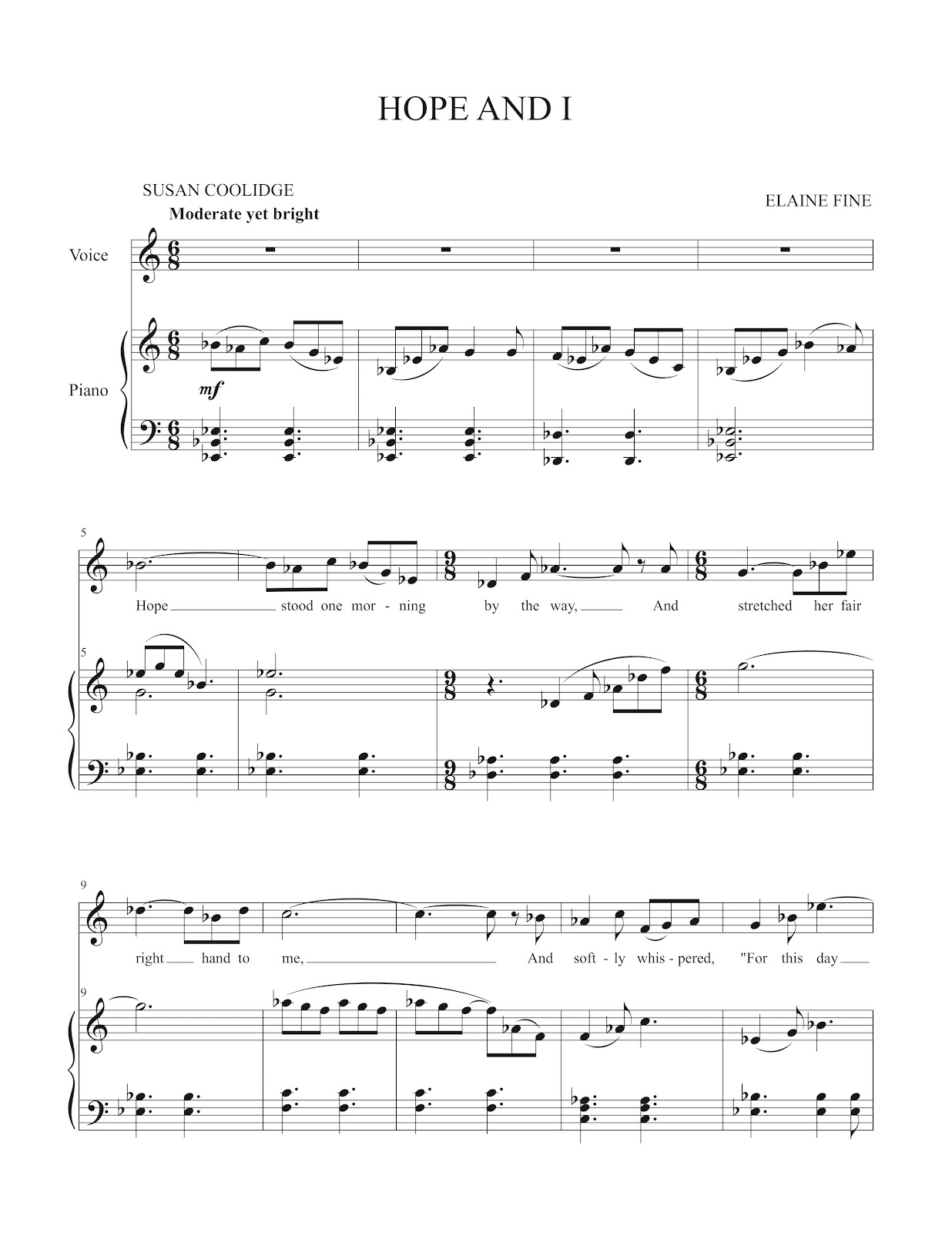 You can find the music here, on this page of the IMSLP. You can listen to a computer-generated recording here.


Friday, June 24, 2022

Wednesday, June 22, 2022
Pleasure, Haydn, and DNA
I was talking with my father about Haydn the other day, and he revealed to me that as a child he loved the same Haydn piano sonatas that I am currently obsesed with (currently meaning over the last decade or so, or since I have had possession of the music that once belonged to my brother). Objectively one could say that all Haydn Piano Sonatas are great in their own specific ways, and that there are some that are so unique, so inventive, so engaging, and so physically pleasurable to play that anyone might choose the same "favorites." One could also say that the Haydn Sonatas that have been anthologized would be the ones that people would play as children, but it seems that Haydn is too often thought of as a "gateway" to Mozart, Beethoven, or Schubert. Maybe it has something to do with the way Haydn gives even non-pianists so much physical pleasure.
My love of Haydn and string playing feels so "hard wired" that I don't feel odd imagining that those specific and particular pleasures are inherited.
It has been documented that trauma, particularly physical trauma, can be passed from one generation to the next. The field of study is called epigenetics, and involves chemical marks that can be left on a person's genes that changes the way a gene gets expressed. It's a new field, and everything I have seen on the internets seems to focus on studies involving inter-generational trauma.
What I wonder if the experince of pleasure that results from a person having a profound and sustained experience with practicing music or art (or literature, or math, or science, or sports, or dance . . . ) early in life, and having the pleasure be so great that it causes the chemical changes necessary for that particular pleasure to pass the ability to experience that pleasure onto future generations. We know that physical traits are passed from generation to generation, and, at least in my family, pitch memory (as in absolute pitch) and, it seems, intelligence and personality traits are inherited (she "takes after" her father, or he "takes after" his grandmother). Then there is the environmental factor.
But the idea of pleasure, something that is so subjective and not easy to quantify, seems to have been under-studied in this way.
I have heard many people say that they inherited their love of this or that from someone in their family, and are thrilled when they do genetic tests that identify a distant ancestor as a great athlete, an artist, or a leader in a political movement. (We do tend not to identify with direct blood relatives with qualities we do not like.)
What interests me particularly, though, is if someone happens to find something early in life that offers extreme pleasure that is not necessarily something present in their family life ("I don't know where she gets it from"), and through the support and nurturing of adults who care enough to support that child's obsession, could that child be changed in an epigenetic way that might pass that pleasure onto his or her children?
My love of Haydn and string playing feels so "hard wired" that I don't feel odd imagining that those specific and particular pleasures are inherited.
It has been documented that trauma, particularly physical trauma, can be passed from one generation to the next. The field of study is called epigenetics, and involves chemical marks that can be left on a person's genes that changes the way a gene gets expressed. It's a new field, and everything I have seen on the internets seems to focus on studies involving inter-generational trauma.
What I wonder if the experince of pleasure that results from a person having a profound and sustained experience with practicing music or art (or literature, or math, or science, or sports, or dance . . . ) early in life, and having the pleasure be so great that it causes the chemical changes necessary for that particular pleasure to pass the ability to experience that pleasure onto future generations. We know that physical traits are passed from generation to generation, and, at least in my family, pitch memory (as in absolute pitch) and, it seems, intelligence and personality traits are inherited (she "takes after" her father, or he "takes after" his grandmother). Then there is the environmental factor.
But the idea of pleasure, something that is so subjective and not easy to quantify, seems to have been under-studied in this way.
I have heard many people say that they inherited their love of this or that from someone in their family, and are thrilled when they do genetic tests that identify a distant ancestor as a great athlete, an artist, or a leader in a political movement. (We do tend not to identify with direct blood relatives with qualities we do not like.)
What interests me particularly, though, is if someone happens to find something early in life that offers extreme pleasure that is not necessarily something present in their family life ("I don't know where she gets it from"), and through the support and nurturing of adults who care enough to support that child's obsession, could that child be changed in an epigenetic way that might pass that pleasure onto his or her children?
Saturday, June 18, 2022
Arrangements for String Orchestra for 2022
Once I know that my Summer Strings arrangements work as expected, I like to share them with other ensembles. Here's this year's music. The pieces that are in the public domain are available in the IMSLP, and the pieces that are not in the public domain are in a dropbox folder I keep for sharing. If you are interested in using the music for personal, educational, or non-commercial purposes, please send me an email message, and I will send you a link to the shared folder.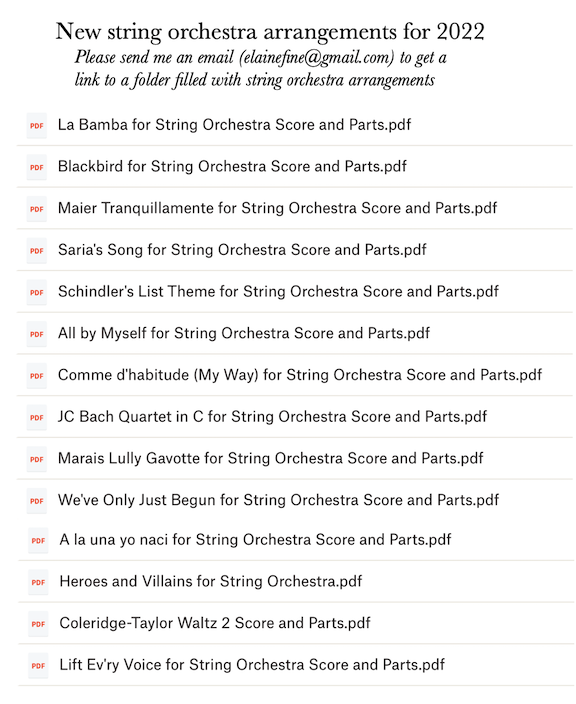
JULY UPDATE: You can listen here to a performance of this set of pieces given on July 12, 2022. The group is a collection of amateur musicians of all ages and all levels, and the program was put together in six ninety-minute rehearsals over the course of six weeks.

JULY UPDATE: You can listen here to a performance of this set of pieces given on July 12, 2022. The group is a collection of amateur musicians of all ages and all levels, and the program was put together in six ninety-minute rehearsals over the course of six weeks.
Friday, June 17, 2022
Getting from one note to the next
It has taken me decades to figure out how to make it from one note to the next expressively, effectively, and efficiently. I now find that paying attention to how one pitch follows another, how one group of pitches follows another, and how one phrase follows another is the most difficult, creative, and satisfying part of practicing violin and viola. It is rather difficult to write about, but I'll give it a try.
Julius Baker, my flute teacher at Juilliard, had a warm-up routine that he required all of his students to do. It mainly involved double-tonguing. Actually, come to think of it, it was totally about double-tonguing. The way he phrased the Allegro of the C major Bach Sonata, BWV 1033 (here transposed to F major) created a long and virtuosic phrase, particularly because he played it very fast:

After my time at Juilliard I went off to Austria, and I studied recorder in Vienna at the Hochschule with Hans Maria Kneihs. Though 21st-century recorder players incorporate double-tonguing, 20th-century recorder players who were attempting to sound like early-18th-century recorder players used a single tongue, and they (we) used it in approximation of the way we imagined string players used their bows. Here is what my (uninformed by actually being a string player) recorder phrasing would look like:
 Hans Kneihs talked about keeping harmonies together, and actually making psychological spacings between beats, allowing one group of four sixteenth notes to lead to the next without creating false accents. Hans had been a cellist, so he saw recorder playing as a way of freeing himself from the difficulties and complexities of bowing.
And the complexities of bowing involve making false accents because the "cocktail" of speed, pressure, where you are in the bow, if you have a string crossing, and your dynamic level all have to be factored into getting from one note to the next in a satisfying way. This illustration reveals the dangers of trying to move from the last sixteenth note of a measure using only the last note (and an up-bow note to boot) to do the heavy lifting (the "red" version).
It is so much easier to have the last group of four sixteenth notes, piloted by a down-bow (the purple), deliver the phrase into the next measure. For me it's a little like using a plastic cup to move sand rather than using a cup made of less-reliable fingers. And by doing this you begin to see possibilities of phrasing that involve features of the phrases--ways of hearing that you may not have thought about. The red example below is a rather straightforward way of thinking about directions that the phrases could go effectively.
 The purple example below is a little bit more creative, and technically and intellectually more difficult:
 I find it to be stimulating to think like this while I am practicing, particularly when I am practicing Bach, because his phrases are so durable and so interesting. Sometimes I aim for consistency, but more often I look and listen to see the patterns that can be revealed though observation.
Often I use this kind of mindset to tackle the questions of how much bow and where in the bow a useful up-bow might function well. Sometimes I incorporate slurs, and sometimes I reverse bowings, giving a chance to my bow arm to figure out how to do "heavy lifting" without making false accents.
I do it with etudes, and I even use this mindset to organize lyrical phrases and phrases in music from all periods. I strive to write durable phrases that can be interpreted in many ways, because this mindset has (finally) become hard-wired and permeates everything I do.
I used to tell my flute students that they needed to pay attention to where every note is, where it has been, and where it is going, but I didn't know how to teach them "how" to do it. I also could not figure out how to eliminate false accents aside from using the "baroque" method I learned from studying recorder.
Flutists have to use their imaginations for such things because they do not have a physical way to move their notes around aside from using their tongues, and there is no real resistance to play "against," unless it is music written specifically to employ the newer techniques that have expanded flute possibilities in the 21st century. Flute teaching and playing has also improved greatly since I left the fold. I have never heard Emmanuel Pahud play with false accents or unimaginative phrasing.
Brass players and reed players have the advantage of resistance, and singers have diction.
We all have rhythm, though.
I believe that all musicians who play music that is written have the obligation to make getting from one note to the next as pleasurable an experience as possible for themselves, they musical partners, and for whoever might be listening.
Julius Baker, my flute teacher at Juilliard, had a warm-up routine that he required all of his students to do. It mainly involved double-tonguing. Actually, come to think of it, it was totally about double-tonguing. The way he phrased the Allegro of the C major Bach Sonata, BWV 1033 (here transposed to F major) created a long and virtuosic phrase, particularly because he played it very fast:

After my time at Juilliard I went off to Austria, and I studied recorder in Vienna at the Hochschule with Hans Maria Kneihs. Though 21st-century recorder players incorporate double-tonguing, 20th-century recorder players who were attempting to sound like early-18th-century recorder players used a single tongue, and they (we) used it in approximation of the way we imagined string players used their bows. Here is what my (uninformed by actually being a string player) recorder phrasing would look like:

And the complexities of bowing involve making false accents because the "cocktail" of speed, pressure, where you are in the bow, if you have a string crossing, and your dynamic level all have to be factored into getting from one note to the next in a satisfying way. This illustration reveals the dangers of trying to move from the last sixteenth note of a measure using only the last note (and an up-bow note to boot) to do the heavy lifting (the "red" version).
It is so much easier to have the last group of four sixteenth notes, piloted by a down-bow (the purple), deliver the phrase into the next measure. For me it's a little like using a plastic cup to move sand rather than using a cup made of less-reliable fingers.


Often I use this kind of mindset to tackle the questions of how much bow and where in the bow a useful up-bow might function well. Sometimes I incorporate slurs, and sometimes I reverse bowings, giving a chance to my bow arm to figure out how to do "heavy lifting" without making false accents.
I do it with etudes, and I even use this mindset to organize lyrical phrases and phrases in music from all periods. I strive to write durable phrases that can be interpreted in many ways, because this mindset has (finally) become hard-wired and permeates everything I do.
I used to tell my flute students that they needed to pay attention to where every note is, where it has been, and where it is going, but I didn't know how to teach them "how" to do it. I also could not figure out how to eliminate false accents aside from using the "baroque" method I learned from studying recorder.
Flutists have to use their imaginations for such things because they do not have a physical way to move their notes around aside from using their tongues, and there is no real resistance to play "against," unless it is music written specifically to employ the newer techniques that have expanded flute possibilities in the 21st century. Flute teaching and playing has also improved greatly since I left the fold. I have never heard Emmanuel Pahud play with false accents or unimaginative phrasing.
Brass players and reed players have the advantage of resistance, and singers have diction.
We all have rhythm, though.
I believe that all musicians who play music that is written have the obligation to make getting from one note to the next as pleasurable an experience as possible for themselves, they musical partners, and for whoever might be listening.
Saturday, June 11, 2022

Wednesday, June 08, 2022
Charm, Passion, Acrobatics, and Kunc

I love the piece so much that I made a fresh engraving of it with a corrected viola part, and with editing help from Mr. Galaganov, who, in 2018, was one of only a handful of people who knew the piece (another was my stand-partner Daniel McCarthy, who turned pages for Mr. Galaganov's performance in Texas. Small viola world.)
I attribute the lack of popularity of the piece to the fact that the original viola part, with its dozens of errors, makes playing this very difficult piece even more difficult to put together. The engraving that I put in the IMSLP is probably the most massive engraving project I have done, but it was a labor of love and devotion, and I'm very pleased with the way it came out.
Mr. Galaganov, who sent me an audio file of his performance of this piece, is a teriffic violist. And he has great taste in his choice of music.
Here's a look at the first two pages of the piece:


You can read more about Pierre Kunc here.
Friday, June 03, 2022
“The Collar” in Italian!
Bassonist Michele Colombo made this wonderful recording in Italian of my setting
of this Hans Christian Andersen story.
Subscribe to:
Posts (Atom)