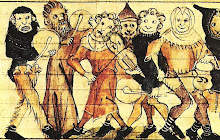
I suppose you could say that I am a city mouse, and since moving to the "country" 27 years ago, I haven't changed my stripes. I still busy myself with "city" (or old-school city) things, and I haven't forsaken city music for the country music that seems to be the music that really puts down roots and flourishes in this area. You could call it a Platzgeist.
Country music around here runs rather deep. There is a fiddle tradition that has deep roots in southern Illinois and Missouri, and, thanks to a bunch of musicians (some who happen to have grown up in the very town I'm writing from), that tradition has been preserved, and is still being preserved the old-fashioned way. The operative word for how this music is being preserved seems to be the word "collected," because people learn traditional fiddle tunes by going out into the country and playing with the old fiddlers who either made them up or learned them from another (perhaps even older) fiddler.
My friend Gaye Harrison, who was married to the recently (as in a few weeks ago) departed Garry Harrison, used the word "collected" to give the origin of a fiddle tune she played the other night (she was playing with a former student of mine who decided to try out life in the world of old-time music rather than the life of old-school music) at an enthusiastically-attended outdoor fundraising event.
I certainly don't begrudge people choosing old-time music over old-school music, but, being a "city mouse," I have never been very good at making old-time music myself.
We know a terrific plumber named Rick who grew up in Charleston during the 1960s and 70s. He loves to recite the various businesses that used to be on the town square, naming their owners, and discussing various features of the bowels of their buildings (which he knows intimately). It was a flourishing place of commerce. Rick told us that while he was growing up there wasn't anything anyone could possibly need that you couldn't get on the square.
Yesterday I had a phone conversation with a man in his 90s who grew up in Mattoon, a town eight miles west of Charleston, in the 1930s and 40s (he read about our Jewish Community Center in the Chicago Tribune). He talked about Mattoon as a paradise: an extremely tolerant and friendly place where businesses thrived. It was an important railroad town, complete with a roundhouse, and people who went into business there could have things sent in by train (fruit, furniture, hardware, clothes, you name it), and sell it in their stores.
Nobody in Charleston really had the need to go to Mattoon to get anything (Charleston had goods delivered by train as well), and nobody in Mattoon really needed to go to Charleston to get anything, except for "high-brow" culture.
Charleston has a university, and at one point the university had a president who loved music, and he encouraged the university to start a school of music. The school of music attracted some excellent musicians, and it looked like Charleston could eventually become a cultural center. I found a town plan in the public library that had an elaborate proposal (complete with pictures) to turn Charleston into a cultural resort-type town with an arts festival kind of like Interlochen. It all had something to do with a fake lake project, and I suppose this plan was part of Charleston's bid to get the lake, which would bring resort-type tourism to the area. People moved to town to get in on this project from the start, but the lake went to the town of Shelbyville, and the arts center was forgotten.
The Zeitgeist changed after that president retired, and the school of music became a department of music. The people (all city mice, like me) brought here as faculty members of the school of music have all retired, and many of them are no longer alive.
But the music that is native to the area is kept alive by people who care about it, and that is something to celebrate.
Tuesday, October 02, 2012


Monday, October 01, 2012
The United States of Alec
If you have 56 minutes, it would be really worth your while to watch this video made by Bill Moyers. If you don't have time to watch, take a look at the transcript.
I hate to use this space for things political, but with the privatization and "monetization" of everything, music and those of us who play it and write it (as well as those of us who listen to it) will have our lives changed drastically if this kind of thing continues. And the "beauty" of this widespread scheme is that it's all legal. Before our very eyes we have a "not-for-profit" institution that calls itself "educational" (so it doesn't pay taxes) doing the work that lobbyists are not allowed to do under the law.
Please watch this, and then share it with people you care about. I hate to go all negative here, but this is really SCARY, and really WRONG. This sort of thing should not happen in a democracy.
I hate to use this space for things political, but with the privatization and "monetization" of everything, music and those of us who play it and write it (as well as those of us who listen to it) will have our lives changed drastically if this kind of thing continues. And the "beauty" of this widespread scheme is that it's all legal. Before our very eyes we have a "not-for-profit" institution that calls itself "educational" (so it doesn't pay taxes) doing the work that lobbyists are not allowed to do under the law.
Please watch this, and then share it with people you care about. I hate to go all negative here, but this is really SCARY, and really WRONG. This sort of thing should not happen in a democracy.
A Glimpse into the GOP's Twisted Mirror
That, at heart, is the twisted beauty of the plan being championed by Ryan and Romney: The higher Republicans manage to drive up the debt, the more ammunition they have in their fight to slash federal spending for the needy. And the more time they waste trumpeting their "fiscal discipline," the more the nation's infrastructure will continue to crumble around them. Squandering two full workweeks of the congressional calendar on votes to repeal Obamacare has cost taxpayers $48 million. That's nearly the same amount of money now needed to repair cracks in the Capitol itself – spending the House GOP has refused to authorize, out of anti-governmental spite. "If the House wants the dome to fall in," said Senate Appropriations chair Ben Nelson, "I hope it falls on their side." If the Republicans experience a crushing blow as a result of their hard-right agenda, of course, it won't be caused by the laws of physics – it will be delivered by the voters on Election Day.Read Tim Dickinson's article in Rolling Stone.
Sunday, September 30, 2012
Moving Forward, for Better or for Whatever
I have thought about it, and I have asked about it, both privately and publicly, and nobody seems to be able to come up with a parallel in the non-musical world to the idea of music (the stuff you listen to) moving from being a service that a person pays for to a good that a person would buy. Perhaps that means that music is making a pioneering move that will only be followed by other services that will become goods.
Our friend Van Dyke Parks told a story about Lillian Gish (when he was a child actor, he had the privilege of working with her) saying that when the idea of sound was introduced to movies, the actors always thought it would be pre-recorded music and not dialogue. Anyone familiar with the film The Artist knows about what happened when actors were required to speak in order to continue working, and anyone not familiar with the film should see it.
Who would have imagined that the post office would be eclipsed by electronic mail, and who would have guessed that most of the calls that come to land-line phones (at least to our land-line phone) are sales calls and scams. Who would have imagined that it would be possible to instantly publish a personal newsletter that can be read by anyone anywhere with an internet connection, that can be instantly translated into hundreds of written languages with the touch of a button.
I wonder if on-the-spot real-time translation (or interpretation) will be the next service to become eclipsed by an automated product. In diplomatic situations and in international corporate conversations it is necessary, or order to really know what someone is saying, to have an interpreter present. If machines take over (and with voice recognition software, they just might) and do a reasonable job, there would be no professional application for people who speak many languages to earn their livelihoods as interpreters. They would need to work as translators who work with written documents, and the product of their work would be a "good": the written translation. Sure, they could interpret for free for their friends and family, and be entertaining at social gatherings. They could enjoy reading literature in the original languages, never need to read subtitles, and they could have nice full lives conversing with people from all over the world, but I imagine that many of the polyglots in our world who are not fortunate enough to land a steady translating job would have to find other things do in order to pay the bills.
Teaching would be an option, but foreign language programs in many of the smaller American universities are shrinking or disappearing, and high schools seem to be having difficulty teaching students to understand and use the grammar of English, the language that the majority of American school-age people speak. I believe a handful of public high schools still teach Latin, but I don't know of any that offer Ancient Greek. Perhaps private schools and charter schools offer these language options, but I imagine that a newly-graduated American polyglot with a Ph.D. would have to wait a long time for a foreign language position to open up in one of those schools. He or she would also be standing at the end of a long line of equally-brilliant and overqualified polyglots. The American polyglot would be forced, out of circumstance, to live elsewhere, either as an expatriate or as an immigrant on a track towards citizenship in a country that values his or her skills.
There is no going backwards. Our technologies are improving much more quickly than our skills, and there is scarcely any time left in the day to work on real-time skills unless we live lives of relative leisure (like me--I have time to practice and write because I am woefully under-employed, and have the great fortune to be married--28 years today--to a wonderful person who can also pay the bills).
We will never go "back" to a time when the only way you could hear music was to be within earshot of it.
We will never go "back" to a time when in order to communicate in writing to someone, you had to do it by making marks on a piece of paper (either by pen, pencil, or printing press) and delivering it to its reader (either within an envelope or within a book cover).
We will never go "back" to a time when ice covered most of the Arctic. And we (whoever "we" is) are physically unable to "freeze" it back up again.
But we do need to move forward and figure out how to make this a better world.
Our friend Van Dyke Parks told a story about Lillian Gish (when he was a child actor, he had the privilege of working with her) saying that when the idea of sound was introduced to movies, the actors always thought it would be pre-recorded music and not dialogue. Anyone familiar with the film The Artist knows about what happened when actors were required to speak in order to continue working, and anyone not familiar with the film should see it.
Who would have imagined that the post office would be eclipsed by electronic mail, and who would have guessed that most of the calls that come to land-line phones (at least to our land-line phone) are sales calls and scams. Who would have imagined that it would be possible to instantly publish a personal newsletter that can be read by anyone anywhere with an internet connection, that can be instantly translated into hundreds of written languages with the touch of a button.
I wonder if on-the-spot real-time translation (or interpretation) will be the next service to become eclipsed by an automated product. In diplomatic situations and in international corporate conversations it is necessary, or order to really know what someone is saying, to have an interpreter present. If machines take over (and with voice recognition software, they just might) and do a reasonable job, there would be no professional application for people who speak many languages to earn their livelihoods as interpreters. They would need to work as translators who work with written documents, and the product of their work would be a "good": the written translation. Sure, they could interpret for free for their friends and family, and be entertaining at social gatherings. They could enjoy reading literature in the original languages, never need to read subtitles, and they could have nice full lives conversing with people from all over the world, but I imagine that many of the polyglots in our world who are not fortunate enough to land a steady translating job would have to find other things do in order to pay the bills.
Teaching would be an option, but foreign language programs in many of the smaller American universities are shrinking or disappearing, and high schools seem to be having difficulty teaching students to understand and use the grammar of English, the language that the majority of American school-age people speak. I believe a handful of public high schools still teach Latin, but I don't know of any that offer Ancient Greek. Perhaps private schools and charter schools offer these language options, but I imagine that a newly-graduated American polyglot with a Ph.D. would have to wait a long time for a foreign language position to open up in one of those schools. He or she would also be standing at the end of a long line of equally-brilliant and overqualified polyglots. The American polyglot would be forced, out of circumstance, to live elsewhere, either as an expatriate or as an immigrant on a track towards citizenship in a country that values his or her skills.
There is no going backwards. Our technologies are improving much more quickly than our skills, and there is scarcely any time left in the day to work on real-time skills unless we live lives of relative leisure (like me--I have time to practice and write because I am woefully under-employed, and have the great fortune to be married--28 years today--to a wonderful person who can also pay the bills).
We will never go "back" to a time when the only way you could hear music was to be within earshot of it.
We will never go "back" to a time when in order to communicate in writing to someone, you had to do it by making marks on a piece of paper (either by pen, pencil, or printing press) and delivering it to its reader (either within an envelope or within a book cover).
We will never go "back" to a time when ice covered most of the Arctic. And we (whoever "we" is) are physically unable to "freeze" it back up again.
But we do need to move forward and figure out how to make this a better world.
Saturday, September 29, 2012
Thoth
I was really pleased to find this entire 42-minute-long documentary about the violinist/performance artist Thoth available to watch on YouTube:
Michael and I watched it last night on DVD, and we both found it fascinating. Thoth is the son of Elayne Jones, a great timpanist who was fired, for reasons connected with racial discrimination, from the San FranciscoOpera Symphony. I recognized her as soon as her face came on the screen, and was pleased to see that this multi-talented man is her son.
How this man can sing, dance, and play (while keeping the bow on the string) boggles the mind. This film, which was shot using sound that was generated from his instrument naturally, and enhanced by the natural acoustics of the tunnel in Central Park, depicts a person fully dedicated to his art and his craft, who can project the world of his (admittedly odd) imagination to total strangers and brighten their lives.
Compare the film above to this segment from his audition for America's Got Talent:
He sounds like a fish out of water amplified among the lights. The panel dismisses him immediately. The scorn on their faces shows the shallowness of their enterprise.
Michael and I watched it last night on DVD, and we both found it fascinating. Thoth is the son of Elayne Jones, a great timpanist who was fired, for reasons connected with racial discrimination, from the San Francisco
How this man can sing, dance, and play (while keeping the bow on the string) boggles the mind. This film, which was shot using sound that was generated from his instrument naturally, and enhanced by the natural acoustics of the tunnel in Central Park, depicts a person fully dedicated to his art and his craft, who can project the world of his (admittedly odd) imagination to total strangers and brighten their lives.
Compare the film above to this segment from his audition for America's Got Talent:
He sounds like a fish out of water amplified among the lights. The panel dismisses him immediately. The scorn on their faces shows the shallowness of their enterprise.
The Tiniest Jewish Congregation in the Country, in the Tribune
The article about the Mattoon Jewish Community Center (my little shul on the prairie) is on the first page of today's Chicago Tribune.
Friday, September 28, 2012
Yom Kippur with the Country's Smallest Reform Congregation
The Mattoon Jewish Community Center has the distinction of being, according to Reform Judiasm magazine, the smallest reform congregation in the country. A tiny item in the magazine caught the eye of a reporter from the Chicago Tribune (though nobody in our tiny congregation seemed to notice it), and a photographer came to photograph our service on Wednesday morning. I had no idea he was taking video, but now my shofar playing is documented for all the world to hear. The photographer wasn't planning to stay for the evening service (the shofar is only blown on Rosh Hashanah and at the very end of the last Yom Kippur service), but we thought it would be nice to have a photo of the shofar in action, so the shofar blowing was a staged shot. If I knew he was filming rather than taking a still picture, I would have played one of the appropriate motives.
On my Kol Nidre list for next year? Asking forgiveness for not warming up my lips for this (now) highly-public moment.
You can watch the video here.
There's going to be an article about us inSunday's Saturday's Chicago Tribune.
On my Kol Nidre list for next year? Asking forgiveness for not warming up my lips for this (now) highly-public moment.
You can watch the video here.
There's going to be an article about us in
Sunday, September 23, 2012
Music's Gradual Change from Being a Service to Being a Good
We are all currently witnessing something that traditionally was thought of as a service transform, through the magic of technology, into a good. And it seems that the trend might render music as a person's livelihood into something truly rare, and something reserved for the relative few.
We didn't think it would happen with 78 records, LP records, or tapes, but the transistor radio and the Walkman made it extremely enjoyable to listen to recordings while being out in the world (i.e. not at home), and listening to music became something private and personal. The quality of the CD and the quality of the technology that has gone into recording music on one end, and "spitting it out" on the other end has come to the point where rendered "readings" are even preferable for reasons of balance and of accuracy to natural ones.
The change has sure put a lot of musicians out of work over the past hundred years or so, because in places where musicians once provided the desired ambience, recordings do it for a tiny, tiny, tiny fraction of the price.
You can buy a CD for $15.00, and play it a thousand times without paying a cent more to anybody (and you can download the files for even less). The guests at your party, the people eating in your restaurant, or the people shopping your store will be bathed in its ambience, and the people who made the recordings, if they are still alive, will never even know. If you sell enough of these to enough people, the world will be flooded with electronically-generated sound with nary a musician attached to it. Oh yes. It already is pretty much that way with the "classical" kind of music.
I have been wracking my brain, and haven't found anything in current life or in the life of times past to compare this transformation of service to good with.
Can you?
UPDATE: I finally found one on-line discussion about this matter, and then another discussion about the question of whether music is a product or a service. If Jeff McDougall (the person who wrote one of the articles that started the discussion) happens to be reading this, I would love to have his take on this question.
We didn't think it would happen with 78 records, LP records, or tapes, but the transistor radio and the Walkman made it extremely enjoyable to listen to recordings while being out in the world (i.e. not at home), and listening to music became something private and personal. The quality of the CD and the quality of the technology that has gone into recording music on one end, and "spitting it out" on the other end has come to the point where rendered "readings" are even preferable for reasons of balance and of accuracy to natural ones.
The change has sure put a lot of musicians out of work over the past hundred years or so, because in places where musicians once provided the desired ambience, recordings do it for a tiny, tiny, tiny fraction of the price.
You can buy a CD for $15.00, and play it a thousand times without paying a cent more to anybody (and you can download the files for even less). The guests at your party, the people eating in your restaurant, or the people shopping your store will be bathed in its ambience, and the people who made the recordings, if they are still alive, will never even know. If you sell enough of these to enough people, the world will be flooded with electronically-generated sound with nary a musician attached to it. Oh yes. It already is pretty much that way with the "classical" kind of music.
I have been wracking my brain, and haven't found anything in current life or in the life of times past to compare this transformation of service to good with.
Can you?
UPDATE: I finally found one on-line discussion about this matter, and then another discussion about the question of whether music is a product or a service. If Jeff McDougall (the person who wrote one of the articles that started the discussion) happens to be reading this, I would love to have his take on this question.
Saturday, September 22, 2012
Nice Music for this New Obama Ad
I wish there were a way to find out who is writing some of the music used in the new Obama Ads.
I particularly enjoyed listening to the music in this one from just a few hours ago.
I particularly enjoyed listening to the music in this one from just a few hours ago.
Friday, September 21, 2012
The Musical "Marketplace" Is Changing Too Quickly
During the 1990s it seemed like there were hundreds and hundreds of brides and grooms in our area who wanted to have string quartets play at their weddings, and my quartet had pretty much as much work as we could handle during the summer months. Before the internet, there was the telephone, and when it rang it was almost never a sales call from some entity somewhere I have never heard of. Often it was a call about a wedding to play, or a party.
The internet and e-mail have certainly made it easier for people who are getting married to contact our quartet, but it has also jettisoned the practice of pairing up brides and string quartets into the territory of bidding and bargaining, which is not a healthy "place" for musicians to spend time.
I blame organizations like Gig Master. Gig Master seems to make its money from charging a fee for musicians to join and be part of their mega listing. They flood the search engines with links to pages for their musicians, and make it easy for "clients" to find possible "vendors." The "vendors" can "bid" for jobs, and the "client" will usually pick the "vendor" with the lowest price. This practice pits musician against musician, which does no good for building and maintaining a respectful society of working musicians.
Our quartet tried Gig Master, but we let our membership lapse after a year because we did not get a SINGLE wedding from being part of their network. We got inquiries, but, since there are four people in a quartet, and since we are all professionals and provide a consistently high-quality "product," we probably have a higher fee than those clients were willing to pay.
In the "market" for everything besides live music, the higher price "good" is usually considered the better "good." People imagine that a $150.00 pair of shoes will be better than a $20.00 pair of shoes. We are often encouraged to buy good things that won't wear out. High-quality cookware should last a lifetime. So should high-quality furniture. A high-quality musical performance lasts for as long as it takes for a musician or a group of musicians to play it.
It's hard to quantify music. If you go to a concert where the tickets cost $50.00, will that concert be as "good" as a concert where the tickets cost $20.00? Consumers want to know if what they are spending their money on is worth the price, and sometimes, when they lack the skills to tell the good from the great, they will convince themselves to enjoy less-than-enjoyable performances because of the price they paid for their tickets. Most of the concerts I play are not so expensive, so, when the concert is good, the people in the audience feel that they got a bargain: a lot of good music for relatively little money. Unfortunately the practice of newspapers paying critics to write honest and timely reviews of concerts is fading before our very eyes, so there is little in the way of post-concert "discussion" beyond talking with the people you happen to know in the audience.
More and more things in current culture seem to be quantified mainly by money. People pick expensive private colleges over state schools because they think the education they get at the more expensive college will be superior (forgetting, of course, that the real price for getting an education has to do with how much time and effort students put into their coursework). Some people make restaurant decisions based on price, and somehow believe that a $500.00 dinner for two would be "better" than one that costs half the price. People who can afford it make the same kinds of decisions about wine (Michael and I like the "house" brand of wine at a grocery store we frequent because of the variety. The wine varies from bottle to bottle, and it is always well worth the rock bottom price.)
I believe that music is not a thing you buy. Music (and that would be Music with a capital M) is played by people, and it happens in real time. Music is something that is different every time it is played. Music is written by people for people to play for their own enjoyment or for other people, and the price of admission that you pay at a concert should cover your part of the fee that the people playing are being paid and part of what it takes to manage a hall and all the workings behind putting on a concert. You are paying for the privilege of taking part in the Music that is happening.
The slope becomes slipperier and slipperier when people talk about buying music the same way they talk about buying a "thing." (I'm not talking about sheet music now, because I would classify that as more of a tool than a thing, though it is, actually, a thing.) When you buy a CD you are paying for the printing, design, engineering, and all the business-oriented stuff that is connected with making anything for publication. The sound stuff that is printed on the CD to make it something you can listen to should remain viable for a certain amount of time, but it is not something that can store recorded music permanently.
"Buying music" in current terms often means downloading an electronic "picture" of a performance or a rendering of several recorded musical fragments onto a device.
Let's hope that the musical "marketplace" will cycle back again, and Music will be thought of as something to experience rather than something to own. And maybe our quartet will get a few more weddings to play.
The internet and e-mail have certainly made it easier for people who are getting married to contact our quartet, but it has also jettisoned the practice of pairing up brides and string quartets into the territory of bidding and bargaining, which is not a healthy "place" for musicians to spend time.
I blame organizations like Gig Master. Gig Master seems to make its money from charging a fee for musicians to join and be part of their mega listing. They flood the search engines with links to pages for their musicians, and make it easy for "clients" to find possible "vendors." The "vendors" can "bid" for jobs, and the "client" will usually pick the "vendor" with the lowest price. This practice pits musician against musician, which does no good for building and maintaining a respectful society of working musicians.
Our quartet tried Gig Master, but we let our membership lapse after a year because we did not get a SINGLE wedding from being part of their network. We got inquiries, but, since there are four people in a quartet, and since we are all professionals and provide a consistently high-quality "product," we probably have a higher fee than those clients were willing to pay.
In the "market" for everything besides live music, the higher price "good" is usually considered the better "good." People imagine that a $150.00 pair of shoes will be better than a $20.00 pair of shoes. We are often encouraged to buy good things that won't wear out. High-quality cookware should last a lifetime. So should high-quality furniture. A high-quality musical performance lasts for as long as it takes for a musician or a group of musicians to play it.
It's hard to quantify music. If you go to a concert where the tickets cost $50.00, will that concert be as "good" as a concert where the tickets cost $20.00? Consumers want to know if what they are spending their money on is worth the price, and sometimes, when they lack the skills to tell the good from the great, they will convince themselves to enjoy less-than-enjoyable performances because of the price they paid for their tickets. Most of the concerts I play are not so expensive, so, when the concert is good, the people in the audience feel that they got a bargain: a lot of good music for relatively little money. Unfortunately the practice of newspapers paying critics to write honest and timely reviews of concerts is fading before our very eyes, so there is little in the way of post-concert "discussion" beyond talking with the people you happen to know in the audience.
More and more things in current culture seem to be quantified mainly by money. People pick expensive private colleges over state schools because they think the education they get at the more expensive college will be superior (forgetting, of course, that the real price for getting an education has to do with how much time and effort students put into their coursework). Some people make restaurant decisions based on price, and somehow believe that a $500.00 dinner for two would be "better" than one that costs half the price. People who can afford it make the same kinds of decisions about wine (Michael and I like the "house" brand of wine at a grocery store we frequent because of the variety. The wine varies from bottle to bottle, and it is always well worth the rock bottom price.)
I believe that music is not a thing you buy. Music (and that would be Music with a capital M) is played by people, and it happens in real time. Music is something that is different every time it is played. Music is written by people for people to play for their own enjoyment or for other people, and the price of admission that you pay at a concert should cover your part of the fee that the people playing are being paid and part of what it takes to manage a hall and all the workings behind putting on a concert. You are paying for the privilege of taking part in the Music that is happening.
The slope becomes slipperier and slipperier when people talk about buying music the same way they talk about buying a "thing." (I'm not talking about sheet music now, because I would classify that as more of a tool than a thing, though it is, actually, a thing.) When you buy a CD you are paying for the printing, design, engineering, and all the business-oriented stuff that is connected with making anything for publication. The sound stuff that is printed on the CD to make it something you can listen to should remain viable for a certain amount of time, but it is not something that can store recorded music permanently.
"Buying music" in current terms often means downloading an electronic "picture" of a performance or a rendering of several recorded musical fragments onto a device.
Let's hope that the musical "marketplace" will cycle back again, and Music will be thought of as something to experience rather than something to own. And maybe our quartet will get a few more weddings to play.
Thursday, September 20, 2012
How Playing the Viola (or any stringed instrument) is Like Playing with a Yo-Yo
I really enjoy listening to the How Stuff Works podcast. I always learn something I never knew before (or even really thought about), like how a yo-yo works. In the podcast I listened to yesterday, the banter concerned the way the spinning motion of a yo-yo gives it gyroscopic stability:
1. The yo-yo is held up in the air, giving it the potential to fall to the ground.I do not have the vocabulary or knowledge of physics to explain why sometimes it feels like pulling and pushing the bow perpendicularly across a string feels like using a yo-yo, but the above explanation does a good deal to illuminate the feelings of opposing forces that seem to be at work while I'm doing it. It is a helpful image to use in order to try to keep the string vibrating (or to minimize the gap in vibration) between bow changes.
2. The yo-yo has string wound around it, giving it the potential to spin as it unwinds.
When the yo-yo is released, both forms of potential energy change to kinetic energy. The yo-yo spool falls straight to the ground, which builds a certain amount of linear momentum (momentum in a straight line). At the same time, the string unwinds, and the spool spins, which builds angular momentum (momentum of rotation).
When the yo-yo reaches the end of the string, it can't fall any farther. But, because it has a good deal of angular momentum, it will keep spinning.
The spinning motion gives the yo-yo gyroscopic stability. A spinning object resists changes to its axis of rotation because an applied force moves along with the object itself. If you push on a point at the top of a spinning wheel, for example, that point moves around to the front of the wheel while it is still feeling the force you applied. As the point of force keeps moving, it ends up applying force on opposite ends of the wheel -- the force balances itself out. This phenomenon keeps a yo-yo's axis perpendicular to the string, as long as the yo-yo is spinning fast enough.
The Colbert Violin Bump
What a thrill it was to tune into the Colbert Report and hear yet another few minutes of terrific music. This time it was Itzhak Perlman playing Kreisler, and for no other reason but to play Kreisler on the TV for millions of people to enjoy. I was shocked to see that this morning, when I went to hear the extra web "song" (as Colbert jokingly called it), only 30 people had been there before me.
It was a very enjoyable Liebesfreud.
Here's the whole episode. Perlman plays Kreisler's arrangement of a piece from Falla's La Vida Breve near the end of the program.
These are pieces that every violinist knows and loves, and pieces that Perlman (and Fritz Kreisler) knew would tickle the inner violinist in anyone listening. One of the most exciting violin moments I have had happened at Juilliard during the first orchestral rehearsal for a performance of La Vida Breve. When the entire violin section (made of the violin stars of our present day who are now in their 50s) got a chance to play this tune, one that they all knew so well from this Kreisler arrangement, it felt like the walls had broken and music was flooding the room. There was such an outpouring of surprise and delight that I still feel it today. Perlman reminded me of that feeling last night.
Thank you Stephen Colbert for inviting Perlman to play on your show.
It was a very enjoyable Liebesfreud.
Here's the whole episode. Perlman plays Kreisler's arrangement of a piece from Falla's La Vida Breve near the end of the program.
These are pieces that every violinist knows and loves, and pieces that Perlman (and Fritz Kreisler) knew would tickle the inner violinist in anyone listening. One of the most exciting violin moments I have had happened at Juilliard during the first orchestral rehearsal for a performance of La Vida Breve. When the entire violin section (made of the violin stars of our present day who are now in their 50s) got a chance to play this tune, one that they all knew so well from this Kreisler arrangement, it felt like the walls had broken and music was flooding the room. There was such an outpouring of surprise and delight that I still feel it today. Perlman reminded me of that feeling last night.
Thank you Stephen Colbert for inviting Perlman to play on your show.
Wednesday, September 19, 2012
Colbert Report Cellist's Identity Revealed!
The kind people at the Colbert Report just told me that the cellist who played such elegant Bach last night was Maria Kitsopoulos. Here's her fresh-from-Naxos biography:
Maria Kitsopoulos, cellist, has been a member of the New York Philharmonic since 1996. She has traveled throughout Europe with the Ensemble Intercontemporain, performed with the Orpheus Chamber Orchestra, the Orchestra of St. Luke’s, the New York Chamber Symphony, and her own four-cello ensemble “Cello”. Solo orchestral engagements include the Phoenix Symphony, the Westfield Symphony (New Jersey), the Graz Orchestra and Athens State Orchestra. Her recordings include portrait discs of Nikos Skalkottas on BIS. She has made prominent appearances with Continuum and is soloist on Continuum’s Naxos Portrait of Leon Kirchner.
Nice Bach in a Totally Unexpected Place
Scroll over to 10:04 of last night's Colbert Report, and you'll hear a very nice performance of Prelude from the Bach G-major Cello Suite. The cellist isn't named, but I would love to know who she is so that I can tell her how much I liked her playing. Now what was the guy in the hat saying, anyway?
[By the way, we covered some Bach instrumental music in my classes yesterday, and I played my students a recording of the Courante from the Sixth Suite. My secret hope is that someone might have been watching this program with his or her friends, and that person could say "I bet that piece is part of a Bach cello suite."]
[By the way, we covered some Bach instrumental music in my classes yesterday, and I played my students a recording of the Courante from the Sixth Suite. My secret hope is that someone might have been watching this program with his or her friends, and that person could say "I bet that piece is part of a Bach cello suite."]
Monday, September 17, 2012
One Difference Between Fine Art and Mass Market Culture
"But I believe we do a disservice to the music and its audience by oversimplifying, demystifying and dis-empowering the magic of complexity in order to lure in possibly unreceptive or unwilling listeners. We rob them of the opportunity of discovering, when they are ready and without bias, the difference between the wondrous ineffability of fine art and the everyday barrage of mass market culture."You can read Martin Perry's whole post here.
Subscribe to:
Posts (Atom)