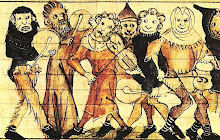
Is that a viola I see strapped to Apollo's belt?
[from this post on Bibliodyessey]

Music is a mystery for people who play it, write it, listen to it, and write about it. The only thing I can really do when I try to say something about music is assume.
Most listeners, regarding present-day music as harmful to the continuance of a traditional lineage, dismiss it as the work of fanatics. By avoiding the discomfort of exploring unknown territory, they do not retard progress but only their individual development. the race of the swift and the battle of the strong continue, but they are out of the running and blame modern conditions instead of their own intolerance and short-sightedness. We have experienced unbelievable development in radio, aeronautics, architecture, painting, and scientific research. Why should we not expect music to follow in the footsteps of its fellow-arts and of invention? It is the usual story of the vision of the few, which is gradually tolerated, then generally accepted, and finally superseded by a new vision. the natural procedure is from the know to the unknown, and the right of way to the New is contested at every step. Opposition to innovation has made history. We never profit by the experiences of the past. We do not seem to realize that we repeat what other ages have gone through, and never seem to understand the secrets the past would reveal. We are not inventors and innovators but merely pawns used by a force which is a composite of the accumulated needs, beliefs, desires, ambitions, inspirations, and inhibitions of each age. This gigantic force is the cause behind the ever-changing effects. Religion, politics, economics, social conditions, art, all act and react upon each other in response to this "spirit of the age," and in turn help to create it. . . . No matter how beautiful, how satisfactory, or how scientific the art of a period may be, we know that it encloses seeds of its fruition, and, at the same time, of its destruction. At the height of perfection, decay begins. The spirit of beauty caught in a net, subjected to a microscope, and preserved in alcohol becomes a museum specimen. Nor can art flourish in the strait-jacket of standardization. And so we see throughout the centuries three inevitable stages in every art epoch: youth, maturity, and decay. The fact that epochs overlap creates friction. The New is seldom welcome; it breeds alarm and distrust. In time it proves its right to a place in the sun, becomes overconfident and arrogant, and, finally, after a life or death struggle, is supplanted by an upstart, a usurper. And the cycle begins again!


Earlier in life Mr. Hirshbein had taken up auto racing, as a consequence of his friendship with James Dean, a racing enthusiast. The two had met when Dean was an unknown young actor.Who knew?
Dean was sitting on Mr. Hirshbein’s doorstep one day listening to him practice while waiting for a neighbor to return. When Jessica Hirshbein invited him in, Dean asked Mr. Hirshbein whether he could play Beethoven’s Opus 111 Sonata.
“That piece really swings,” Ms. Hirshbein recalled Dean saying. “ I love those syncopations."
After Dean was killed in an automobile crash in 1955, Mr. Hirshbein gave up auto racing at his wife’s insistence.