Tuesday, September 12, 2006

Bartok and Shostakovich Concertos in Finals

It looks like we will get to hear three performances of the Bartok Concerto #2 this weekend in Indianapolis. I don't think that the Bartok Concerto is on the "A" list of concertos that orchestras ask for when they engage violinists as soloists (the big Romantic concertos are the ones that draw in the audiences). Likewise with the Shostakovich, but because this is the 100th anniversary of his birth (I believe it is the 25th of September), he has gotten a great deal of play this year.

I'm hoping that these violinists play these concertos, particularly the Bartok, so well that every orchestra will want to play them.

Here are the finalists and the concertos they are playing


Wednesday

Lamsma: Mozart 5
Lee: Mozart 5
Choi: Mozart 3

Thursday

Hristova: Haydn
Golden: Mozart 4
Hadelich: Mozart 2

Friday

Lamsma: Shostakovich
Lee: Bartok
Choi: Shostakovich

Saturday

Hristova: Bartok
Golden: Dvorak
Hadelich: Bartok


Monday, September 11, 2006

Very Different Styles from the Same Teacher

How interesting to hear Stephanie Jeong and Anna Tifu in back-to-back recitals. Both are fine violinists, both are students of Aaron Rosand, and their musical personalities are very different from one another. Jeong seems to have a larger sound than Tifu, but Tifu is also an excellent violinist. Her interpretation of the Beethoven Spring is rather convetional to my ears, and her sound in it wasn't as strong as some of the other semi-finalists were in their Beethoven Sonatas. Her Franck was really fine, as was her Tzigane. The last performance of A Night at the Chinese Opera was just great, maybe one of the best of the 16 readings, but so was the penultimate performance by Jeong.

I feel for the judges because the musicians in this semi-final round are so impressive. My "short list" has eight people I would like to hear in the finals: Saeka Matsuyama, Simone Lamsma, Yura Lee, Bella Hristova, Augustin Hadelich, Celeste Golden, Stephanie Jeong, and Anna Tifu.

Very Exciting Bartok

Celeste Golden's performance with Akira Eguchi of the Bartok Sonata #1 was simply sensational. It think it was my favorite piano performance by Eguchi of the Competition. Augustin Hadelich's solo Bartok yesterday was also fantastic.

I imagine that Celeste Golden will be in the finals (her Romantic Concerto is the Dvorak), but some of the other people I imagine will be in the finals will be playing the Bartok Concerto #2. It is very likely that we will hear multiple performances of that piece this weekend, making the IVCI a sort of accidental Bartok festival.

Sunday, September 10, 2006

Augustin Hadelich

I was completely bowled over by the recital I heard Augustin Hadelich play in Indianapolis today (I heard it on line). I think that the difference between him and all the other violinists I have heard in this Indianapolis competition is that I could imagine myself playing like most of the other violinists, that is, if I had enough technique, strength, stamina, and if I had healthy nerves. With Augustin Hadelich it is different. When he plays, he challenges my musical imagination. I feel like I can understand his playing physically, but the excitement, intensity, and personal investment that goes into every note and every phrase sends his playing to a completely different musical level from anything I could ever even imagine attaining or really understanding.

I had my violin case open while I was watching his recorded performance, and I looked at him, and then looked at the picture of Michael Rabin I keep in my case. My reaction to Hadelich's playing is not that different from my reaction to Michael Rabin's playing.

The video of his recital is archived now, and may only be available for a few more days. If you want a thrill go here and follow the link to listen to the performances of the finalists.

Saturday, September 09, 2006

My moment with Chinese Opera

Listening to Bright Sheng's A Night at the Chinese Opera reminds me of my first encounter with Chinese Opera.

In the early 1980s I was filling for a music teacher on maternity leave at St. Catherine's School for Girls in Hong Kong. The pictures on the introduction to their website look exactly like the school looked over 20 years ago. The uniforms are the same, and they still have an orchestra (which was started by Keith Anderson, the person who now writes program notes for Naxos).

One afternoon I went on a field trip with my students to a rural part of Hong Kong that the other teachers said was very much like rural China. My job was to teach the girls at St. Catherine's Western music, and they decided that the bus ride was a chance for them to teach me something about Chinese music (I loved these girls).

First they taught me to sing Ach du lieber Augustine in Cantonese, and then they started singing some music from a Chinese opera. I was completely surprised by what I heard. They used their voices in very strange ways, but they seemed completely comfortable (these were very musical girls). I was also amazed that these young children would embrace what seemed to be a rather adult musical style. I guess I likened it to American children introducing their Chinese teacher to Western music by singing a bit of Verdi.

When my six weeks at St. Catherine's were up, the students gave me a box of small ceramic masks that represented characters in Chinese Opera.

Tremendous chamber music playing

What a treat to have just heard Yura Lee play Beethoven's First Sonata and Brahms' Third Sonata with Rohan De Silva at the IVCI this morning. I didn't expect to hear such fine chamber music playing in a competition! Their reading of the Bright Sheng piece was a true dialogue--extrordinarily engaging and exciting. Now on to Ysaye.

Friday, September 08, 2006

Bright Sheng's A Night at the Chinese Opera

What an exciting event this is: a world premiere of a fantastic new violin piece at the International Violin Competition of Indianapolis that is available for everyone to hear on line. Last night we got to hear the piece twice, and it was played with two vastly different interpretations.

Saeka Matsuyama, a Japanese violinist played it with rhythmic spring that immediately evoked images for me of the delicate and "over the top" stylized characters of the Chinese opera. Her performance was engaging and charming--dramatic and strong, but never "dramatic" in an overtly Western way. I particularly liked her range of sounds (that sounded like Chinese instruments), and her liberal use of slides.

Daniela Shtereva, a violinist from Bulgaria and her pianist played the piece in a far more aggressive way that sounded more like Western drama. Frankly it sounded like a wild night at a Bulgarian opera, which is highly appropriate because her dramatic, musical, and cultural experience comes from a tradition that is in a different world, both geographically and culturally, from the world of Chinese opera.

I'm really looking forward to today's performances.

This experience seems to be to be a lot like giving a bunch of visual artists the same set of objects to paint, using the same colors and the same materials, and observing that resulting paintings might have far more to do with the individuality of the artists than the objects themselves. This is a remarkable chance to witness the blurring of the lines between a composer and a collaborating performer, particularly since in this case it is the performer who is being judged.

There is also the cultural aspect. Bright Sheng grew up in Shanghai, but he was schooled in the Western musical tradition. Still, his music reflects who he is, and much of it is his music, though it uses Western instruments and techniques, consists of musical response to Chinese culture. He is such a fine composer because he writes music that reflects who he is as a musician as well as his cultural heritage. It is music that really works, music superbly written for the violin, and music that speaks in a way that goes far beyond the limits of spoken (or sung) language.

We are at an odd musical crossroads. There is no doubt for anyone listening to this competition that some of the most sublime musicians and finest violinists, playing music that we used to say belonged to a Western tradition, are from Asian countries or have one or two parents who come from countries in Asia. These musicians have, until now, been evaulated on their performances of music that has always been part of the tradition of the West.

All of a sudden things have changed, and we have the unique chance to watch and listen to it change before our very eyes and ears. All of a sudden 16 fantastic violinists who have been steeped in the traditions of the music Bach, Mozart, Beethoven, Paganini, and Ysaye, are stepping out of their musical skins and taking a huge leap out of that tradition into a world of musical wonder that most of them have never explored before: Chinese Opera. Bright Sheng is giving it to them on a silver platter, and they are giving it to the whole world for everyone to hear as it happens, in streaming audio.

Wednesday, September 06, 2006

Day Three: Waiting for the results

I'm trying to be patient. I imagine that thousands of other people (or maybe hundreds of thousands, who knows) are logging onto the IVCI website with the hopes of finding out who they will be hearing in the semi-final round.

I heard two violinists today who I really loved: Stephanie Jeong and Emilie-Anne Gendron. I heard Stephanie play at a master class ten years ago when she was 9. She played like a 20-year-old then, and she has continued to grow as a violinist and as a musician. I guess I would say that she plays with the musical mind of a very smart woman in her 60s, and has the physical stamina of a 19-year-old. She gets a personal award from me for the most inspiring use of the outer extremes of the bow. Gendron (who has a real college degree) played a stunning short piece by Sibelius, and my favorite Paganini Caprice (for listening), #9 (the one that imitates flutes and horns). I also loved her Bach A minor.

Well, it is time for me to try the IVCI website one more time. I hope that the results come in before I start teaching this afternoon.

Tuesday, September 05, 2006

Day Three of Listening to Violinists in Indianapolis

I have decided to be bold and list the violinists I have heard so far that I hope to see and hear in the semi-final round of the Indianapolis competition. There are seven people playing tomorrow.

Saeka Matsuyama (I liked what I heard through the technical recording difficulties)
Simone Lamsma
Daniel Khalikov
Zhijiong Wang
Ryoko Yano
Yura Lee
David Coucheron
Ye-Eun Choi
Bella Hristova
Yang Xu
Rachel Harding
Augustin Hadelich
Eunice Keem

Of course my list doesn't mean much of anything, but it will be fun to compare with the list that comes out of the computed calculations of the judges.

Monday, September 04, 2006

Indianapolis Competition Day Two

Like any good addict I have organized my day around my addictive activities, which means I basically spent most of the holiday today watching and listening to the competition. I did my eating and practicing during the breaks, and I listened to the archived performances that I missed because I was teaching.

Practicing this evening has been interesting for me. I was worried at first that I would be horribly disappointed with the level of my playing (I don't think I'll ever be able to play Paganini, even in private), but I feel like I really learned a lot from watching these young people play.

There are people I would love to hear play again, so I guess it does mean a lot to me who gets into the next round. I just hope that the judges have similar musical tastes to my musical taste. It seems that with playing at this high technical level, the thing that people will be judged most on is musical personality. Today there were people with musical personalities I liked with techniques that let them down and made them tense, and there were people with musical personalities I did not like who played without any technical flaws at all.

I'm looking forward to tomorrow.

Sunday, September 03, 2006

Listening to Violinists in Indianapolis

Now I understand how sports fanatics feel. I have been basically tied to my computer all day listening and watching (in real time) the prelimary round of the International Violin Competition of Indianapolis and I find it really hard to stop. I really like the way some of the violinists play, and I am indifferent to others. I'm glad I'm not one of the official judges of this competition, but I'm glad that I am able to watch and listen and learn about the process of judging, because, try as I may, I judge most of time. The only time I don't judge is when I am dazzled or fascinated by someone's musicianship.

I wonder how this computer access will affect the violinists who are playing. I'm sure that all of them are curious about one another's playing, and I'm sure that the voyeuristic ease of listening and watching on the computer would be very tempting for violinists who are playing this afternoon and in the rounds during the rest of the week.

Monday, August 28, 2006

Article about Meadowmount in Business Week

This is a very interesting article about the the Meadowmount School of Music. The unnamed writer of the article (s/he identifies himself or herself as a lapsed cellist) suggests that perhaps quantity of practice is more important than talent.

Saturday, August 26, 2006

Competitions past and Future

I am very excited about the International Violin Competition of Indianapolis because I will have the opportunity to go to Indianapolis to hear the final round of the competition and write about it for Strings and the American Record Guide. The competition begins on September 3, and all the rounds will be broadcast in real time over the web through the competition website.

Though I don't like "competition" as a rule when it comes to music, some of my most interesting experiences, musical and otherwise, happened at an international flute competition in Budapest, Hungary. I went to Budapest to play in the competition in September of 1980, between a summer orchestral job in Graz, Austria, and a job that I was going to begin at the end of September in Schladming, Austria.

Hungary was still a communist country in 1980, and its currency was "soft," meaning you could convert currency from Western Europe into forins, but you couldn't convert forins back into Western European currency. I didn't know anything about this at the time, so I converted nearly all my cash (it wasn't much) into forins, and had a blast in Budapest buying music (it was really cheap) and eating in restaurants. When it was time to leave Budapest I had what amounted to $35.00 tucked in a hiding place in my wallet, and that was the only way I could take the train from the Hungarian border to my destination in Austria.

All the flutists who played in the competition stayed in the same dormitory. There were people from all over the world, and I found that the people from Eastern Europe were particularly friendly. German was the common language then, but there were a bunch of people who were excited to speak in English. I remember one flutist from Budapest invited me to her house, which was palatial. Her father was some kind of party official, and she lived a rather charmed life. I also visited with a violinist friend named Maria Vermus who taught at the music academy in Budapest and was not connected with the party. She was a great violinist, one of finest I have ever heard, but even with a teaching position at a fine school she lived in near poverty.

The first round of the competition consisted of one of the Bach Sonatas for flute and continuo (the C major, E minor, or E major--I chose the E major). I remember reading through the piece with the harpsichordist who played for everyone in the competition, and then meeting another harpsichordist, a student at the Academy named Geza, who was very eager to talk (in English) about my rather funky (now it would be considered historically-informed performance practice) way of playing Bach. He also wanted to talk about Western philosophy and play some sonatas together. Geza brought up all kinds of things that I had never thought about like the different national styles in Bach's writing for flute.

When I heard the Italian flutist Massimo Merceli play the C major Bach Sonata, I understood exactly what the Italian style, as explained to me by Geza, was all about. Massimo played beautifully, but he didn't make it past the preliminary round. When it was time for me to play I completely re-thought my E major Sonata, and I played it in the Italian style. I had a wonderful time pIaying, and was really happy to have gotten new musical insights from Geza, the Hungarian harpsichordist, and from hearing one of my fellow competitors play in a way that was truly beautiful. I didn't make it into the semi-final round either. Maybe the judges, who I believe were mostly French, didn't particularly like the Italian style of playing Bach. Who knows.

I had a great time in Budapest after the prelimary round was over. I can't remember who won the competition, but I do know that Massimo, who played in a way that really meant something, has a career as a soloist now.

Thursday, August 24, 2006

Holst's "The Planets" is once again up to date

I just learned from my husband Michael that Pluto was voted out of our solar system. It is indeed a sad day in my house. The only consolation for me is that the solar system as described musically in Gustav Holst's The Planets from 1916 once again reflects the current "face" of our solar system.

Friday, August 11, 2006

My mother's eyes and ears


My mother was a flutist until she was no longer able to play because of an operation she had on her hands. Though she has had arthritis since she was a little girl, she was still able to play flute until she was in her forties. I started playing the flute (her flute) when she stopped.

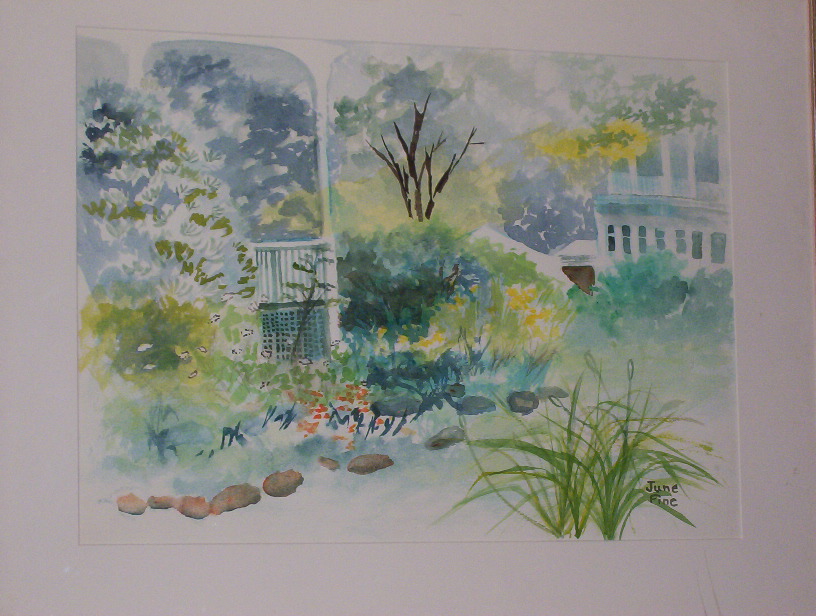
When she had to stop playing she decided to follow another creative path and became a painter. The paintings I remember from my childhood were not particularly impressive--mostly trees and flowers. She studied and worked very diligently at her painting while I moved to Illinois and raised a family of my own, so I saw very little of her more mature work. I was proud of my mother's accomplishments as a painter, and I liked the paintings I had seen, but I had no idea about the scope and quantity of her work.

My mother's vision has been deteriorating for the past ten years, and she is now completely blind. She asked me if I would like to take some paintings home with me on my next visit. My next visit was this past week. I felt odd taking paintings off her walls, but It felt wonderful to be able to have a piece of my mother's lost vision. That she was able to acquire enough technique to capture what she saw was a great gift. She put a tremendous amount of love into her work, and it is still there in her paintings. Her love can hang on my walls, and I can see it and feel it any time I want.

My mother also let me have her flute. It was the flute I practiced on for hours and hours every day during the first two years I played. She had extra keys and levers put on the instrument to make it possible for her to play it (they didn't really work--the surgeon she had put a pin in her thumb so that she couldn't bend it enough to hold the flute). I played it in her living room the day before yesterday. I played the siciliano from the Bach E flat Sonata, a piece I haven't thought about in years. It felt unusual and exciting to play, bringing back my tactile and aural memories from playing the instrument when I was 14, and feeling the similarity of my "voice" and my mother's "voice."