Like any good addict I have organized my day around my addictive activities, which means I basically spent most of the holiday today watching and listening to the competition. I did my eating and practicing during the breaks, and I listened to the archived performances that I missed because I was teaching.
Practicing this evening has been interesting for me. I was worried at first that I would be horribly disappointed with the level of my playing (I don't think I'll ever be able to play Paganini, even in private), but I feel like I really learned a lot from watching these young people play.
There are people I would love to hear play again, so I guess it does mean a lot to me who gets into the next round. I just hope that the judges have similar musical tastes to my musical taste. It seems that with playing at this high technical level, the thing that people will be judged most on is musical personality. Today there were people with musical personalities I liked with techniques that let them down and made them tense, and there were people with musical personalities I did not like who played without any technical flaws at all.
I'm looking forward to tomorrow.
Monday, September 04, 2006


Sunday, September 03, 2006
Listening to Violinists in Indianapolis
Now I understand how sports fanatics feel. I have been basically tied to my computer all day listening and watching (in real time) the prelimary round of the International Violin Competition of Indianapolis and I find it really hard to stop. I really like the way some of the violinists play, and I am indifferent to others. I'm glad I'm not one of the official judges of this competition, but I'm glad that I am able to watch and listen and learn about the process of judging, because, try as I may, I judge most of time. The only time I don't judge is when I am dazzled or fascinated by someone's musicianship.
I wonder how this computer access will affect the violinists who are playing. I'm sure that all of them are curious about one another's playing, and I'm sure that the voyeuristic ease of listening and watching on the computer would be very tempting for violinists who are playing this afternoon and in the rounds during the rest of the week.
I wonder how this computer access will affect the violinists who are playing. I'm sure that all of them are curious about one another's playing, and I'm sure that the voyeuristic ease of listening and watching on the computer would be very tempting for violinists who are playing this afternoon and in the rounds during the rest of the week.
Monday, August 28, 2006
Article about Meadowmount in Business Week
This is a very interesting article about the the Meadowmount School of Music. The unnamed writer of the article (s/he identifies himself or herself as a lapsed cellist) suggests that perhaps quantity of practice is more important than talent.
Saturday, August 26, 2006
Competitions past and Future
I am very excited about the International Violin Competition of Indianapolis because I will have the opportunity to go to Indianapolis to hear the final round of the competition and write about it for Strings and the American Record Guide. The competition begins on September 3, and all the rounds will be broadcast in real time over the web through the competition website.
Though I don't like "competition" as a rule when it comes to music, some of my most interesting experiences, musical and otherwise, happened at an international flute competition in Budapest, Hungary. I went to Budapest to play in the competition in September of 1980, between a summer orchestral job in Graz, Austria, and a job that I was going to begin at the end of September in Schladming, Austria.
Hungary was still a communist country in 1980, and its currency was "soft," meaning you could convert currency from Western Europe into forins, but you couldn't convert forins back into Western European currency. I didn't know anything about this at the time, so I converted nearly all my cash (it wasn't much) into forins, and had a blast in Budapest buying music (it was really cheap) and eating in restaurants. When it was time to leave Budapest I had what amounted to $35.00 tucked in a hiding place in my wallet, and that was the only way I could take the train from the Hungarian border to my destination in Austria.
All the flutists who played in the competition stayed in the same dormitory. There were people from all over the world, and I found that the people from Eastern Europe were particularly friendly. German was the common language then, but there were a bunch of people who were excited to speak in English. I remember one flutist from Budapest invited me to her house, which was palatial. Her father was some kind of party official, and she lived a rather charmed life. I also visited with a violinist friend named Maria Vermus who taught at the music academy in Budapest and was not connected with the party. She was a great violinist, one of finest I have ever heard, but even with a teaching position at a fine school she lived in near poverty.
The first round of the competition consisted of one of the Bach Sonatas for flute and continuo (the C major, E minor, or E major--I chose the E major). I remember reading through the piece with the harpsichordist who played for everyone in the competition, and then meeting another harpsichordist, a student at the Academy named Geza, who was very eager to talk (in English) about my rather funky (now it would be considered historically-informed performance practice) way of playing Bach. He also wanted to talk about Western philosophy and play some sonatas together. Geza brought up all kinds of things that I had never thought about like the different national styles in Bach's writing for flute.
When I heard the Italian flutist Massimo Merceli play the C major Bach Sonata, I understood exactly what the Italian style, as explained to me by Geza, was all about. Massimo played beautifully, but he didn't make it past the preliminary round. When it was time for me to play I completely re-thought my E major Sonata, and I played it in the Italian style. I had a wonderful time pIaying, and was really happy to have gotten new musical insights from Geza, the Hungarian harpsichordist, and from hearing one of my fellow competitors play in a way that was truly beautiful. I didn't make it into the semi-final round either. Maybe the judges, who I believe were mostly French, didn't particularly like the Italian style of playing Bach. Who knows.
I had a great time in Budapest after the prelimary round was over. I can't remember who won the competition, but I do know that Massimo, who played in a way that really meant something, has a career as a soloist now.
Though I don't like "competition" as a rule when it comes to music, some of my most interesting experiences, musical and otherwise, happened at an international flute competition in Budapest, Hungary. I went to Budapest to play in the competition in September of 1980, between a summer orchestral job in Graz, Austria, and a job that I was going to begin at the end of September in Schladming, Austria.
Hungary was still a communist country in 1980, and its currency was "soft," meaning you could convert currency from Western Europe into forins, but you couldn't convert forins back into Western European currency. I didn't know anything about this at the time, so I converted nearly all my cash (it wasn't much) into forins, and had a blast in Budapest buying music (it was really cheap) and eating in restaurants. When it was time to leave Budapest I had what amounted to $35.00 tucked in a hiding place in my wallet, and that was the only way I could take the train from the Hungarian border to my destination in Austria.
All the flutists who played in the competition stayed in the same dormitory. There were people from all over the world, and I found that the people from Eastern Europe were particularly friendly. German was the common language then, but there were a bunch of people who were excited to speak in English. I remember one flutist from Budapest invited me to her house, which was palatial. Her father was some kind of party official, and she lived a rather charmed life. I also visited with a violinist friend named Maria Vermus who taught at the music academy in Budapest and was not connected with the party. She was a great violinist, one of finest I have ever heard, but even with a teaching position at a fine school she lived in near poverty.
The first round of the competition consisted of one of the Bach Sonatas for flute and continuo (the C major, E minor, or E major--I chose the E major). I remember reading through the piece with the harpsichordist who played for everyone in the competition, and then meeting another harpsichordist, a student at the Academy named Geza, who was very eager to talk (in English) about my rather funky (now it would be considered historically-informed performance practice) way of playing Bach. He also wanted to talk about Western philosophy and play some sonatas together. Geza brought up all kinds of things that I had never thought about like the different national styles in Bach's writing for flute.
When I heard the Italian flutist Massimo Merceli play the C major Bach Sonata, I understood exactly what the Italian style, as explained to me by Geza, was all about. Massimo played beautifully, but he didn't make it past the preliminary round. When it was time for me to play I completely re-thought my E major Sonata, and I played it in the Italian style. I had a wonderful time pIaying, and was really happy to have gotten new musical insights from Geza, the Hungarian harpsichordist, and from hearing one of my fellow competitors play in a way that was truly beautiful. I didn't make it into the semi-final round either. Maybe the judges, who I believe were mostly French, didn't particularly like the Italian style of playing Bach. Who knows.
I had a great time in Budapest after the prelimary round was over. I can't remember who won the competition, but I do know that Massimo, who played in a way that really meant something, has a career as a soloist now.
Thursday, August 24, 2006
Holst's "The Planets" is once again up to date
I just learned from my husband Michael that Pluto was voted out of our solar system. It is indeed a sad day in my house. The only consolation for me is that the solar system as described musically in Gustav Holst's The Planets from 1916 once again reflects the current "face" of our solar system.
Friday, August 11, 2006
My mother's eyes and ears
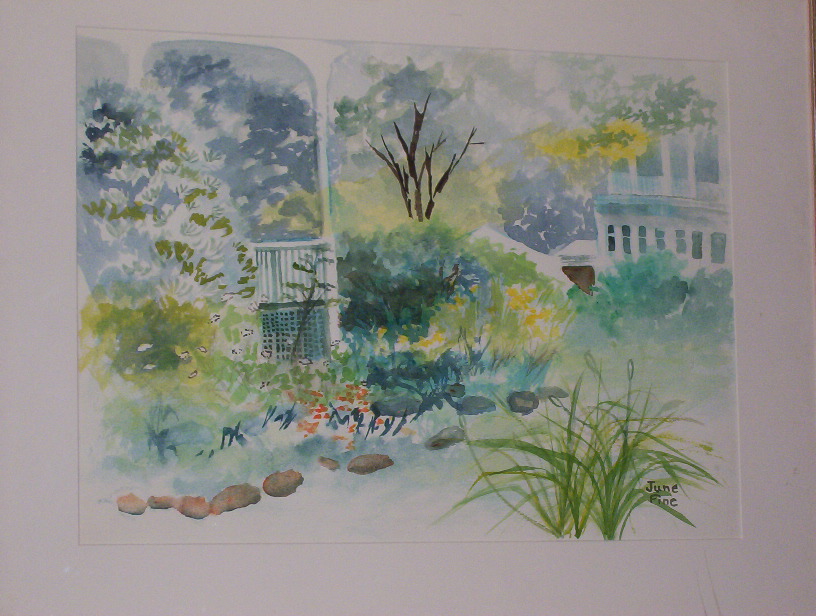
My mother was a flutist until she was no longer able to play because of an operation she had on her hands. Though she has had arthritis since she was a little girl, she was still able to play flute until she was in her forties. I started playing the flute (her flute) when she stopped.
When she had to stop playing she decided to follow another creative path and became a painter. The paintings I remember from my childhood were not particularly impressive--mostly trees and flowers. She studied and worked very diligently at her painting while I moved to Illinois and raised a family of my own, so I saw very little of her more mature work. I was proud of my mother's accomplishments as a painter, and I liked the paintings I had seen, but I had no idea about the scope and quantity of her work.
My mother's vision has been deteriorating for the past ten years, and she is now completely blind. She asked me if I would like to take some paintings home with me on my next visit. My next visit was this past week. I felt odd taking paintings off her walls, but It felt wonderful to be able to have a piece of my mother's lost vision. That she was able to acquire enough technique to capture what she saw was a great gift. She put a tremendous amount of love into her work, and it is still there in her paintings. Her love can hang on my walls, and I can see it and feel it any time I want.
My mother also let me have her flute. It was the flute I practiced on for hours and hours every day during the first two years I played. She had extra keys and levers put on the instrument to make it possible for her to play it (they didn't really work--the surgeon she had put a pin in her thumb so that she couldn't bend it enough to hold the flute). I played it in her living room the day before yesterday. I played the siciliano from the Bach E flat Sonata, a piece I haven't thought about in years. It felt unusual and exciting to play, bringing back my tactile and aural memories from playing the instrument when I was 14, and feeling the similarity of my "voice" and my mother's "voice."
Friday, August 04, 2006
Playing music with kids just for fun
For the second summer in a row a friend and I have "run" a program that we call "Summer Strings." We meet once a week during about 8 weeks of the summer, and we play music. The general favorites are pieces by Handel, Vivaldi, and Mozart, but we also mix things up with arrangements of show tunes and music from movies. Since there is not that much music for string orchestra that is accessible to younger kids, we play a lot of "custom" arrangements (in other words, quartet arrangements I have made over the years) of pieces. We have unwritten and unspoken guidelines for our group: anyone of any age and any playing level can come and play, nobody is required to come, it doesn't cost anybody anything (the local arts council gave us money for photocopying) anyone can sit wherever he or she wants, nobody practices the music (they can't--it stays in the place we play), anyone can make comments and tempo suggestions, and we do not have a conductor.
At the beginning of each summer things are a bit rough. People are shy and a bit insecure. By the end of the summer we have real music making. Without having to be told in any way at all, the people who participate in Summer Strings know the social and musical rewards of practicing, and they learn the joy of playing music in a situation that is totally devoid of pressure.
I'm really looking forward to next summer.
At the beginning of each summer things are a bit rough. People are shy and a bit insecure. By the end of the summer we have real music making. Without having to be told in any way at all, the people who participate in Summer Strings know the social and musical rewards of practicing, and they learn the joy of playing music in a situation that is totally devoid of pressure.
I'm really looking forward to next summer.
Tuesday, July 25, 2006
Gilles Apap Mozart Cadenza
I love Gilles Apap's playing, and it is just great to have this video clip of him accessible to anyone by way of YouTube.
Thursday, July 20, 2006
Excellent Mozart Article in the New Yorker
"Examination of Mozart’s surviving sketches and drafts—Constanze threw many sketches away—reveals that the composer sometimes began a piece, set it aside, and resumed it months or years later; rewrote troubling sections several times in a row; started movements from scratch when a first attempt failed to satisfy; and waited to finish an aria until a singer had tried out the opening. Ulrich Konrad calls these stockpiles of material “departure points”—“a delineation of intellectual places to which Mozart could return as necessary.” In other words, the music in Mozart’s mind may have been like a huge map of half-explored territories; in a way, he was writing all his works all the time. The new image of him as a kind of improvising perfectionist is even more formidable than the previous one of God’s stenographer. Ambitious parents who are currently playing the “Baby Mozart” video for their toddlers may be disappointed to learn that Mozart became Mozart by working furiously hard, and, if Constanze was right, by working himself to death."
I was really happy to come across this article called A Storm of Style by Alex Ross in the New Yorker. The article speaks for itself: no comment is needed. I'm glad that a "hard copy" will be arriving in the mail shortly because this is one I would like to read many times.
Sunday, July 16, 2006
Just the way it has always been
I find a special pleasure knowing that when I practice I am doing pretty much the same thing in the pretty much the same way that I would have done ten years ago, or twenty years ago, or fifty years ago, or one hundred years ago, or one hundred fifty years ago, or even two hundred years ago. In this modern world where much of the technology we use on a daily basis changes so quickly it is nice to know that the most important musical technology, careful practicing, has remained pretty much the same.
Wednesday, July 12, 2006
Making judgements about music
"No art is so subject to indiscriminate judgement as music. It would seem that nothing could be easier to judge. Not only professional musicians, but even those who pose as amateurs, would like to be regarded as judges of what they hear."
". . . We fare no better with regard to composition. We would not willingly be considered ignorant, and yet we do not always feel that we are capable of deciding matters rightly. Thus, in order that we may regulate our judgements accordingly, our first question is usually, 'By whom is the piece composed?' If, then, the piece is by someone to whom we have previoulsy given our approval, we immediately, and without further reflection, declare it beautiful. If the opposite is the case, or if we perhaps object to something about the person of the composer, the piece too is considered worthless. If anyone wishes to be palpably convinced of this, he needs only to put forth two compositions of equal quality under different names, one in good, the other in bad repute. The ignorance of many judges will soon be apparent."
Johann Joachim Quantz, On Playing the Flute (1752), translated by Edward R. Reilly
Musicians are still basically an insecure lot, and there is nothing that aggravates musicians' insecurities more than having to make a judgement about a piece of music written by a living composer. There seem to be all sorts of strings attached to formulating an opinion, including exposing oneself as being ignorant of 20th century- or 21st-century techniques, or being thought of as "backwards" for embracing and enjoying tonality. Some people find favor with music from "exotic cultures" simply because of the "hipness" of the culture, whether it be foreign or domestic; and some people have preconceptions about music written by a person of a particular nationality, and they don't know whether to judge the music as "good" on the basis of how much it represents their own preconceptions of the culture. We also still tend to judge music on the basis of the gender of the composer.
I find myself in at least three positions regarding making judgements about music. Since I write CD reviews, I am required to make judgements about recordings I hear. I always have to go with my instincts regarding new music that is unfamiliar to me. Through reviewing recordings I have found several living composers who have written pieces of music that I really like. I feel it is my duty as a musician to say why I like what they have written. Hopefully there are music lovers and composers who appreciate my efforts.
As a performing musician I look for usefulness in music. If I am going to perform a piece of music, I want it to be a piece that I can spend several hours a day with for a long time. I want it to be a piece that is continually interesting for me to practice and rehearse. I want it to be a piece that can eventually sound good on my instrument, and a piece that I can express myself through musically.
As a composer, everything is different when it comes to making judgements about music because I don't write music to be judged. I write music because I like to write music. I do not consider anything I write to be anything besides what it is: music to play and to enjoy. It is not great. It is what it is. It is a vacation from what I do as a "critic," but not far removed from what I do as a performing musician because I do feel that it is somehow useful. People still need new music to play, and people (people who do not feel the burden of having to make any sort of "larger" judgement) seem to like listening to the stuff I write. I have come to the conclusion that people of the present like to have music and art that reflects something of whatever this era we live in is, and as long as I need to express myself in this way, it is perfectly fine to do so.
So, if anyone reading this ever hears anything I write, please refrain from having to make a judgement about it and its place in the "grand scheme" of music. Just enjoy it if you do, and listen to something else if you don't. I imagine there are other composers who feel this way.
Monday, July 03, 2006
Words on marrying well from Virgil Thomson
This is from Virgil Thomson's 1939 essay "How Composers Eat, or Who Does What to Whom and Who gets Paid."
. . . A surprisingly large number of composers are men of private fortune. Some of these have it from papa, but the number of those who have married their money is not small. The composer, in fact, is rather in demand as a husband. Boston and New England generally are noted for the high position there allotted to musicians in the social hierarchy and for the number of gifted composers who have in consequence married into flowery beds of ease. I don't know why so many composers marry well, but they do. It is a fact. I don't suppose their sexuality is any more impressive than anybody else's, though certainly, as intellectuals go, the musician yields to none in that domain. After all, if a lady of means really wants an artistic husband, a composer is about the best bet, I imagine. Painters are notoriously unfaithful, and they don't age gracefully. They dry up and sour. Sculptors are of an incredible stupidity. Poets are either too violent or too tame, and terrifyingly expensive. Also, due to the exhausting nature of their early lives, they are likely to be impotent after forty. Pianists and singers are megalomaniacs; conductors worse. Besides, executants don't stay home enough. The composer, of all art-workers in the vineyard, has the prettiest manners and ripens the most satisfactorily. His intellectual and his amorous powers seldom give completely out before his death.
. . . A surprisingly large number of composers are men of private fortune. Some of these have it from papa, but the number of those who have married their money is not small. The composer, in fact, is rather in demand as a husband. Boston and New England generally are noted for the high position there allotted to musicians in the social hierarchy and for the number of gifted composers who have in consequence married into flowery beds of ease. I don't know why so many composers marry well, but they do. It is a fact. I don't suppose their sexuality is any more impressive than anybody else's, though certainly, as intellectuals go, the musician yields to none in that domain. After all, if a lady of means really wants an artistic husband, a composer is about the best bet, I imagine. Painters are notoriously unfaithful, and they don't age gracefully. They dry up and sour. Sculptors are of an incredible stupidity. Poets are either too violent or too tame, and terrifyingly expensive. Also, due to the exhausting nature of their early lives, they are likely to be impotent after forty. Pianists and singers are megalomaniacs; conductors worse. Besides, executants don't stay home enough. The composer, of all art-workers in the vineyard, has the prettiest manners and ripens the most satisfactorily. His intellectual and his amorous powers seldom give completely out before his death.
Saturday, July 01, 2006
Song of the Limberlost: a new piece for harp
Last summer, after promising myself that I would have nothing to do with composition contests, I wrote a piece for one. I did it because the specifics of the contest (it is called the USA International Harp Competition) asked for a piece that had something to do with Gene Stratton-Porter, who is one of my favorite writers. My first favorite book ever was The Magic Garden. I found a copy of it in my attic when I was a child. I was looking for The Secret Garden because my fourth grade teacher was reading it to us, and I wanted to read ahead. I read it countless times in childhood, and was able to read it again in adulthood when my husband Michael found a copy of it through a used book store many years ago, and gave it to me as a present. He also read it out loud to me. What a guy.
When I moved to my small midwestern town I actually found people who knew who Gene Stratton-Porter was, and there were even books of hers in the local library. Thanks to the library and to interlibrary loan (and a few lucky days in used book stores) I was able to read nearly all of her books in their original editions. Now her books have been reissued and are easily available. They are still rare and special to me.
For this contest I chose to write reflections on A Girl of the Limberlost because I have always wanted to write a piece to reflect the music in the novel. I am very proud of what I wrote, but it didn't win any of the prizes offered by the competition.
The big prize for me is that now I can share the piece, and anyone can play it. Here is a recording of it played by Julia Kay Jamieson.
When I moved to my small midwestern town I actually found people who knew who Gene Stratton-Porter was, and there were even books of hers in the local library. Thanks to the library and to interlibrary loan (and a few lucky days in used book stores) I was able to read nearly all of her books in their original editions. Now her books have been reissued and are easily available. They are still rare and special to me.
For this contest I chose to write reflections on A Girl of the Limberlost because I have always wanted to write a piece to reflect the music in the novel. I am very proud of what I wrote, but it didn't win any of the prizes offered by the competition.
The big prize for me is that now I can share the piece, and anyone can play it. Here is a recording of it played by Julia Kay Jamieson.
Wednesday, June 14, 2006
Back to Reality
Well, I have taken off the fairy-princess dress, and I am back practicing viola. I have viola music to learn, and the only way to play viola parts well is to practice them on the viola. Of course I have to do my Sevcik too since I have become greedy and still want to acquire more technique.
I'm giving my violin a well-deserved rest until it's time to work on the Debussy Sonata. I hope it appreciates the time off.
So what have I noticed about the viola that I didn't notice before? The resonance is totally different from the resonance of the violin. There is much more potential for roughness in the sound, and the upper register has a quality very much unlike the sweetness of the violin's high register. I also notice that I am far more comfortable playing at the frog when playing the viola than I am playing the violin.
I'm giving my violin a well-deserved rest until it's time to work on the Debussy Sonata. I hope it appreciates the time off.
So what have I noticed about the viola that I didn't notice before? The resonance is totally different from the resonance of the violin. There is much more potential for roughness in the sound, and the upper register has a quality very much unlike the sweetness of the violin's high register. I also notice that I am far more comfortable playing at the frog when playing the viola than I am playing the violin.
Thursday, June 08, 2006
Sense of Accomplishment
I just finished all 480 of the numbers in my Moyse chart as applied to Sevcik, and know that I am a much better violinist because of it. I even played a recital this past weekend that was a great improvement over the last one I played, proving that practicing Sevcik really works.
So what's next? I guess I'll apply my number system to a few more books of Sevcik or Dounis, maybe.
So what's next? I guess I'll apply my number system to a few more books of Sevcik or Dounis, maybe.
Subscribe to:
Posts (Atom)